L20-A Grover Algorithm 3 - Phase and XOR Oracles
Keywords
Summary
146 words
Critical Evaluation
Value of the Information & Strength of the Argument
The lecture provides a thorough and rigorous explanation of Grover’s algorithm, with clear mathematical derivations and geometric intuition. The instructor builds the argument step-by-step, from the basic vectors to the rotation operators and the final iteration count. He addresses common misconceptions and emphasizes the practical implications of the algorithm’s speedup. The argumentation is solid and well-structured, making complex concepts accessible to students with a background in linear algebra.
Scientific Rigor, Source Quality, Title Accuracy
The lecture is scientifically rigorous, with accurate mathematical derivations and consistent reasoning. The instructor does not cite external sources, but the content is standard in quantum computing education. The title accurately reflects the content, focusing on the phase and XOR oracles. The lecture is part of a structured course, and the instructor’s expertise is evident. No external sources are cited, but the material is well-established.
148 words
Title / Content Match
The title accurately reflects the content, which focuses on the Grover algorithm's phase and XOR oracles.
Quality & Reliability
8/10
The lecture is a formal educational presentation by a university professor, with rigorous mathematical derivations and clear explanations. The content is consistent with established quantum computing theory, and the instructor demonstrates deep knowledge. However, it is a single source without external citations, and the interactive format may introduce minor digressions.
Key Moments
Markers derived by PSI from the transcript: the creator did not define chapters.
- Review of Grover's algorithm geometric representation and key vectors.
- Discussion of padding for non-power-of-two database sizes.
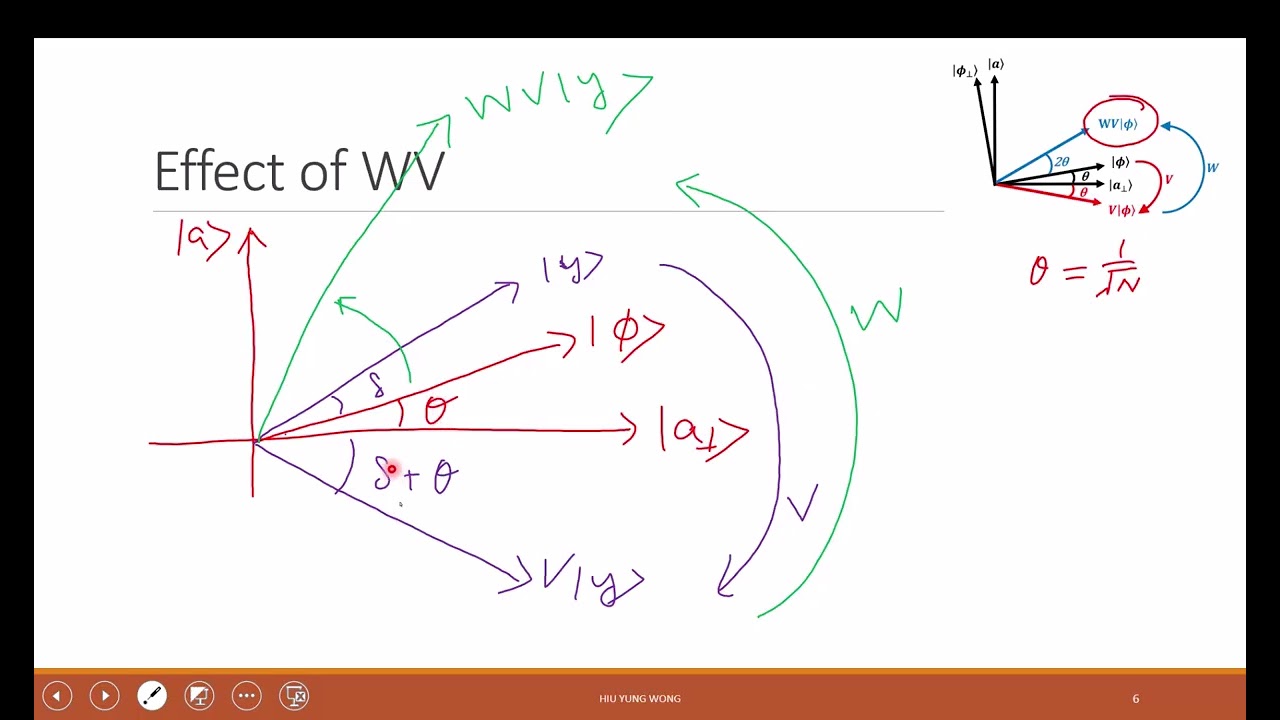
- Explanation of the rotation operators V and W as reflections.
- Derivation of the rotation angle 2θ and the number of iterations.
- Discussion of measurement and error probability in Grover's algorithm.
- Introduction to implementing the phase oracle.
- Introduction to the XOR oracle and its equivalence to the phase oracle.
- Mathematical proof of XOR oracle equivalence using the |−⟩ state.
- Q&A on oracle implementation and advice on using ChatGPT for learning.
- Conclusion and summary of key points.
Cited Sources
- Course Playlist — Playlist containing the lecture series on quantum computing.
Concurring Sources
- Grover's algorithm - Wikipedia — Standard reference for Grover's algorithm, consistent with the lecture's content.
Contribution & Novelties
The lecture provides a clear and detailed explanation of the phase and XOR oracles in Grover’s algorithm, emphasizing their equivalence and practical implementation. It bridges the gap between theoretical concepts and circuit design, which is valuable for students. The instructor’s interactive teaching style and use of geometric intuition enhance understanding.
Pour aller plus loin :
- Grover’s algorithm - Wikipedia — Overview of the algorithm and its applications.
- Quantum amplitude amplification - Wikipedia — Generalization of Grover’s algorithm.
- Quantum oracle - Wikipedia — Definition and types of oracles in quantum computing.
90 words
Radar Profile
The radar profile shows high scores in information quality, technical level, and reliability, with slightly lower scores in information quantity and global reliability. This indicates a technically dense and accurate lecture, but with limited breadth and reliance on a single source.