Josephson Junction and Superconducting Quantum Circuit Fabrication Process
Keywords
Summary
163 words
Critical Evaluation
Value of the Information & Strength of the Argument
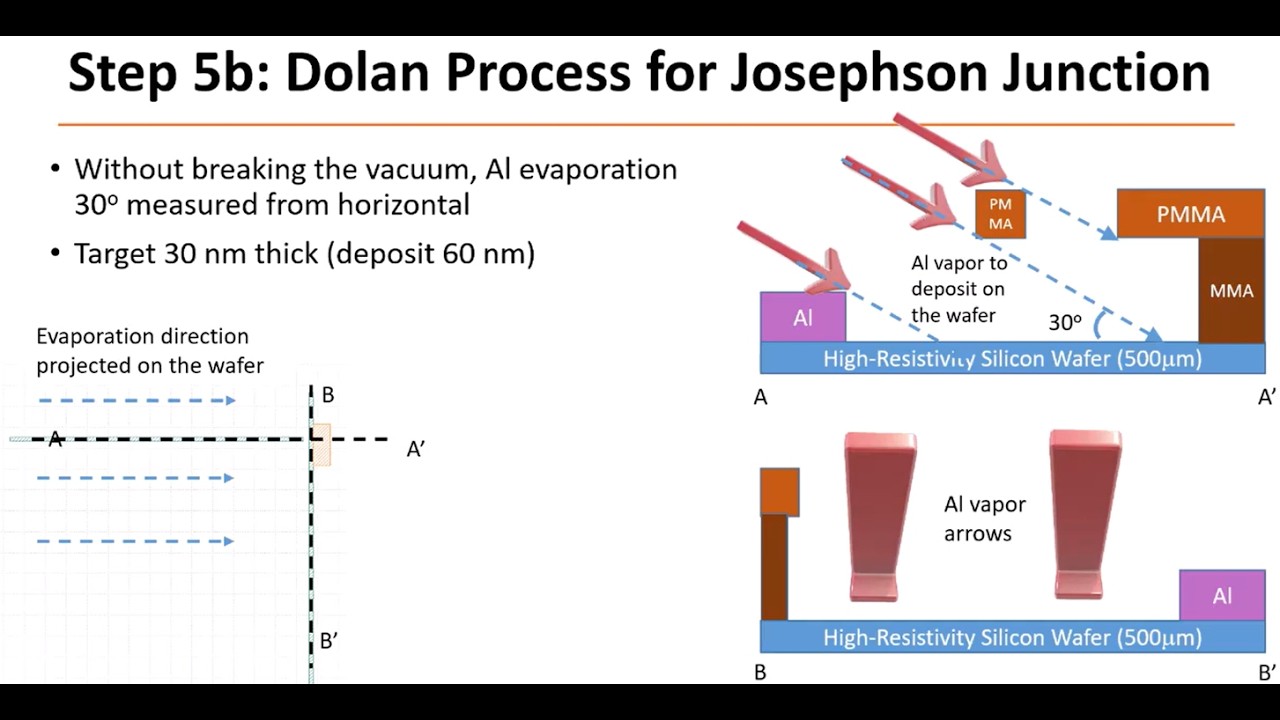
The video provides a high-value, step-by-step explanation of a complex fabrication process, making it accessible to students and researchers. The argumentation is solid, as the presenter explains the rationale behind each step, such as the need for high-resistivity substrates to reduce energy loss and the use of a bridge process to create the undercut for angle evaporation. The use of real equipment photos and clear diagrams enhances the educational value. The presenter also acknowledges the limitations of the modified data, which adds to the credibility of the content.
Scientific Rigor, Source Quality, Title Accuracy
The scientific rigor is good, as the process is based on a real demonstration at a national lab. However, the presenter notes that some numbers and procedures are modified for public use, which introduces some uncertainty. The sources are not formally cited, but the collaboration with the Molecular Foundry is acknowledged. The title accurately reflects the content, and the video is well-structured, with clear explanations and visual aids. No comments were provided for analysis.
177 words
Title / Content Match
The title accurately reflects the content, which focuses on the fabrication process of Josephson junctions and superconducting quantum circuits.
Quality & Reliability
8/10
The video is a detailed tutorial based on a real fabrication process demonstrated by the Molecular Foundry at Lawrence Berkeley National Lab. The presenter clearly states that some numbers and procedures are modified for public use, and acknowledges potential mistakes. The content is technically accurate and well-structured, with clear explanations of the fabrication steps. However, the lack of formal citations and the modified nature of the data slightly reduce the score.
Key Moments
Markers derived by PSI from the transcript: the creator did not define chapters.
- Introduction and acknowledgments to the Molecular Foundry team.
- Overview of the sample layout and the two sets of masks.
- Explanation of wafer cleaning and the importance of high-resistivity substrates.
- Deposition of 100 nm aluminum using e-beam evaporation.
- Patterning of the circuit using maskless laser lithography and wet etching.
- Introduction to the two-layer e-beam resist process for the Josephson junction.
- Detailed explanation of the Dolan bridge process and angle evaporation.
- Ion milling to clean the surface before deposition.
- Angle evaporation of aluminum to form the Josephson junction.
- Liftoff and final steps of the fabrication process.
Cited Sources
- Molecular Foundry at Lawrence Berkeley National Lab — The fabrication process was demonstrated by the Quantum Team at the Molecular Foundry.
Concurring Sources
- Superconducting qubit fabrication — General information on superconducting qubit fabrication aligns with the video's content.
Contribution & Novelties
This video provides a rare, detailed look into the actual fabrication process of superconducting quantum circuits, which is often proprietary or not publicly documented. It bridges the gap between theoretical knowledge and practical implementation, making it a valuable resource for students and researchers. The step-by-step explanation of the Dolan bridge process, including the use of two-layer resists and angle evaporation, is particularly insightful.
Pour aller plus loin :
- Josephson effect — Fundamental physics behind the Josephson junction.
- Superconducting quantum computing — Overview of the technology and its challenges.
- Dolan bridge technique — Specific lithography technique used for Josephson junction fabrication.
100 words
Radar Profile
The radar profile shows high scores in quantity and quality of information, with a strong technical level. The reliability score is slightly lower due to the modified nature of the data, but overall the video is a solid educational resource.