L18A Deutsch Algorithm on IBM Q
Keywords
Summary
164 words
Critical Evaluation
Value of the Information & Strength of the Argument
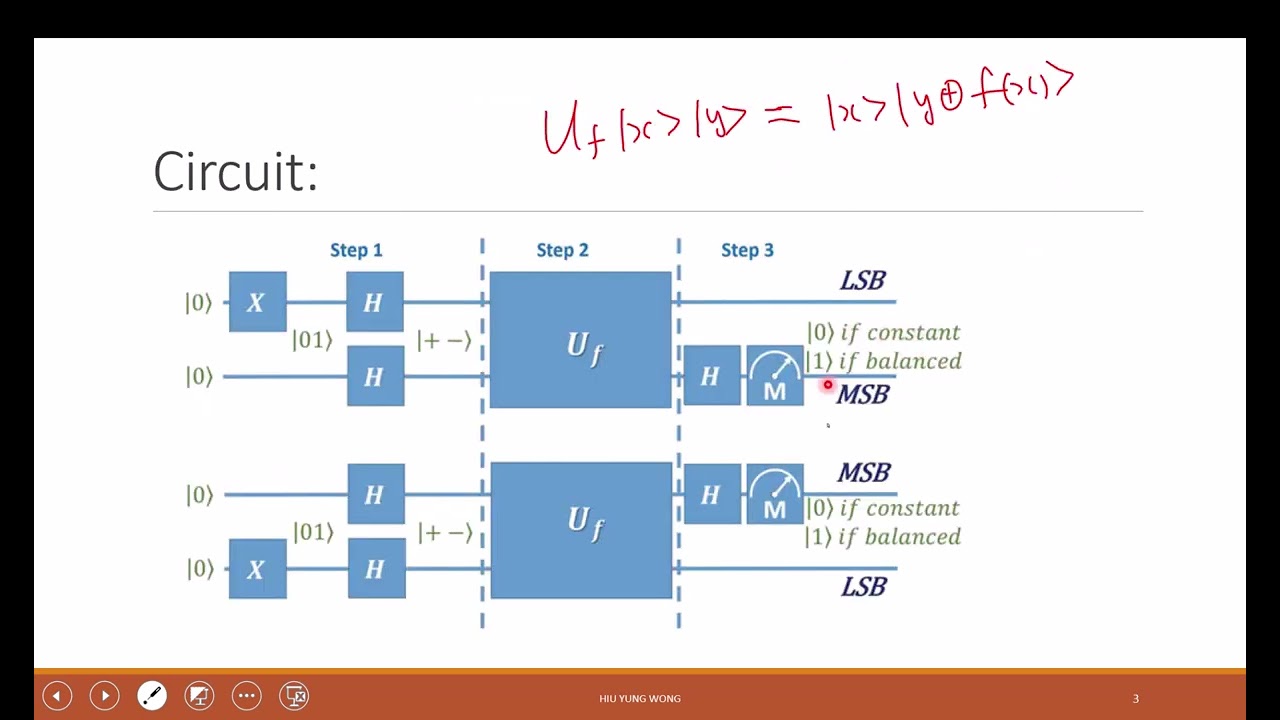
The video provides a clear and structured explanation of the Deutsch algorithm, breaking down the circuit step by step. The instructor effectively uses a simple example to illustrate the concept of a quantum oracle and the role of superposition. The argumentation is logical, building from the theoretical foundation to practical implementation. The discussion of errors is valuable, as it addresses real-world challenges in quantum computing. However, the video could benefit from more detailed explanations of the mathematical principles behind the algorithm and the oracle construction.
Scientific Rigor, Source Quality, Title Accuracy
The video is scientifically accurate, with correct explanations of the Deutsch algorithm and quantum gates. The instructor demonstrates a good understanding of the subject. However, no external sources are cited, and the video relies solely on the instructor’s expertise. The title accurately reflects the content, which is a focused tutorial on implementing the Deutsch algorithm on IBM Q. The lack of citations and references may reduce the perceived rigor, but the content itself is sound.
175 words
Title / Content Match
The title accurately reflects the content, which is a lecture on the Deutsch algorithm implementation on IBM Q.
Quality & Reliability
7/10
The video is a clear tutorial on implementing the Deutsch algorithm on IBM Q, with correct theoretical explanations and practical demonstration. However, it lacks formal citations and in-depth error analysis.
Key Moments
Markers derived by PSI from the transcript: the creator did not define chapters.
- Introduction and summary of the Deutsch algorithm
- Explanation of the quantum oracle and its implementation
- Circuit construction for the Deutsch algorithm on IBM Q
- Discussion of measurement in the plus/minus basis
- Simulation results and introduction to quantum errors
- Detailed explanation of error sources in quantum computing
- Conclusion and mention of fault-tolerant quantum computing
Cited Sources
- Quantum Computing, TCAD, Semicond by Hiu-Yung Wong - Playlist — The video is part of a playlist on quantum computing, providing additional context and related lectures.
Concurring Sources
- Deutsch–Jozsa algorithm - Wikipedia — Provides a formal description of the Deutsch algorithm and its generalization, consistent with the video's explanation.
Contribution & Novelties
The video provides a practical tutorial on implementing the Deutsch algorithm on IBM Q, which is valuable for students and practitioners. It bridges the gap between theoretical concepts and real-world implementation, highlighting the challenges of noise and errors. The discussion of error sources is particularly useful for understanding the limitations of current quantum hardware.
Pour aller plus loin :
- Deutsch–Jozsa algorithm - Wikipedia — Overview of the algorithm and its generalization.
- Quantum error correction - Wikipedia — Techniques to mitigate errors in quantum computing.
- IBM Quantum Experience — Platform for running quantum circuits on real hardware.
96 words
Radar Profile
The radar profile shows high scores in information quality and technical level, indicating a solid educational content. The lower score in information quantity suggests the video is concise but may lack depth in some areas. Overall, it is a reliable tutorial for learning the Deutsch algorithm implementation.
💬 No comments were provided for analysis.