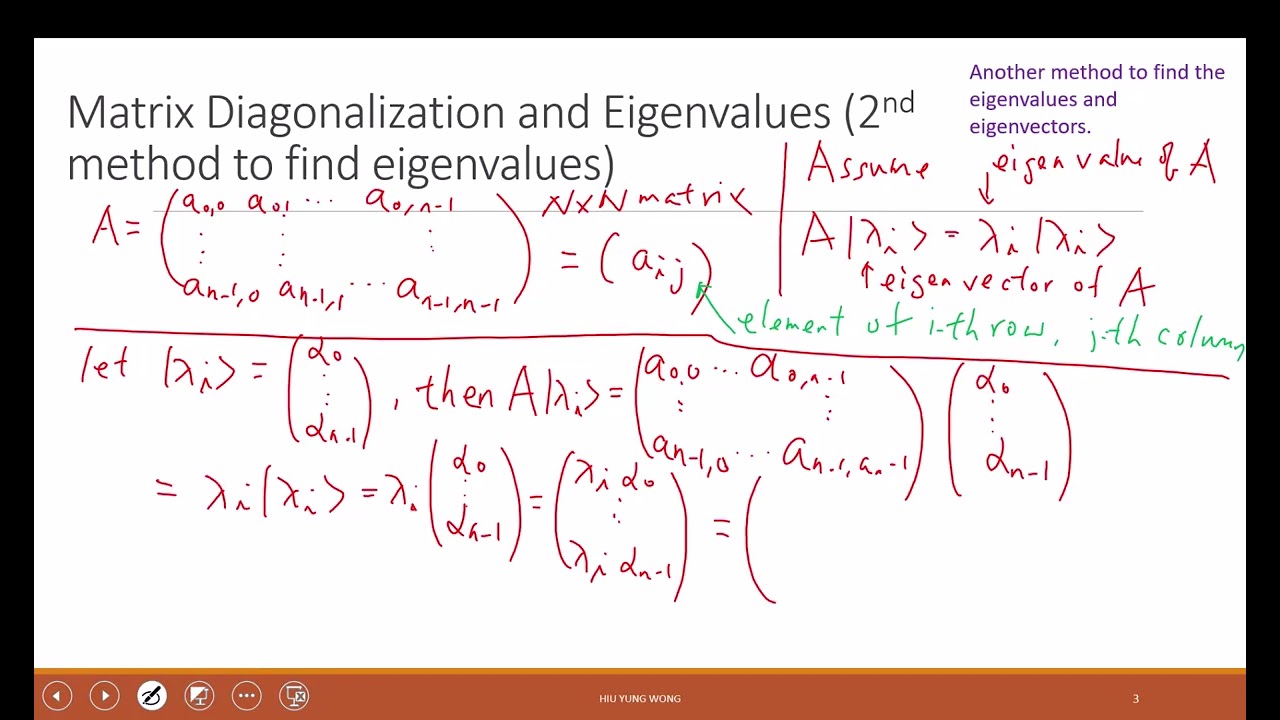
L7B - Matrix Diagonalization, Finding Eigenvalues, Constructing Matrix from Eigenvectors
Keywords
Summary
132 words
Critical Evaluation
Value of the Information & Strength of the Argument
The video provides a solid introduction to matrix diagonalization, clearly explaining the mathematical steps and their significance in quantum computing. The instructor uses a pedagogical approach, breaking down complex concepts into manageable parts and reinforcing understanding through examples. The argumentation is logical and coherent, with each step building on the previous one. The value lies in its clarity and practical application, making it useful for students and practitioners new to quantum computing.
Scientific Rigor, Source Quality, Title Accuracy
The scientific rigor is high for a tutorial: the mathematical derivations are correct and well-explained. The instructor does not cite external sources, but the content is standard linear algebra and quantum mechanics, which is well-established. The title accurately describes the content, and the video stays on topic throughout. No public comments were provided for analysis.
142 words
Title / Content Match
The title accurately reflects the content: the video covers matrix diagonalization, finding eigenvalues, and constructing matrices from eigenvectors.
Quality & Reliability
8/10
The video is a clear, step-by-step tutorial on matrix diagonalization, eigenvalues, and eigenvectors, with a focus on quantum computing applications. The instructor demonstrates the mathematical derivations and provides examples (e.g., sigma x). The content is accurate and well-structured, though it is a lecture rather than a peer-reviewed source.
Key Moments
Markers derived by PSI from the transcript: the creator did not define chapters.
- Introduction to matrix diagonalization and review of eigenvalues/eigenvectors.
- Derivation of the characteristic equation det(A - λI) = 0.
- Explanation of representing a matrix in the basis of its eigenvectors, leading to diagonal form.
- Example: diagonalizing the Pauli-X matrix (sigma x) and finding its eigenvalues and eigenvectors.
- Discussion on the equivalence of sigma x and sigma z when expressed in different bases.
- Construction of a matrix from its eigenvalues and eigenvectors using outer products.
- Conclusion and summary of key points.
Cited Sources
- Playlist: Quantum Computing, TCAD, Semicond — The playlist containing this lecture and related videos.
Concurring Sources
- Eigenvalues and eigenvectors - Wikipedia — Standard reference for the mathematical definitions and properties.
- Pauli matrices - Wikipedia — Provides details on the Pauli matrices used in the examples.
Contribution & Novelties
The video provides a clear and accessible tutorial on matrix diagonalization, specifically tailored for quantum computing applications. It bridges the gap between abstract linear algebra and practical quantum mechanics by using the Pauli matrices as examples. The instructor’s step-by-step approach helps demystify the process of finding eigenvalues and eigenvectors and constructing matrices from them.
Pour aller plus loin :
- Eigenvalues and eigenvectors - Wikipedia — For a comprehensive overview of the mathematical concepts.
- Pauli matrices - Wikipedia — To explore the properties and applications of Pauli matrices in quantum mechanics.
- Quantum logic gate - Wikipedia — To see how these concepts are applied in quantum computing.
106 words
Radar Profile
The radar profile shows high scores in quality of information, technical level, and reliability, with a slightly lower score in quantity of information. This indicates a focused, well-explained tutorial that may not cover all aspects of the topic but excels in clarity and accuracy.