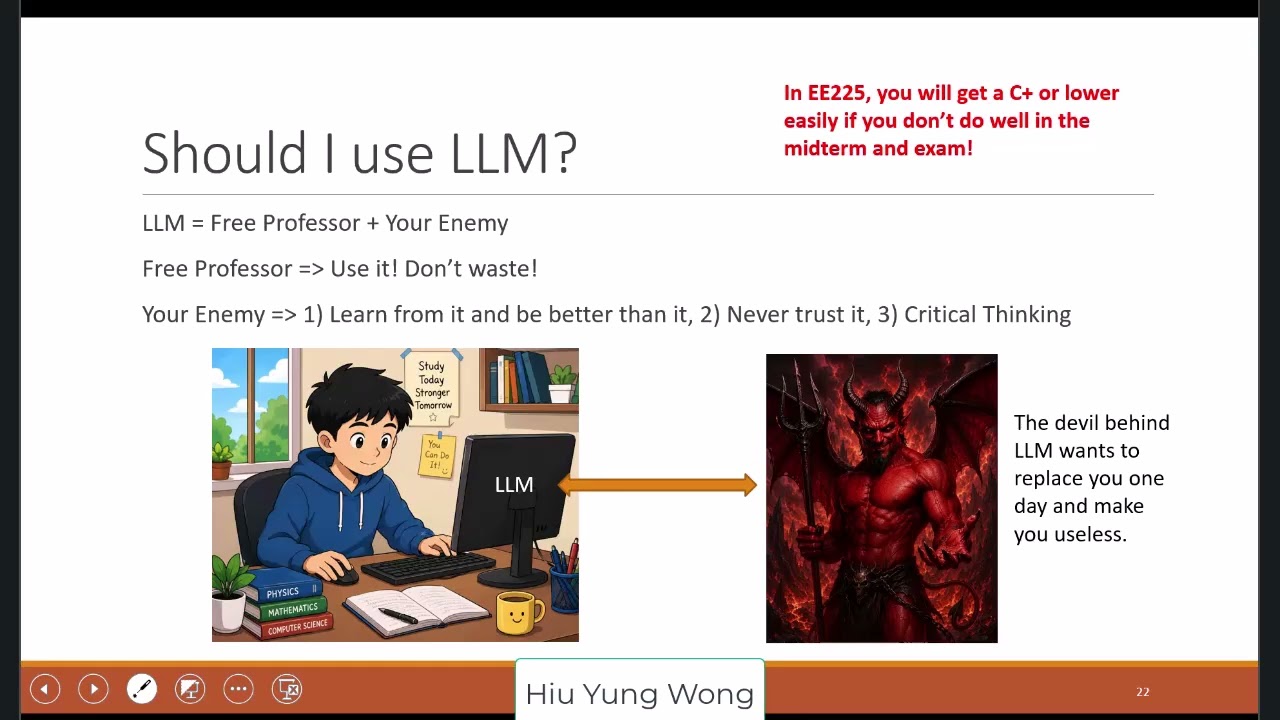
L1A: How to use AI and LLM in this Quantum Computing Class
Keywords
Summary
170 words
Critical Evaluation
Value of the Information & Strength of the Argument
The video’s value lies in its practical, actionable advice for students on how to integrate LLMs into their learning process without becoming overly dependent. The argumentation is built on a clear pedagogical philosophy: LLMs are powerful tools that can enhance learning if used actively, but they pose a risk of fostering passive consumption and eroding critical thinking. The instructor supports his claims with a concrete example from quantum computing, demonstrating both the potential of LLMs to explain concepts and the danger of accepting their outputs uncritically. The reasoning is coherent and persuasive, though it relies on anecdotal evidence and personal opinion rather than empirical data or educational research.
Scientific Rigor, Source Quality, Title Accuracy
The video does not cite any formal sources or references. The only link in the description is to a YouTube playlist, which likely contains other course materials. The title accurately reflects the content, which is a focused discussion on AI/LLM usage policies in a specific class. The lack of citations is acceptable for a course lecture, but it limits the video’s standalone scientific rigor. The advice is based on the instructor’s experience and pedagogical judgment, which is reasonable but not empirically validated.
205 words
Title / Content Match
The title accurately reflects the content: a lecture segment on the rules and best practices for using AI and LLMs in a quantum computing class.
Quality & Reliability
7/10
The video provides practical, experience-based advice on using LLMs in education, with a clear pedagogical stance. It includes a concrete example of prompting and emphasizes critical verification. However, it lacks formal citations or references to educational research, and the advice is anecdotal.
Key Moments
Markers derived by PSI from the transcript: the creator did not define chapters.
- Introduction: The instructor introduces the topic of using LLMs in the class, framing them as a 'free professor' and an 'enemy'.
- Discussion on the environmental impact of LLMs and the importance of using them reasonably.
- The instructor explains why LLMs are 'enemies' and advises students to learn from them and be better, rather than just using them for answers.
- Warning about the dangers of trusting LLMs without critical thinking, leading to loss of skills and career vulnerability.
- Example of a bad use of ChatGPT: asking for a direct answer to a homework question, which yields a correct answer but no learning.
- Demonstration of a good use: asking ChatGPT to explain the derivation step-by-step, promoting understanding.
- Second example: the student shares their reasoning with ChatGPT, which corrects a misconception about control qubits.
- Introduction of the concept of 'phase kickback' and the importance of verifying LLM outputs.
- Encouragement to engage in a dialogue with LLMs, asking follow-up questions to deepen understanding.
- Final advice: treat LLMs as a free professor or knowledgeable friend, but never rely on them psychologically; always verify and maintain critical thinking.
Cited Sources
- Quantum Computing, TCAD, Semicond by Hiu-Yung Wong - YouTube Playlist — The playlist containing this video and other course materials.
Concurring Sources
- No specific concordant sources are cited in the video. — The video does not reference external sources.
Dissenting Sources
- No specific discordant sources are cited in the video. — The video does not reference external sources.
Contribution & Novelties
The video offers a practical, course-specific policy for integrating LLMs into education, emphasizing active learning and critical thinking. It provides a concrete example of how to prompt an LLM for understanding rather than just answers, and highlights the importance of verifying LLM outputs, especially in a complex field like quantum computing.
Pour aller plus loin :
- Critical thinking — The video’s central theme is the importance of critical thinking when using AI tools.
- Phase kickback — The video uses the concept of phase kickback in quantum computing as an example of where LLMs can be wrong.
- Large language model — The video discusses the use of LLMs in education and their potential benefits and risks.
115 words
Radar Profile
The radar profile shows a balanced performance across all dimensions, with slightly higher scores in information quality and reliability, reflecting the video's practical and well-reasoned advice. The lower score in information quantity is due to the short duration and limited scope, while the technical level is moderate, suitable for a general audience.