L12 - Partial Measurements, NOT, Phase Shift, CNOT, Controlled Phase Shift, SWAP, Toffoli Gate
Keywords
Summary
158 words
Critical Evaluation
Value of the Information & Strength of the Argument
The lecture provides a solid foundation in quantum gate operations, with clear explanations and mathematical rigor. The instructor builds concepts step-by-step, from single-qubit to multi-qubit gates, and emphasizes the importance of basis states in defining gates. The argumentation is logical and consistent, with examples and checks on each gate’s action. The discussion of partial measurement and renormalization is particularly valuable, as it addresses a common point of confusion. The instructor also clarifies the role of the CNOT gate in creating entanglement, which is crucial for quantum advantage.
Scientific Rigor, Source Quality, Title Accuracy
The lecture is scientifically rigorous, with accurate mathematical derivations and correct gate definitions. The instructor does not cite external sources but relies on standard quantum computing knowledge, which is appropriate for a tutorial. The title accurately reflects the content, covering all the mentioned topics. The lecture is part of a playlist, which provides context and continuity. The instructor’s teaching style is interactive, with questions from students, and he corrects a typo in his own material, demonstrating attention to detail.
181 words
Title / Content Match
The title accurately reflects the content, which covers partial measurements and several quantum gates including NOT, phase shift, CNOT, controlled phase shift, SWAP, and Toffoli.
Quality & Reliability
8/10
The lecture is a well-structured tutorial on quantum gates, with clear definitions and mathematical derivations. The instructor demonstrates deep knowledge and corrects a typo in the material. The content is consistent with standard quantum computing literature.
Key Moments
Markers derived by PSI from the transcript: the creator did not define chapters.
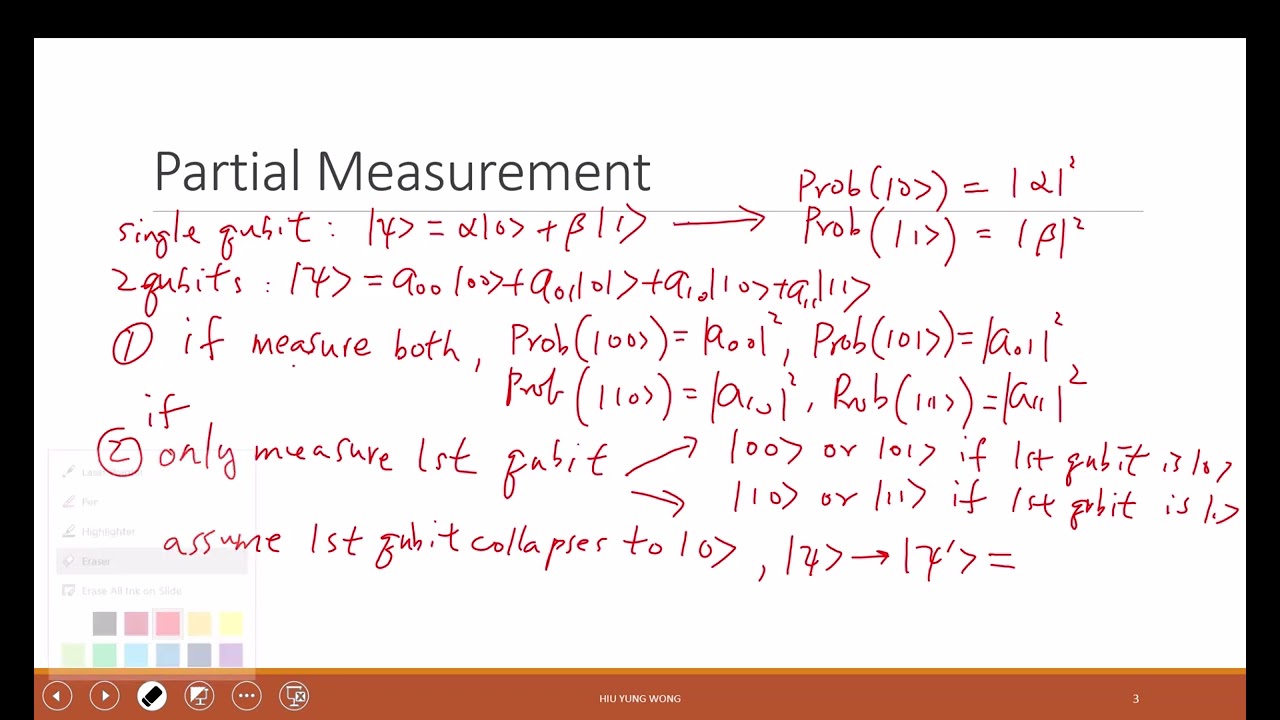
- Introduction to partial measurement on multi-qubit systems.
- Explanation of renormalization after partial measurement.
- Review of NOT gate and construction of multi-qubit gates via tensor product.
- Introduction to CNOT gate and its role in entanglement.
- Discussion of MSB/LSB conventions in circuit diagrams.
- Definition of phase shift gate and its matrix representation.
- Special case of phase shift: Z gate and its action on plus/minus states.
- Introduction to controlled phase shift gate and its derivation.
- SWAP gate definition and its matrix.
- Brief introduction to Toffoli gate.
Cited Sources
- Quantum Computing, TCAD, Semicond by Hiu-Yung Wong - Playlist — The lecture is part of this playlist, which contains related course materials.
Concurring Sources
- Quantum logic gate - Wikipedia — Standard reference for quantum gates, consistent with the lecture's content.
- Controlled NOT gate - Wikipedia — Provides details on the CNOT gate, matching the lecture's explanation.
Contribution & Novelties
This lecture provides a clear and systematic introduction to quantum gates, with a focus on the method of defining gates via their action on basis states. It clarifies the concept of partial measurement and renormalization, which is often glossed over. The lecture also emphasizes the importance of MSB/LSB conventions in circuit design, a practical detail that is crucial for implementation. The controlled phase shift gate is derived logically from the CNOT gate, and the SWAP gate is presented as a non-entangling gate. The lecture is part of a larger course, providing a solid foundation for further study.
Pour aller plus loin :
- Quantum logic gate - Wikipedia — Overview of quantum gates and their properties.
- CNOT gate - Wikipedia — Detailed explanation of the CNOT gate and its role in quantum computing.
- Phase shift gate - Wikipedia — Information on phase shift gates and their variants.
- Toffoli gate - Wikipedia — Description of the Toffoli gate and its universality.
159 words
Radar Profile
The radar profile shows high scores in information quantity, quality, and reliability, with a slightly lower technical level, indicating a comprehensive yet accessible tutorial. The lecture is well-balanced, with strong educational value and accurate content.