HFSS: Import Eigenmode Mesh for S Parameter Simulation in CPW with a Transmission Line
Keywords
Summary
141 words
Critical Evaluation
Value of the Information & Strength of the Argument
The video provides valuable practical guidance for engineers and researchers using HFSS for quantum chip design. The argumentation is based on the author’s experience and the demonstrated workflow. The value lies in the time-saving technique of importing an eigenmode mesh, which is not commonly covered in standard tutorials. The author clearly explains the rationale behind the approach and shows the results, supporting the effectiveness of the method.
Scientific Rigor, Source Quality, Title Accuracy
The scientific rigor is adequate for a tutorial, with a clear methodology and reproducible steps. The author provides a GitHub repository with the project files, which is a good practice for transparency. However, the video lacks formal citations to scientific literature, relying on the author’s expertise. The title accurately reflects the content, and the tutorial is well-structured. No comments were provided for analysis.
145 words
Title / Content Match
The title accurately describes the content: importing an eigenmode mesh for S-parameter simulation in a CPW structure.
Quality & Reliability
7/10
The tutorial is clear and methodical, based on the author's expertise in quantum chip design. It demonstrates a practical workflow with HFSS, but lacks formal citations or references to scientific literature. The GitHub repository provides supporting materials, enhancing reproducibility.
Key Moments
Markers derived by PSI from the transcript: the creator did not define chapters.
- Introduction and overview of the tutorial
- Accessing the GitHub repository and opening the project
- Reviewing eigenmode results and selecting the correct mode
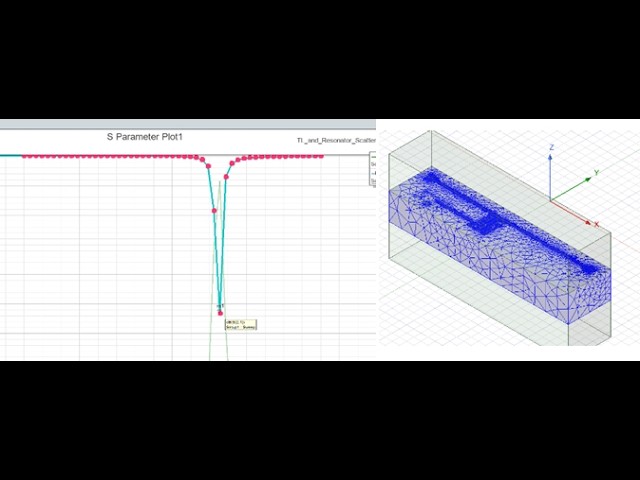
- Plotting the mesh and observing dense mesh in resonator region
- Copying the project and changing solution type to S-parameter
- Deleting the lumped RLC and assigning lumped ports
- Configuring analysis with mesh import and setting up frequency sweep
- Running simulation and plotting S11 and S21 results
- Observing dip in S11 at resonator frequency and concluding
Cited Sources
- GitHub Repository: A Step-by-Step Superconducting Quantum Chip Design Tutorial — The author references this repository for the project files used in the tutorial.
- YouTube Playlist: Quantum Computing, TCAD, Semiconductor — The playlist contains related tutorials on quantum chip design.
Concurring Sources
- GitHub Repository — The repository provides the project files used in the tutorial, supporting reproducibility.
Contribution & Novelties
The tutorial offers a practical technique for improving S-parameter simulation efficiency in HFSS by importing an eigenmode mesh. This approach is particularly useful for quantum chip design where accurate simulation of resonators is critical. The author demonstrates the workflow step-by-step, making it accessible to practitioners.
Pour aller plus loin :
- HFSS (High Frequency Structure Simulator) — Overview of the simulation software used.
- Coplanar waveguide — The transmission line structure discussed.
- Scattering parameters — The S-parameters used to characterize the circuit.
80 words
Radar Profile
The radar profile shows high scores in technical level and information quality, reflecting the tutorial's depth and practical value. The lower scores in quantity of information and global reliability are due to the lack of formal citations and the narrow focus of the content.