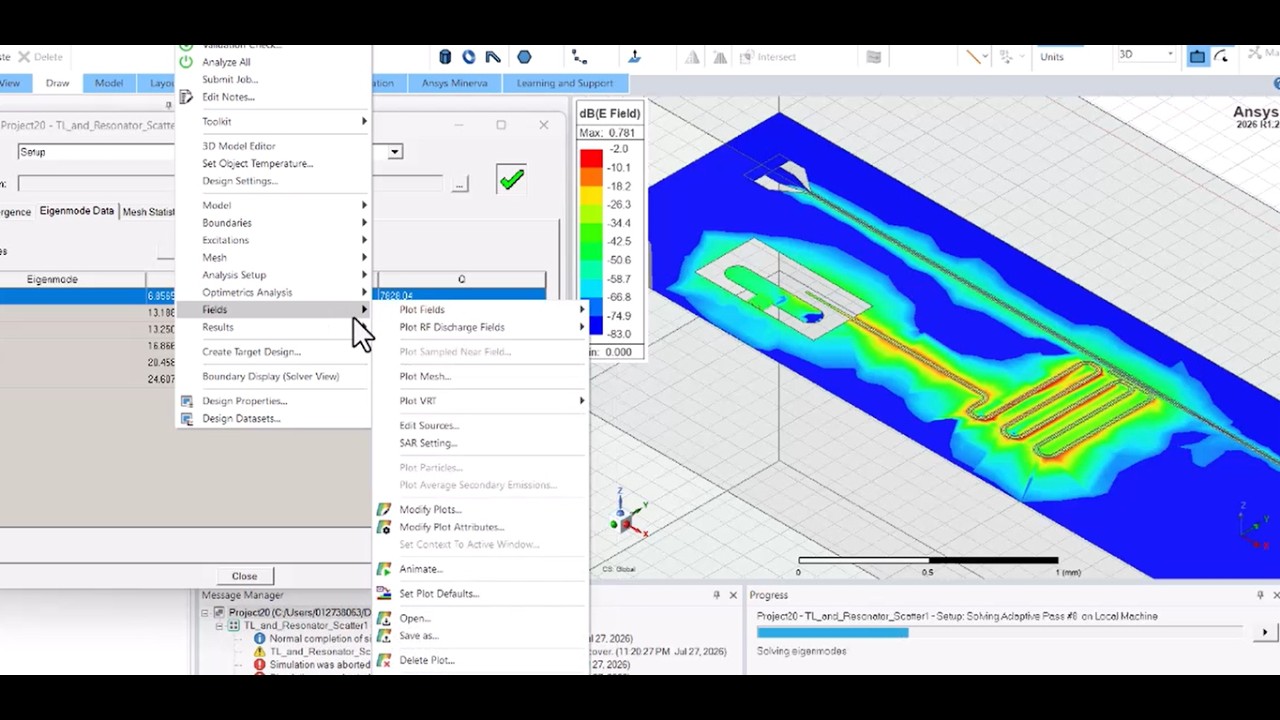
Quality Factor and Eigenmode Simulations of a Resonator Attached to a Transmission Line in HFSS
Keywords
Summary
189 words
Critical Evaluation
Value of the Information & Strength of the Argument
The video provides valuable practical insights into simulating superconducting resonators using HFSS, a topic not commonly covered in detail. The author demonstrates a systematic workflow, from design in Qiskit Metal to eigenmode analysis, and explains the reasoning behind each step. The argumentation is solid, as he justifies the effective dielectric constant estimation and the choice of boundary conditions. He also addresses potential pitfalls, such as mode hybridization due to incorrect junction inductance, and shows how to troubleshoot. The tutorial is well-structured and builds on previous videos, making it useful for researchers and engineers in quantum computing.
105 words
Title / Content Match
The title accurately reflects the content, which focuses on eigenmode simulations and quality factor extraction for a resonator attached to a transmission line.
Quality & Reliability
7/10
The video is a practical tutorial demonstrating eigenmode simulation of a superconducting resonator coupled to a transmission line using HFSS. The author explains the design process, including effective dielectric constant estimation and boundary condition setup. The content is based on the author's own simulation workflow and references his GitHub repository. While the methodology is sound, the video lacks formal citations to peer-reviewed literature, and the effective dielectric constant estimation is presented as an approximation without rigorous derivation. The author acknowledges limitations and encourages viewers to refer to other videos for details.
Key Moments
Markers derived by PSI from the transcript: the creator did not define chapters.
- Introduction and overview of the tutorial
- Explanation of effective dielectric constant calculation
- Creating the structure in Qiskit Metal
- Setting up eigenmode simulation in HFSS
- Assigning lumped RLC boundary conditions
- Running simulation and plotting results
- Analyzing modes and troubleshooting hybridization
- Final results and conclusion
Cited Sources
- GitHub Repository: Transmission Line Coupled to a Resonator — The author refers to this repository for the Jupyter notebook and HFSS project files used in the tutorial.
- YouTube Playlist: Superconducting Quantum Chip Design Tutorial — The author mentions this playlist for related videos on the topic.
Concurring Sources
- GitHub Repository — The repository contains the exact files and scripts used in the video, supporting the tutorial's reproducibility.
Contribution & Novelties
This video provides a detailed, step-by-step tutorial on performing eigenmode simulations for a superconducting resonator coupled to a transmission line using HFSS. It offers practical insights into setting up boundary conditions, interpreting results, and troubleshooting common issues like mode hybridization. The author shares his workflow and code, which is valuable for researchers entering the field.
Pour aller plus loin :
- Superconducting quantum computing — Provides background on superconducting qubits and resonators.
- Quality factor — Explains the concept of quality factor in resonators.
- Coplanar waveguide — Relevant to the transmission line design discussed.
92 words
Radar Profile
The radar profile shows high scores in technical level and information quality, indicating a detailed and accurate tutorial. The lower score in information quantity suggests the video focuses on a specific aspect rather than broad coverage. Overall, the video is a reliable resource for practitioners.
💬 No comments were provided for analysis.