L24b - Bloch Sphere and Extrema
Keywords
Summary
189 words
Critical Evaluation
Value of the Information & Strength of the Argument
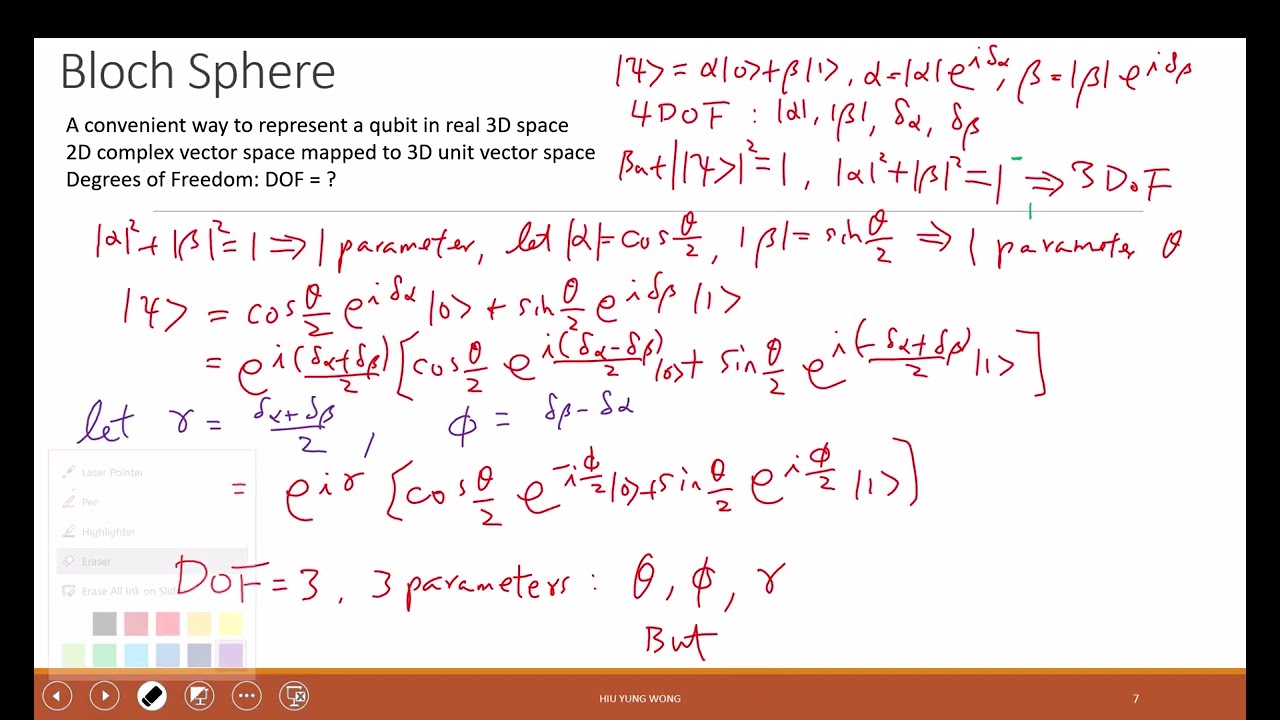
The video provides a solid, rigorous explanation of the Bloch sphere, building from fundamental linear algebra and quantum mechanics principles. The argumentation is logical and step-by-step, with the instructor carefully deriving the general qubit state and justifying the removal of the global phase. He uses concrete examples to illustrate the mapping between the mathematical representation and the geometric picture, which enhances understanding. The value lies in its clear pedagogical approach, making complex concepts accessible without oversimplifying. The instructor also addresses common misconceptions, such as the misinterpretation of the Bloch sphere as a physical 3D vector, which adds to the educational value.
Scientific Rigor, Source Quality, Title Accuracy
The scientific rigor is high: the derivation is mathematically sound, and the instructor correctly applies quantum mechanics principles. However, the video does not cite any external sources or references, relying solely on the instructor’s expertise. The title accurately reflects the content, focusing on the Bloch sphere and its extrema. The lack of citations is a minor weakness, but the content itself is reliable and well-presented.
181 words
Title / Content Match
The title accurately reflects the content: the lecture focuses on the Bloch sphere and its extrema (north pole, south pole, equator states).
Quality & Reliability
8/10
The video is a clear, step-by-step mathematical derivation of the Bloch sphere representation of a qubit, with rigorous linear algebra and quantum mechanics principles. The instructor corrects errors and emphasizes conceptual pitfalls. The content is accurate and well-structured, though it lacks explicit citations to external sources.
Key Moments
Markers derived by PSI from the transcript: the creator did not define chapters.
- Introduction: general qubit representation and degrees of freedom.
- Normalization condition reduces degrees of freedom to three.
- Parametrization with theta and phi; factoring out global phase.
- Explanation of global phase and its lack of physical significance.
- Introduction of the Bloch sphere as an embedding of qubit states.
- Example: theta=0 gives |0>; theta=pi gives |1>.
- Example: theta=pi/2, phi=0 gives |+>; theta=pi/2, phi=pi/2 gives state differing by global phase.
- Conclusion: each point on Bloch sphere corresponds to infinite states differing by global phase.
Cited Sources
- Quantum Computing, TCAD, Semicond by Hiu-Yung Wong - Playlist — The video is part of a playlist on quantum computing; the playlist link is provided in the description.
Concurring Sources
- Bloch sphere - Wikipedia — The Wikipedia article on the Bloch sphere confirms the mathematical representation and the geometric interpretation presented in the video.
Contribution & Novelties
The video offers a clear and rigorous derivation of the Bloch sphere representation, emphasizing the mathematical steps and the physical significance of the global phase. It is particularly useful for learners who want to understand the underlying linear algebra without prior quantum mechanics knowledge. The instructor’s approach of embedding the qubit state space into 3D space clarifies a common point of confusion.
Pour aller plus loin :
- Bloch sphere - Wikipedia — Provides a comprehensive overview of the Bloch sphere and its applications.
- Qubit - Wikipedia — Background on qubits and their mathematical representation.
- Quantum state - Wikipedia — General concept of quantum states and their representation.
107 words
Radar Profile
The radar profile shows high scores in information quantity, quality, and technical level, with a slightly lower but still strong reliability score. This indicates a well-balanced, technically sound educational video with minor limitations in source citation.
💬 No comments were provided for analysis.