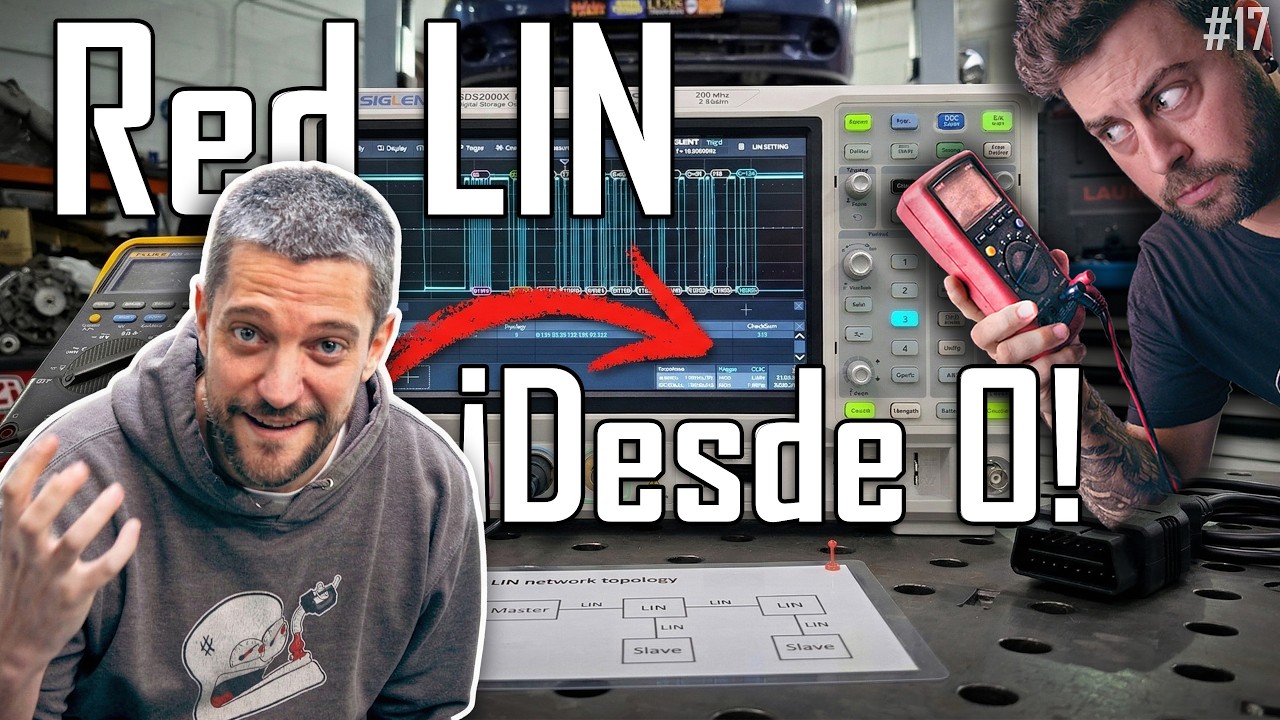
⚡ Curso de Electricidad del Automóvil (17): Red LIN - ¡De 0 a 100!
Keywords
Summary
185 words
Critical Evaluation
Value of the Information & Strength of the Argument
The video provides high practical value for automotive technicians and enthusiasts, offering a thorough understanding of the LIN bus from theory to real-world application. The argumentation is solid, based on clear explanations of the protocol and supported by live demonstrations. The presenter effectively uses analogies (e.g., Mario swimming) to explain concepts like duty cycle, making complex topics accessible. The step-by-step approach, from basic principles to advanced diagnostics, ensures a logical progression. The inclusion of real vehicle testing and oscilloscope captures adds credibility and practical relevance.
Scientific Rigor, Source Quality, Title Accuracy
The scientific rigor is adequate for a tutorial: the presenter explains the LIN protocol accurately, referencing standard specifications (e.g., 80%/20% transmit thresholds, 60%/40% receive thresholds). However, no formal sources are cited within the video; the description provides links to previous course episodes and related resources, but these are not direct references to external standards. The title accurately reflects the content, as it is a comprehensive course on the LIN bus. The video’s educational nature is evident, with a clear structure and practical focus.
183 words
Title / Content Match
The title accurately reflects the content: a comprehensive course episode on the LIN bus, from basics to advanced diagnostics.
Quality & Reliability
8/10
The video is a detailed technical tutorial on the LIN bus in automotive applications, presented by an experienced channel. It combines theoretical explanations with practical demonstrations on a real vehicle, including diagnostic procedures. The content is accurate and well-structured, though it lacks formal citations and is based on the presenter's expertise.
Chapters
- Red LIN en el Automóvil: Intro
- Bus LIN – Local Interconnect Network
- Red LIN - Ejemplo de Circuito Real. Maestros y Esclavos
- Comunicación Digital. Mensajes "1":12v y "0": 0V
- ¿Cómo Funciona la Red LIN? Circuito Interno Simplificado
- Red LIN - ¿Cuántas Unidades se Pueden Conectar a la Vez?
- Mensajes de Red LIN. ¿Cómo Funcionan? (1)
- Red LIN - Prácticas en coche real. (PHEV - Híbrido Enchufable - 2026)
- Mensajes de Red LIN. ¿Cómo Funcionan? (2)
- Mensajes de Red LIN. ¿Cómo Funcionan? (3)
- ¿Cómo Decodifcar Mensajes de Red LIN?
- ¿Cómo Diagnosticar la Red LIN?
- Diagnosis Avanzada de la Red LIN
- Próximos Capítulos
Cited Sources
- Curso Electricidad del Automóvil – ¡De Básica a Pro! — Link to the full course playlist, providing context for the series.
- Parte 9: El arte del CAN BUS — Previous episode on CAN bus, relevant for understanding higher-level networks.
- Parte 16: Redes de Comunicación — Previous episode on communication networks, setting the stage for LIN.
- Parte 12: El Osciloscopio — Episode on oscilloscope usage, essential for the practical demonstrations.
Concurring Sources
- LIN bus on Wikipedia — Provides general information on LIN bus, consistent with the video's content.
- LIN Protocol Specification — Official LIN consortium, offering detailed specifications that align with the video's technical explanations.
External References
Contribution & Novelties
The video offers a comprehensive, hands-on tutorial on the LIN bus, filling a gap for practical diagnostic knowledge. It uniquely combines theory with real vehicle testing, showing how to decode messages and troubleshoot faults. The explanation of voltage thresholds and the master-slave architecture is particularly clear.
Pour aller plus loin :
- LIN bus on Wikipedia — Overview of the LIN protocol, its history, and technical details.
- LIN Protocol Specification — Official LIN consortium website with specifications and resources.
- Automotive Networking: CAN, LIN, FlexRay — Introduction to automotive network protocols, including LIN.
91 words
Radar Profile
The radar profile shows high scores in information quantity and quality, with a moderate technical level. This indicates a comprehensive tutorial that is accessible yet detailed, suitable for learners with some background in automotive electronics.