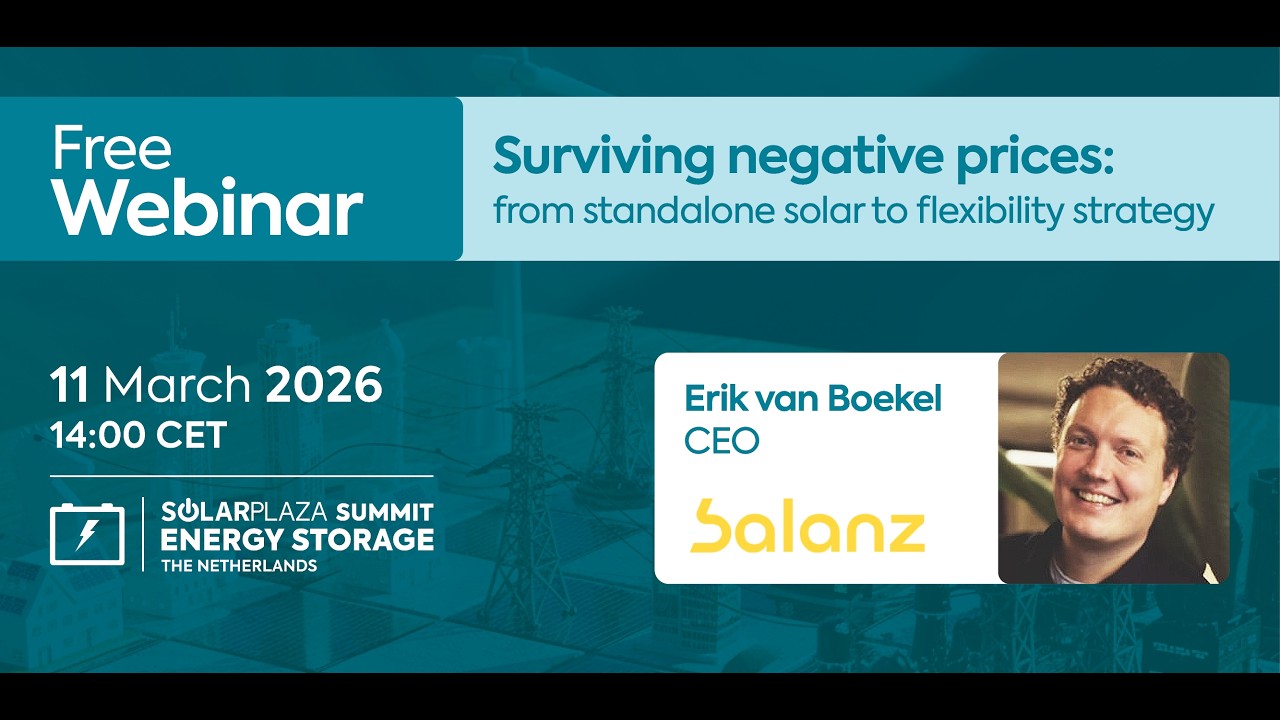
Solarplaza Webinar | Surviving negative prices: from standalone solar to flexibility strategy
Keywords
Summary
165 words
Critical Evaluation
Value of the Information & Strength of the Argument
The webinar provides valuable insights into the practical challenges of integrating high shares of solar energy, particularly the issue of negative prices and the need for flexibility. The argumentation is solid, grounded in market data and the speaker’s extensive experience. Van Boekel effectively explains the mechanics of negative prices, capture rate decline, and the impact of subsidies, making a compelling case for proactive curtailment and market participation. The discussion on BRPs and the potential for data-driven trading adds depth, though some claims could benefit from more concrete data or references.
Scientific Rigor, Source Quality, Title Accuracy
The scientific rigor is moderate; the presentation is based on the speaker’s professional expertise and general market trends, but specific data points are not fully cited. The title accurately reflects the content, focusing on strategies for solar assets to survive negative prices. The webinar is promotional in nature, as it showcases Balanz’s services, but the technical content is informative. No external sources are cited beyond the company’s website and LinkedIn, which limits the verifiability of the claims.
182 words
Title / Content Match
The title accurately reflects the content, which focuses on strategies for solar assets to survive negative prices.
Quality & Reliability
7/10
The speaker is an experienced energy market professional, and the content is based on market data and practical experience. However, the webinar is promotional in nature, and specific data points are not fully sourced.
Chapters
- Webinar intro
- About Solarplaza
- Event announcement
- Webinar logistics
- Topic: negative prices
- Speaker intro: Erik van Boekel
- Eric introduction
- Rising negative prices in Europe
- Building a stable solar business case
- Electricity pricing & gas impact
- Solar value outlook
- Need for low-margin scalable systems
- What a BRP does
- Forecasting & weather data
- Data advantage in energy trading
- Negative price problem explained
- Solar cash flow challenges
- Capture rate decline
- Negative hours & subsidy loss
- Imbalance costs impact
- Curtailment as a solution
- Only 20% of assets respond to prices
- Increasing flexible capacity
- How curtailment stabilizes prices
- Reducing balancing costs
- Value stacking with intraday markets
Cited Sources
- Solarplaza Events — Mentioned as a resource for upcoming events and insights.
- Solarplaza LinkedIn — Mentioned as a way to stay updated.
Concurring Sources
- Solarplaza Events — The webinar is part of Solarplaza's events, which align with the topic.
Contribution & Novelties
The webinar offers a practical perspective on how standalone solar can adapt to negative prices, emphasizing the importance of flexibility and market participation. It highlights the role of BRPs and data-driven strategies, which is a relatively novel approach for asset owners. The discussion on the potential of marginal increases in steerable capacity to eliminate prolonged negative price blocks is insightful.
Pour aller plus loin :
- Negative electricity prices — Provides background on the phenomenon.
- Balance responsible party — Explains the role of BRPs in energy markets.
- Curtailment (electricity) — Discusses curtailment as a flexibility measure.
95 words
Radar Profile
The radar profile shows high scores in quantity and quality of information, with moderate technical depth and reliability. This indicates a well-informed presentation that is accessible to a broad audience, but with some limitations in sourcing and depth.