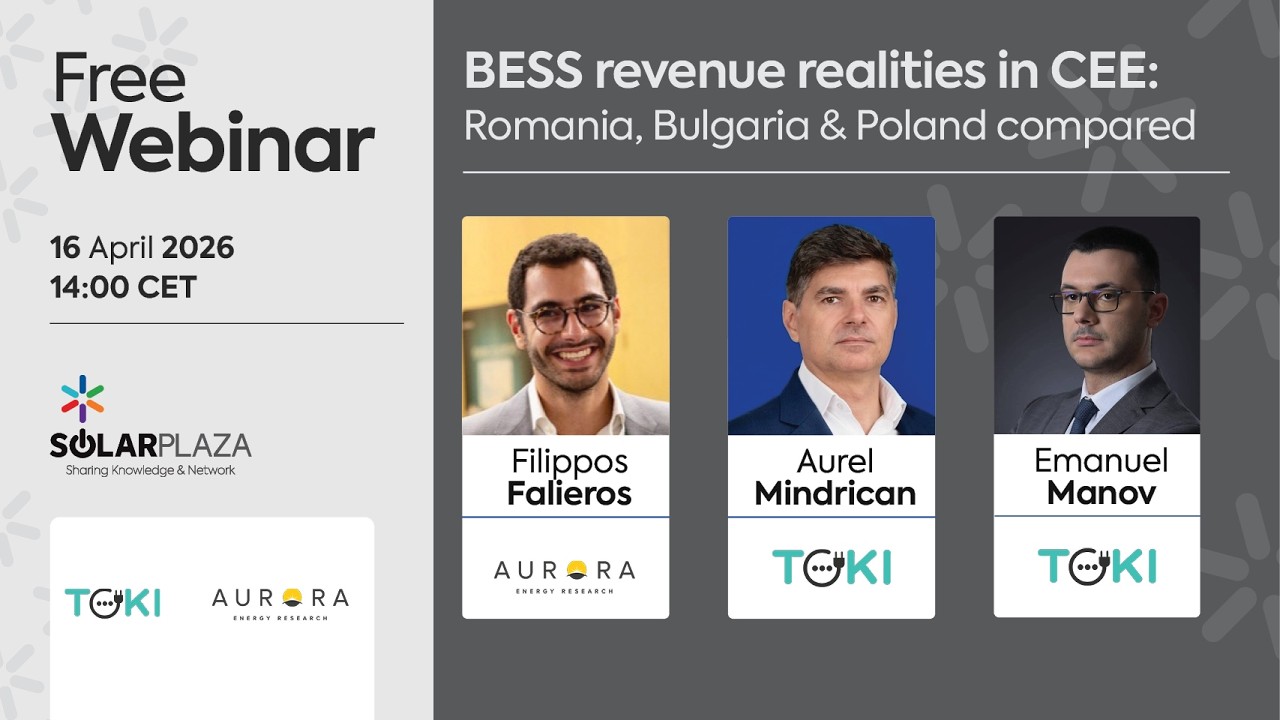
Solarplaza Webinar | BESS revenue realities in CEE: Romania, Bulgaria & Poland compared
Keywords
Summary
168 words
Critical Evaluation
Value of the Information & Strength of the Argument
The webinar provides valuable, actionable insights for investors and operators in CEE BESS markets. The argumentation is solid, combining Aurora’s quantitative modeling with TOKI’s operational experience. The speakers effectively illustrate how theoretical revenue models often fail to account for real-world constraints like grid limitations and regulatory hurdles. The discussion on contracting mechanisms (tolling, swaps) is particularly useful for understanding how to mitigate revenue volatility and improve bankability. However, the presentation is largely qualitative, and specific data points are not deeply detailed, which limits the depth of the analysis.
Scientific Rigor, Source Quality, Title Accuracy
The webinar demonstrates scientific rigor through the use of Aurora’s proprietary modeling and the practical experience of TOKI. The sources cited are primarily the speakers’ own analyses and market observations, with no external references provided. The title accurately reflects the content, which is a comparative analysis of BESS revenues in the three countries. The discussion is well-structured, but the lack of detailed methodology and potential commercial bias from the presenters (both are involved in the industry) slightly reduce the overall rigor. No comments were provided for analysis.
190 words
Title / Content Match
The title accurately reflects the content, which compares BESS revenue realities across Romania, Bulgaria, and Poland.
Quality & Reliability
7/10
The webinar features experts from Aurora Energy Research and TOKI, providing data-driven insights and practical operational experience. While it is an expert panel rather than a peer-reviewed study, the analysis is grounded in proprietary modeling and real-world market operations, lending credibility. However, the lack of detailed methodology and potential commercial biases slightly reduce the score.
Chapters
- Webinar intro and agenda (CEE battery revenues overview)
- Speakers and Q&A setup
- Platform and event announcements
- Transition to Aurora presentation
- Aurora intro and analysis scope
- Modeling approach (Kronos platform)
- Market comparison: Poland, Romania, Bulgaria
- Bulgaria outlook and saturation risk
- Revenue stacking and IRR timing effects
- Market maturity and early mover advantage
- Collocated vs standalone economics
- Revenue volatility and financing challenges
- Need for stable cash flows
- Contracting: tolling, swaps, hybrid PPAs
- Tolling structures and revenue floors
- Spread swaps overview
- Key conclusions: markets + contracting importance
- Transition to Toki
- Toki overview and regional presence
- Romania battery expansion outlook
- Romania market reality (negative prices, arbitrage)
- Collocated vs standalone in practice
- Market drivers (regulation, geopolitics, weather)
- Bulgaria market status and limitations
- Weak ancillary services and revenue stack issues
- Grid constraints and operational bottlenecks
- Subsidy rules and collocation limits
- Optimization challenges for batteries
- Romania balancing market and volatility
- Future interconnection and regional markets
- Status of tolling/hedging agreements
- Romania regulation outlook
- Bankable offtake discussion
- Operational constraints (grid + trading execution)
- Western Balkans opportunity view
- Cannibalization risk discussion
Cited Sources
- Solarplaza Events — Mentioned as a resource for upcoming events and insights.
- Solarplaza LinkedIn — LinkedIn page for Solarplaza, mentioned in the description.
Concurring Sources
- Aurora Energy Research — The consulting firm that presented the modeling analysis, providing data on BESS revenues.
Contribution & Novelties
The webinar provides a comparative analysis of BESS revenue opportunities in three CEE markets, highlighting the differences in market maturity, regulatory frameworks, and revenue stacking potential. It offers practical insights from operators on the ground, bridging the gap between theoretical models and real-world challenges. The discussion on contracting mechanisms like tolling and spread swaps is particularly valuable for investors seeking bankable revenue streams.
Pour aller plus loin :
- Battery energy storage system — Provides foundational knowledge on BESS technology and applications.
- Capacity market — Explains the capacity market mechanism, which is crucial for Poland’s BESS revenue stack.
- Ancillary services — Details the ancillary services that batteries can provide, relevant to the discussion on revenue stacking.
- Tolling agreement — Offers context on tolling agreements, a key contracting tool mentioned in the webinar.
131 words
Radar Profile
The radar profile shows a balanced performance across all dimensions, with slightly higher scores in quantity of information and technical level, reflecting the webinar's depth and practical insights. The lower score in quality of information and global reliability suggests that while the content is informative, it relies on expert opinion rather than peer-reviewed data.