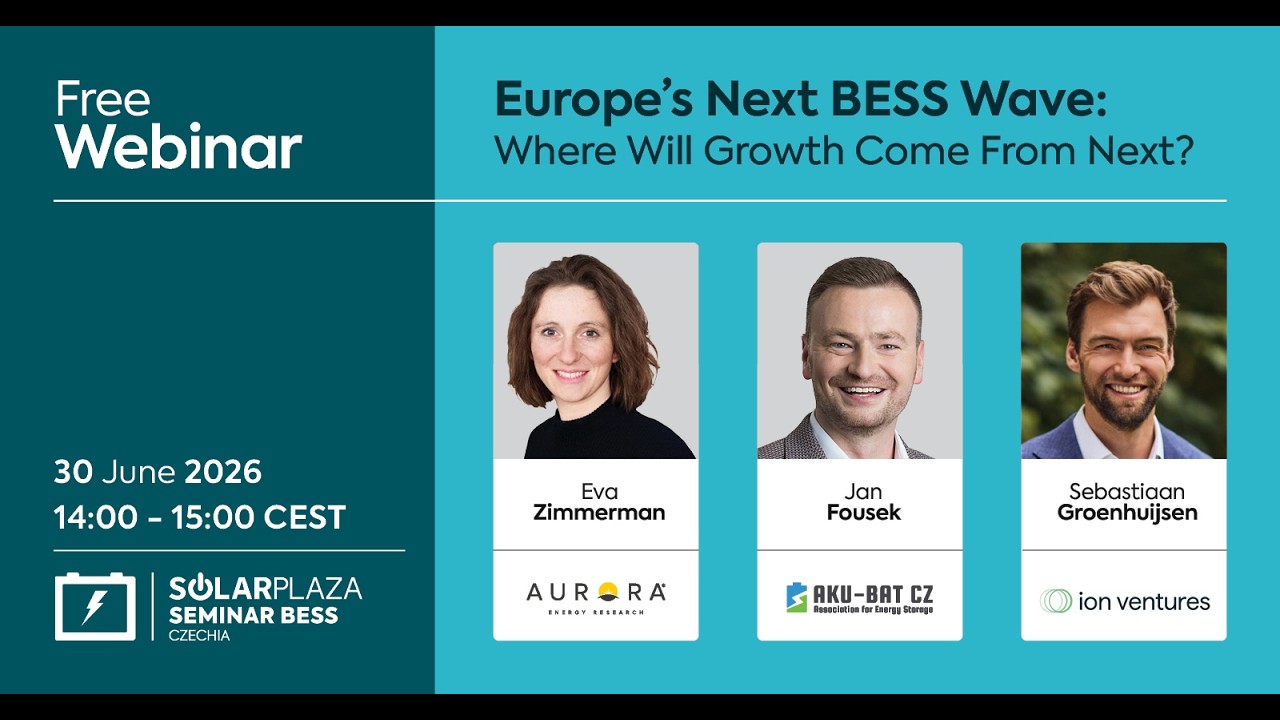
Solarplaza Webinar | Europe’s next BESS wave: where will growth come from next?
Keywords
Summary
198 words
Critical Evaluation
Value of the Information & Strength of the Argument
The webinar provides valuable insights into European BESS market dynamics, combining quantitative data from Aurora Energy Research with on-the-ground perspectives from the Czech Republic and a developer’s strategic approach. The argumentation is generally solid, with speakers supporting their claims with specific figures (e.g., installed capacity, pipeline sizes, IRRs) and practical examples. However, some statements are based on projections and assumptions that are not fully detailed, and the promotional nature of the webinar may introduce bias.
Scientific Rigor, Source Quality, Title Accuracy
The scientific rigor is moderate. Speakers reference their own reports and market data, but specific sources are not cited in detail during the presentation. The title accurately reflects the content, focusing on future BESS growth markets. The webinar is well-structured with clear sections, but the lack of detailed citations and the promotional context slightly reduce its overall rigor.
148 words
Title / Content Match
The title accurately reflects the content, which focuses on identifying future BESS growth markets in Europe.
Quality & Reliability
7/10
The webinar features industry experts from research, association, and development backgrounds, providing data-driven insights and practical experience. However, it is a promotional event by Solarplaza, and some claims lack detailed sourcing.
Chapters
- Welcome & Webinar Opening
- Focus Markets: Greece, Portugal, Czechia, and Ireland
- Agenda Overview
- About Solarplaza & Platform Services
- Technical Notes & Q&A Housekeeping
- Introduction of Jörn Richstein (Aurora Energy Research)
- Long-term Drivers for BESS Investments in Europe
- Phase-out of Thermal/Coal Generation
- Rising European Power Demand & New Tech Inflection Points
- Battery Cost Projections & Ancillary Service Markets
- European Country Attractiveness & Market Rankings
- Announced Battery Storage Pipeline Scale (2024–2026+)
- Long-term Investment Volume vs. Project Economics (IRR Analysis)
- Introduction of Jan Fousek (Akubat Czechia)
- Czech Installed Battery Capacity Data (Residential vs. C&I/Utility)
- Legislative Changes: "Lex RES 3" and Standalone Projects
- Grid Tariffs & Market Stagnation Risks
- The Czech "Applications Boom" & Double Charging Removal
- The New Tariff Structure Proposed for January 2027
- Connection Requests Pipeline vs. Ancillary Service Limits
- Future Outlook: Targets for 2030 & Decentralized Flexibility
- Introduction of Sebastiaan Groenhuijsen (ION Ventures)
- About ION Ventures & Business Model
- Pipeline Breakdown: UK, Ireland, and Continental Europe Expansion
- Global Trends: Electrification & Exponential Solar Growth
- Market Selection Strategy: The Weighted Scoring Model (Poland Case Study)
- Step-by-Step Project Delivery Process & Risk Management Strategy
- Key Takeaways for Developers
- Speaker Panel Reunion for Q&A
- Q1: What supply chain shifts are driving BESS cost reductions?
- Debate: Chinese Tier-1 margins, port oversupply, and CBAM/VAT impacts
- Q2: What percentage of the 122 GW pipeline will actually get realized?
- Discussion on grid speculation, speculative applications, and competing gas turbines
- Q3: Best practices for identifying and working with local partners?
- Final Wrap-up: The importance of local native speaker teams in power forecasting
- Upcoming Solarplaza Events & Closing Remarks
Cited Sources
- Solarplaza Events — Mentioned as the organizer and for upcoming events.
- Solarplaza LinkedIn — Mentioned as a company page for updates.
Concurring Sources
- Solar Power Europe — Industry association providing data on solar and storage deployment in Europe.
Contribution & Novelties
The webinar offers a multi-perspective analysis of emerging BESS markets in Europe, combining research data, national association insights, and developer strategy. It highlights specific markets like Greece, Portugal, Czechia, and Ireland, and discusses practical considerations for market entry. The discussion on the Czech tariff structure and the applications boom provides unique regional insights.
Pour aller plus loin :
- Battery Energy Storage Systems (BESS) — Overview of BESS technology and applications.
- European Union Energy Storage Strategy — EU policy context for energy storage.
- Aurora Energy Research — Research firm providing market analysis, referenced by the speaker.
95 words
Radar Profile
The radar profile shows balanced scores across all dimensions, with slightly higher scores in quantity of information and technical level, reflecting the webinar's data-rich and expert-driven content. The lower score in reliability is due to the promotional context and lack of detailed citations.