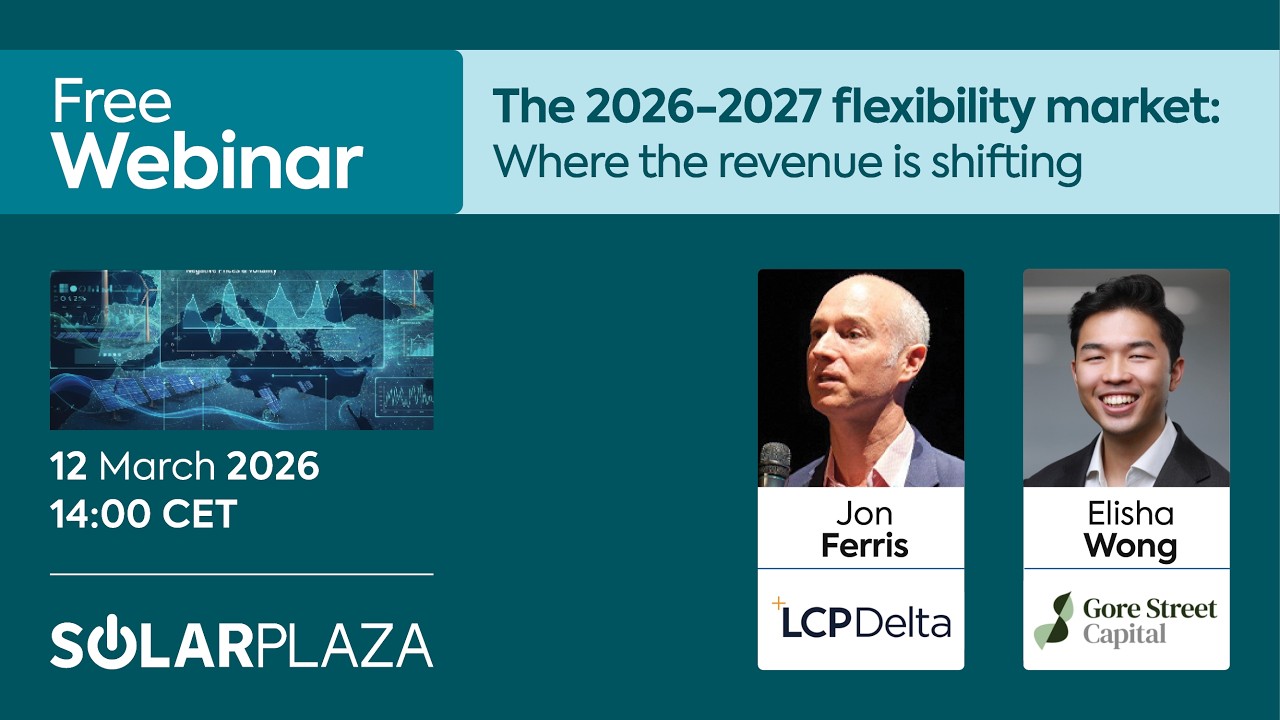
Solarplaza Webinar | The 2026-2027 flexibility market: Where the revenue is shifting
Keywords
Summary
155 words
Critical Evaluation
Value of the Information & Strength of the Argument
The webinar provides valuable insights into the current and future state of flexibility markets in Europe, drawing on the speakers’ extensive industry experience. The argumentation is solid, with clear explanations of market dynamics and revenue streams. The speakers effectively use examples from specific markets (e.g., GB, Germany, Spain) to illustrate their points. However, the content is largely qualitative and forward-looking, with limited quantitative data presented. The discussion on BESS revenue saturation and the shift towards arbitrage is well-argued, but the lack of detailed data or case studies weakens the overall persuasiveness.
Scientific Rigor, Source Quality, Title Accuracy
The scientific rigor is moderate. The speakers are credible experts, but the webinar is an opinion-based discussion rather than a peer-reviewed analysis. The sources cited are limited to the company’s own resources and LinkedIn, with no external references provided. The title accurately reflects the content, which focuses on the shifting revenue opportunities in the flexibility market. The webinar does not provide a comprehensive literature review or cite specific studies, which limits its scientific rigor. However, the practical insights from industry practitioners add value.
189 words
Title / Content Match
The title accurately reflects the content, which focuses on the shifting revenue opportunities in the flexibility market for 2026-2027.
Quality & Reliability
7/10
The webinar features two industry experts with substantial experience in flexibility markets and BESS investment. The content is based on market data and practical experience, but it is largely opinion and forward-looking analysis rather than peer-reviewed research. The sources cited are limited to the company's own resources and LinkedIn, with no external references provided.
Chapters
- Webinar intro: flexibility markets
- Agenda & topics
- Session structure
- About Solarplaza
- Questions & logistics
- Speaker intro: Jon Ferris
- Flexibility markets overview
- Role of demand-side flexibility
- Access to wholesale markets
- Capacity markets in Europe
- Ancillary services markets
- Growth of local flexibility markets
- Retail tariffs & consumer flexibility
- Speaker intro: Elisha Wong
- BESS investment overview
- Main BESS revenue streams
- Ancillary service saturation
- BESS design considerations
- Technical services & grid needs
- Grid congestion & connection limits
- Capturing value in BESS markets
- Merchant vs contracted revenues
- Choosing the right route-to-market
- Key takeaways for BESS owners
- Q&A session
- Importance of RTM partners
- Fast-response flexibility markets
- Technology requirements for batteries
- Why capacity markets are difficult
- Future flexibility market outlook
- Closing remarks
Cited Sources
- Solarplaza Events — Mentioned in the video description as a resource for upcoming events and insights.
- Solarplaza LinkedIn — Mentioned in the video description as a way to stay updated.
Concurring Sources
- LCP Delta — Jon Ferris's firm, which provides market intelligence and consultancy on energy transition.
- Gore Street Capital — Elisha Wong's firm, which invests in utility-scale BESS.
Contribution & Novelties
The webinar provides a timely overview of the flexibility market landscape for 2026-2027, highlighting the shift from ancillary services to energy arbitrage as a key revenue driver. It offers practical insights for BESS owners and investors on navigating market saturation and optimizing asset design. The discussion on local flexibility markets and the role of demand-side flexibility adds a forward-looking perspective.
Pour aller plus loin :
- European Union Agency for the Cooperation of Energy Regulators (ACER) — Relevant for understanding regulatory frameworks for flexibility markets.
- International Energy Agency (IEA) - Electricity — Provides data and analysis on electricity markets and flexibility.
- Energy Storage Association (ESA) — Offers resources on energy storage technologies and market trends.
114 words
Radar Profile
The radar profile shows a balanced performance across all dimensions, with slightly higher scores in information quantity and quality, reflecting the webinar's comprehensive coverage and expert insights. The technical level is adequate for an industry audience, and the overall reliability is moderate due to the opinion-based nature of the content.