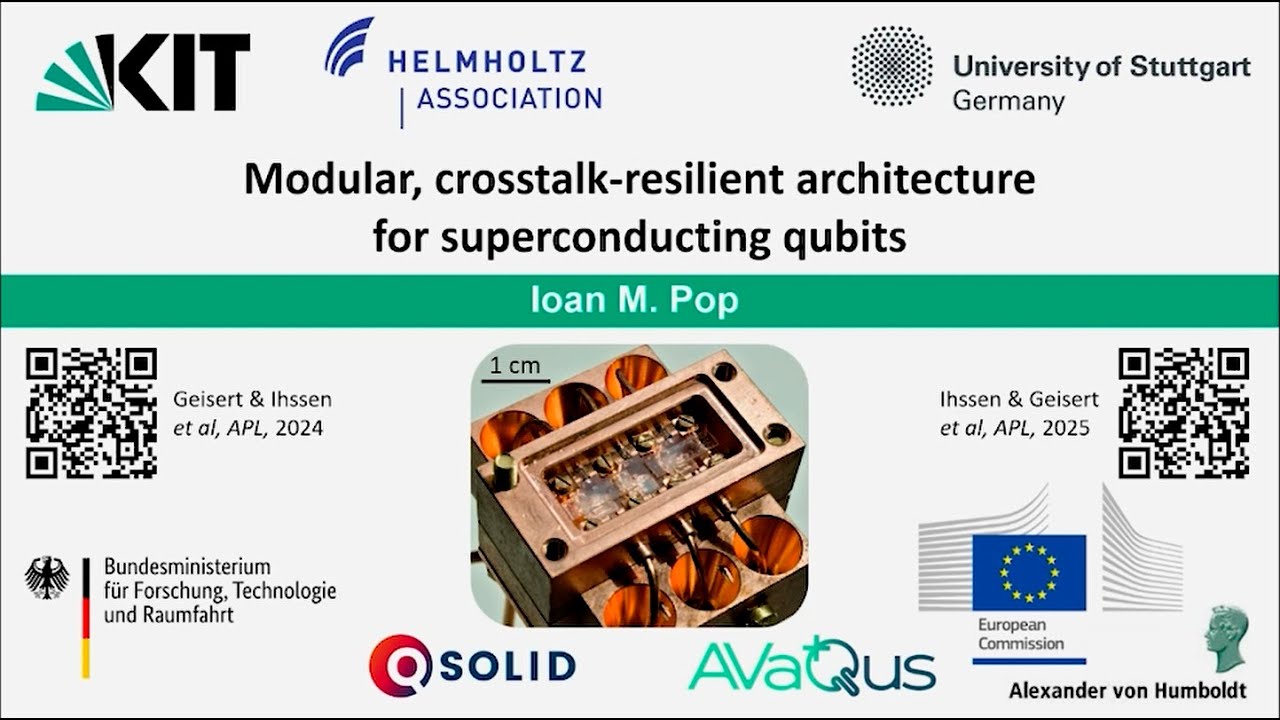
INQA Conference 2025: Ioan Pop - Karlsruhe Institute of Technology
Keywords
Summary
145 words
Critical Evaluation
Value of the Information & Strength of the Argument
The talk provides valuable insights into a novel architecture for superconducting qubits, addressing key challenges of scalability and crosstalk. The argumentation is solid, based on experimental data and published papers. The speaker clearly explains the motivation and the design choices, and the results are presented with appropriate caveats. The approach is innovative and could significantly impact the field.
Scientific Rigor, Source Quality, Title Accuracy
The presentation is scientifically rigorous, referencing two peer-reviewed papers and building on previous work. The sources are credible and directly relevant. The title accurately reflects the content, focusing on the modular and crosstalk-resilient aspects. The talk is well-structured and the technical details are consistent with current knowledge.
120 words
Title / Content Match
The title accurately reflects the content: a conference talk by Ioan Pop from KIT on superconducting qubit architecture.
Quality & Reliability
8/10
Presentation by a leading researcher at a scientific conference, based on peer-reviewed work (two back-to-back papers). Technical details are consistent with current understanding of superconducting qubits. Some claims are not fully elaborated due to time constraints, but overall high reliability.
Key Moments
Markers derived by PSI from the transcript: the creator did not define chapters.
- Introduction and overview of the talk
- Challenges in superconducting qubit scaling
- Comparison with other non-monolithic architectures
- Design of the flux qubit and readout scheme
- Experimental results on readout fidelity and state reset
- Modular flip-chip architecture and crosstalk suppression
- Two-qubit coupling and gate implementation
- Discussion of T1 times and future directions
Cited Sources
- Paper on flux qubit readout — Mentioned as back-to-back papers with first authors Simon and Zuran
- Paper on modular architecture — Mentioned as back-to-back papers with first authors Zuran and Simon
Concurring Sources
- Google quantum error correction paper — Referenced for error bursts and mitigation strategies
- IBM roadmap — Referenced for scaling plans
Contribution & Novelties
The talk presents a novel architecture combining kinetic inductance readout and modular flip-chip design, achieving high readout fidelity and low crosstalk. The approach is original and addresses key scalability issues.
Pour aller plus loin :
- Superconducting quantum computing — Overview of the field.
- Flux qubit — Background on flux qubits.
- Kinetic inductance — Explanation of the readout mechanism.
- Flip-chip technology — General concept of flip-chip integration.
66 words
Radar Profile
The radar profile shows high scores in technical level and information quality, with slightly lower scores in quantity and reliability, reflecting a focused technical talk with strong experimental backing.