INQA Conference 2025: Joan Falcó-Roget - Sano Centre for Computational Medicine
Keywords
Summary
102 words
Critical Evaluation
Value of the Information & Strength of the Argument
The talk provides a valuable contribution by introducing a new approach to community detection using quantum annealing, addressing limitations of existing methods. The argumentation is solid: the algorithm is derived mathematically, tested on multiple network types, and compared to state-of-the-art classical algorithms. The speaker acknowledges the heuristic nature and discusses scalability, providing a balanced view. The use of real neuroimaging data demonstrates practical applicability. However, the presentation is dense and may require prior knowledge of quantum computing and network science.
Scientific Rigor, Source Quality, Title Accuracy
The scientific rigor is high: the algorithm is formally derived, and experiments are described with sufficient detail. The speaker cites a preprint and mentions the use of the QHyper library, but no external sources are explicitly listed in the description. The title accurately reflects the content. The talk is part of a conference, indicating peer review. The speaker discloses no conflicts of interest. The Q&A session addresses potential concerns about solution variability and implications.
169 words
Title / Content Match
The title accurately reflects the content: a conference presentation by Joan Falcó-Roget on hierarchical quantum annealing for community detection.
Quality & Reliability
8/10
Presentation of a novel algorithm with rigorous mathematical derivation, experimental validation on benchmark networks and real neuroimaging data, and discussion of limitations. The work is a preprint under review, and the speaker discloses no conflicts of interest.
Key Moments
Markers derived by PSI from the transcript: the creator did not define chapters.
- Introduction: motivation from neuroscience and cancer networks
- Definition of modularity and community detection problem
- Binary formulation for two communities and QUBO mapping
- Limitations of existing approaches: DQM and one-hot encoding
- Proposed recursive binary division algorithm
- Mathematical derivation of the generalized modularity matrix
- Algorithm implementation and embedding strategy
- Results on toy models and comparison with Louvain/Leiden
- Results on real-world networks and neuroimaging data
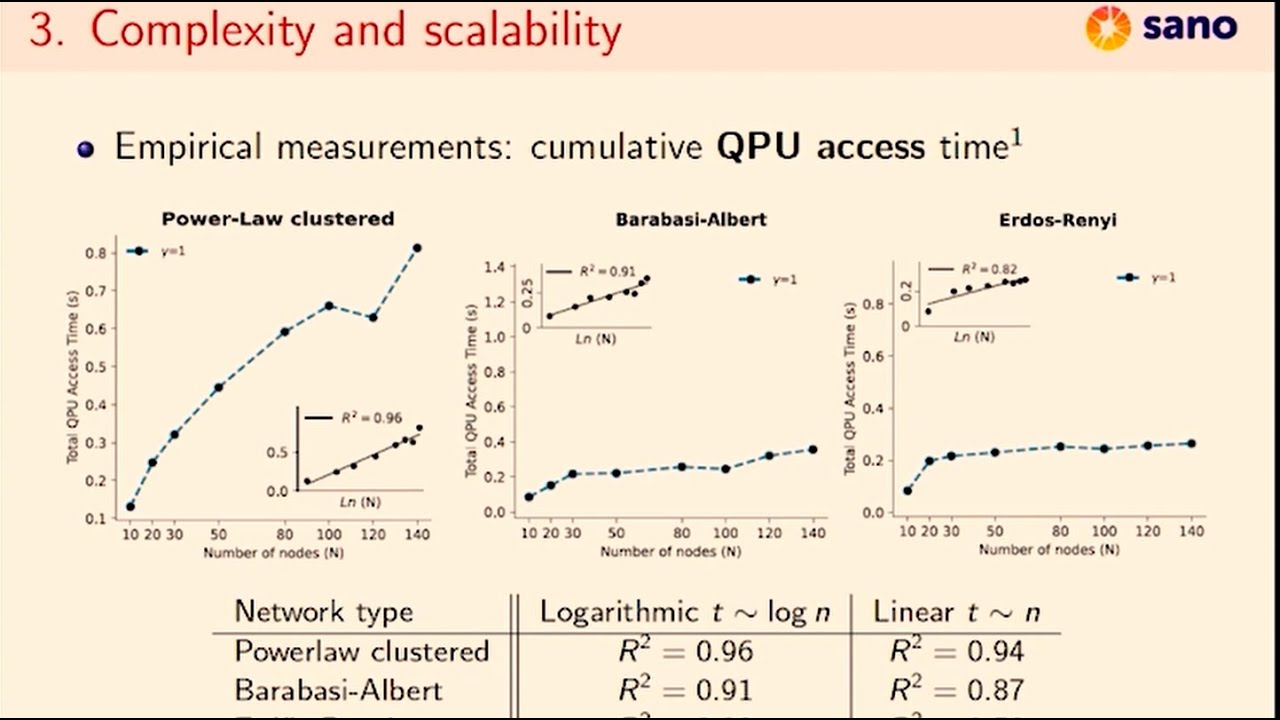
- Complexity analysis and scalability discussion
- Comparison with one-hot encoding and practical time measurements
- Implementation on QHyper and future directions
- Conclusion and Q&A session
Cited Sources
- Preprint (not specified) — Mentioned as a preprint under review, not updated since last review.
Concurring Sources
- Preprint (not specified) — The presented work is based on a preprint, which is the primary source.
Contribution & Novelties
The talk presents a novel hierarchical quantum annealing algorithm for community detection that avoids one-hot encoding and constraints, offering a more transparent and potentially scalable approach. It demonstrates competitive performance with classical algorithms and shows promise for real-world applications in neuroscience. The method provides a way to uncover hierarchical community structures, which is valuable for understanding complex systems.
Pour aller plus loin :
- Quantum annealing — Background on the quantum computing paradigm used.
- Modularity (networks) — Definition and context of the optimization target.
- Community structure — Overview of community detection in networks.
- Louvain method — Classical algorithm used for comparison.
- Leiden algorithm — Another classical algorithm used for comparison.
109 words
Radar Profile
The radar profile shows high scores in technical level and information quality, with slightly lower scores in quantity and reliability, reflecting a specialized presentation with solid methodology but limited breadth and external validation.