INQA Conference 2025: Christian Hensel - Qilimanjaro Quantum Tech
Keywords
Summary
153 words
Critical Evaluation
Value of the Information & Strength of the Argument
The talk provides valuable insights into a novel numerical method for simulating superconducting circuits, addressing a real computational bottleneck. The argumentation is solid, with clear explanations of the limitations of exact diagonalization and the advantages of tensor networks. The speaker supports claims with preliminary results and acknowledges the need for further validation. The discussion of potential limitations, such as the impact of long-range interactions, adds to the credibility.
Scientific Rigor, Source Quality, Title Accuracy
The presentation is scientifically rigorous, with a clear methodology and validation against exact diagonalization where possible. However, the talk does not cite specific external sources, and the results are preliminary and not yet peer-reviewed. The title accurately reflects the content, which is a technical talk on tensor network simulations of superconducting circuits. The speaker mentions a software package called ’tensor’ but does not provide a reference.
149 words
Title / Content Match
The title accurately reflects the content, a technical talk on tensor network simulations of superconducting circuits.
Quality & Reliability
7/10
Presentation of preliminary results with clear methodology and validation against exact diagonalization, but limited peer review and no published results yet.
Key Moments
Markers derived by PSI from the transcript: the creator did not define chapters.
- Introduction and overview of the talk's structure.
- Introduction to superconducting circuits and persistent-current qubits.
- Derivation of the lumped-element Hamiltonian and the challenge of projecting to spin Hamiltonians.
- Limitations of exact diagonalization and the exponential scaling of computational resources.
- Introduction to tensor networks and matrix product operators (MPOs).
- Implementation details of the tensor network framework and the DMRG algorithm.
- Preliminary results for single and coupled flux qubits, showing periodic responses.
- Extension to fluxonium qubits and comparison with hierarchical diagonalization.
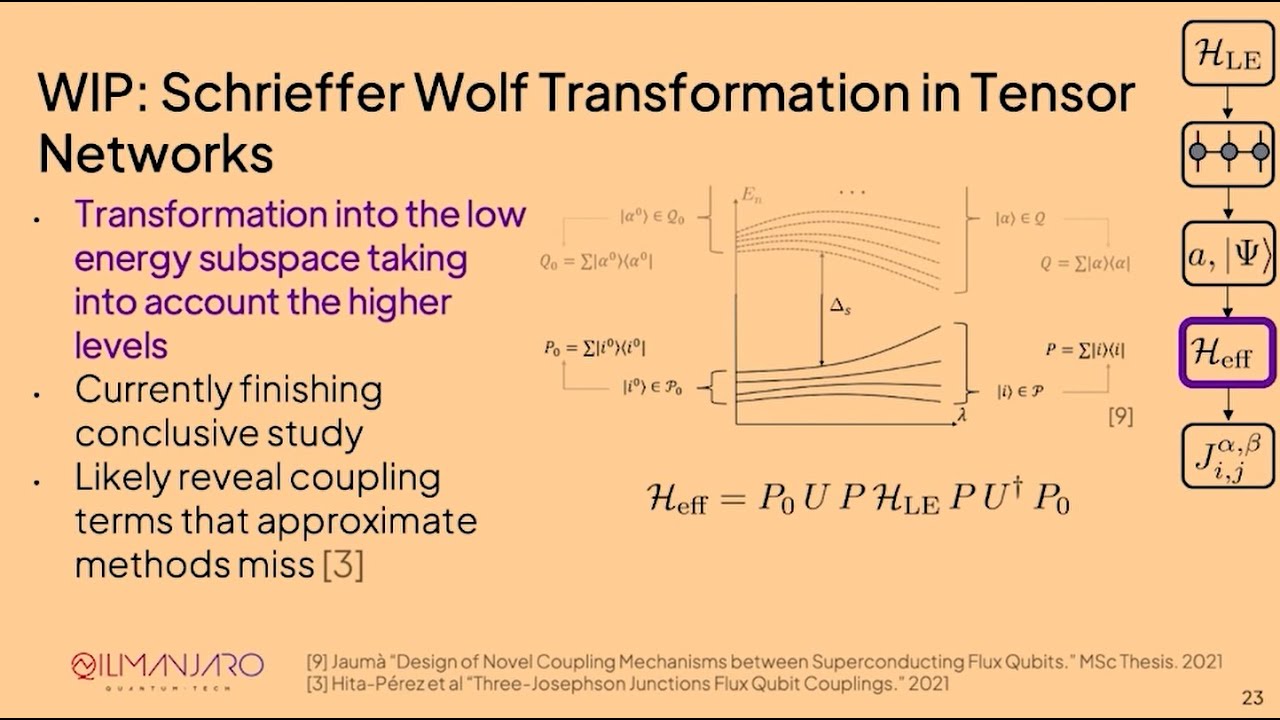
- Outlook and future work, including Schrieffer-Wolff transformation and scaling to more qubits.
- Conclusion and Q&A session.
Contribution & Novelties
The talk presents a novel application of tensor networks to simulate larger superconducting circuits, addressing the exponential scaling of exact diagonalization. The approach allows for the study of strongly coupled systems without approximations, potentially revealing new physics. The preliminary results validate the method and suggest it can handle systems beyond current capabilities.
Pour aller plus loin :
- Density matrix renormalization group — The DMRG algorithm is central to the method.
- Matrix product operator — The representation used for the Hamiltonian.
- Superconducting quantum computing — Background on the platform.
88 words
Radar Profile
The radar profile shows high scores in technical level and information quality, reflecting the specialized and detailed nature of the talk. The lower scores in reliability and global note are due to the preliminary status of the results and lack of external references.