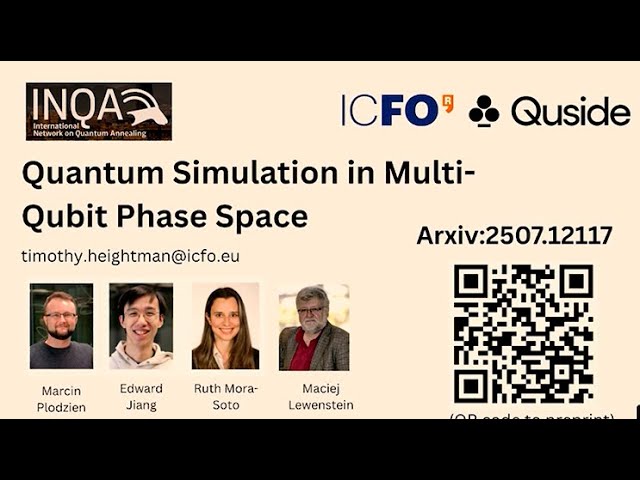
Quantum Simulation in Multi-Qubit Phase Space
Keywords
Summary
155 words
Critical Evaluation
Value of the Information & Strength of the Argument
The talk provides a clear and compelling argument for the value of phase-space methods in quantum simulation. The speaker demonstrates the formalism’s ability to represent multi-qubit states and dynamics faithfully, with examples including Bell states and the Jaynes-Cummings model. The argumentation is solid, building from the Stratonovich-Weyl correspondence to a full dynamical framework. The potential advantages for quantum machine learning are well articulated, particularly the recasting of the curse of dimensionality. However, the talk is largely theoretical, and the practical benefits are not yet fully demonstrated, as the applications are still in early stages.
Scientific Rigor, Source Quality, Title Accuracy
The talk is scientifically rigorous, with a clear methodology and references to a preprint on arXiv. The speaker acknowledges the work is under peer review, which is appropriate. The title accurately reflects the content. The sources cited are limited to the preprint and general concepts, but the talk is based on original research. The adéquation between title and content is strong.
170 words
Title / Content Match
The title accurately reflects the content, which focuses on quantum simulation in multi-qubit phase space.
Quality & Reliability
7/10
The talk presents original research with a preprint on arXiv, but it is not yet peer-reviewed. The methodology is clearly explained and the results are plausible, but the lack of external validation and the early stage of the work limit the reliability score.
Key Moments
Markers derived by PSI from the transcript: the creator did not define chapters.
- Introduction to the motivation: curse of dimensionality in Hilbert space and desire to apply deep learning.
- Overview of the Stratonovich-Weyl correspondence and its two flavors: continuous variable and spin systems.
- Construction of the Q function and its properties, including positivity and extension to multi-qubit systems.
- Examples of phase-space representations: pi eigenstates, thermal states, and Bell states.
- Extension to dynamics: commutators become differential vector fields on the spin configuration manifold.
- Demonstration of real-time evolution, imaginary time evolution, and open system dynamics in phase space.
- Many-body compatibility: visualization of entanglement dynamics in a two-qubit system.
- Application to light-matter interaction: Jaynes-Cummings model in phase space.
- Discussion of why phase space is machine learning friendly: estimation via Monte Carlo and automatic differentiation.
- Recasting the curse of dimensionality: linear coordinates but nonlinear function, and implications for deep learning.
- Summary and ongoing applications: quantum Fourier transform simulation, tomography, and Hamiltonian learning.
Cited Sources
- arXiv preprint (link in description) — The speaker refers to a preprint on arXiv for details of the formalism.
Concurring Sources
- Phase-space formulation of quantum mechanics — General background on phase-space methods.
Contribution & Novelties
The talk presents a novel formalism for quantum simulation in multi-qubit phase space, extending the Stratonovich-Weyl correspondence to many-body systems. This provides a new route for quantum machine learning and classical simulation of many-body quantum systems. The approach recasts the curse of dimensionality in terms of harmonic support on a domain that scales linearly with qubit number, which is more amenable to deep learning architectures.
Pour aller plus loin :
- Stratonovich-Weyl correspondence — Overview of phase-space formulation in quantum mechanics.
- Quantum machine learning — General overview of QML.
- Normalizing flows — Generative models used in the talk for tomography.
99 words
Radar Profile
The radar profile shows high scores in technical level and information quantity, reflecting the advanced and detailed nature of the talk. The quality of information and reliability are slightly lower due to the early-stage nature of the research and lack of peer review. Overall, the talk is highly technical and informative, with a strong theoretical foundation.
💬 No comments were provided for analysis.