INQA Conference 2025: Anna Maria Dziubyna - Jagiellonian University
Keywords
Summary
182 words
Critical Evaluation
Value of the Information & Strength of the Argument
The talk provides valuable insights into the application of tensor network methods to optimization problems, a relatively novel approach. The argumentation is solid, supported by benchmark results on multiple problem instances and comparisons with established solvers. The speaker clearly explains the algorithm’s steps and the challenges encountered, such as contraction instabilities. The presentation of both strengths and limitations adds to its credibility.
Scientific Rigor, Source Quality, Title Accuracy
The talk demonstrates scientific rigor through detailed algorithmic descriptions and systematic benchmarking. However, specific sources are not explicitly cited within the talk, and the description does not provide references. The title accurately reflects the content, as it is a conference presentation by the named researcher. The lack of explicit citations limits the ability to verify claims independently.
134 words
Title / Content Match
The title accurately reflects the content: a conference presentation by Anna Maria Dziubyna from Jagiellonian University.
Quality & Reliability
8/10
The talk presents original research with detailed algorithmic descriptions and benchmark results, but lacks peer-reviewed publication details and independent verification.
Key Moments
Markers derived by PSI from the transcript: the creator did not define chapters.
- Introduction and motivation for using tensor networks in optimization.
- Overview of the algorithm: branch and bound with tensor network contractions.
- Explanation of PEPS tensor network representation for spin-glass problems.
- Technical details: sparse tensors, boundary MPS, and randomized SVD.
- Benchmark results on random Pegasus and Zephyr instances.
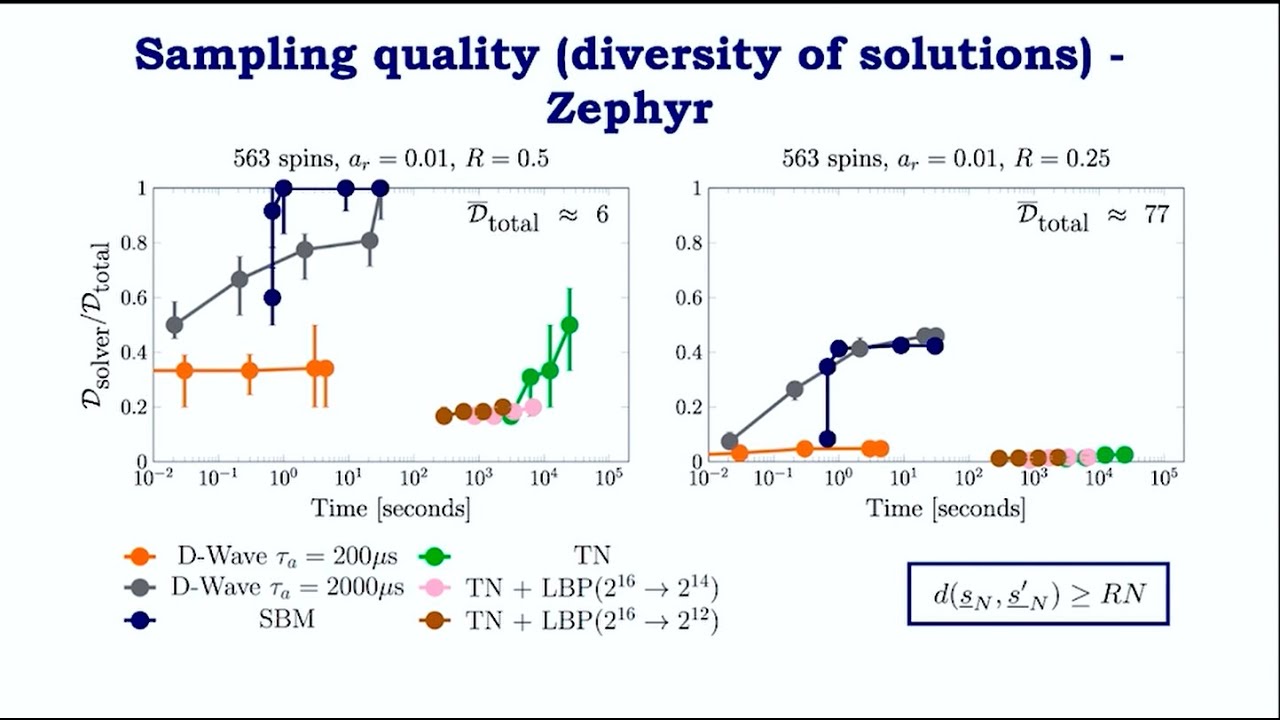
- Results on tile-planting instances and comparison with D-Wave and SBM.
- Diversity of solutions metric and analysis.
- Stability analysis and trade-offs between temperature and contraction accuracy.
- Introduction to LHZ architecture and tensor network representations.
- Ongoing work and future directions.
Contribution & Novelties
The talk presents a novel application of tensor network methods to discrete optimization on quantum annealing geometries, demonstrating competitive performance on certain problem classes. The approach offers a deterministic alternative to probabilistic solvers, with potential advantages in solution diversity for specific instances.
Pour aller plus loin :
- Tensor network — Provides background on tensor networks and their applications.
- Ising model — The spin-glass model is a variant of the Ising model.
- Quantum annealing — Context for the optimization problems addressed.
- Branch and bound — The search strategy used in the algorithm.
- Lechner-Hauke-Zoller architecture — The LHZ architecture for fully connected spin glasses.
102 words
Radar Profile
The radar profile shows high scores in technical level and information quantity, with slightly lower scores in quality and reliability, reflecting the advanced technical content and the lack of explicit citations.