Improving the success probability of LHZ using quantum walks
Keywords
Summary
180 words
Critical Evaluation
Value of the Information & Strength of the Argument
The talk presents valuable original research with clear numerical evidence. The argumentation is solid: the speaker systematically compares multiple decoding methods and provides sanity checks against random chance and direct embedding. The improvement from spanning tree decoding is convincingly demonstrated, and the explanation for its superiority (energy-based selection) is well-argued. The speaker also acknowledges limitations, such as small system sizes and the use of a heuristic for gamma, which adds credibility. The discussion of the constraint strength’s effect on performance is insightful, though the speaker admits to not fully exploring the optimal choice.
Scientific Rigor, Source Quality, Title Accuracy
The talk references key papers in the field, including the original LHZ embedding paper and papers on belief propagation and minimum weight decoding. The speaker provides a link to her published paper in the description. The methodology is clearly described, and the numerical simulations appear reproducible. The title accurately reflects the content. The speaker does not overclaim results and appropriately notes the scope of the study. The presentation is rigorous, though some details (e.g., exact parameters) are omitted for brevity.
188 words
Title / Content Match
The title accurately reflects the content, focusing on improving success probability via quantum walks in the LHZ embedding.
Quality & Reliability
8/10
Presentation of original research with numerical simulations, references to published papers, and clear methodology. Limitations acknowledged (small system sizes, heuristic gamma).
Key Moments
Markers derived by PSI from the transcript: the creator did not define chapters.
- Introduction to optimization problems and Ising models
- Explanation of LHZ embedding and its purpose
- Comparison of quantum walks and adiabatic quantum computation
- Definition of finite-time success probability and optimal gamma
- Impact of LHZ embedding on quantum walk performance
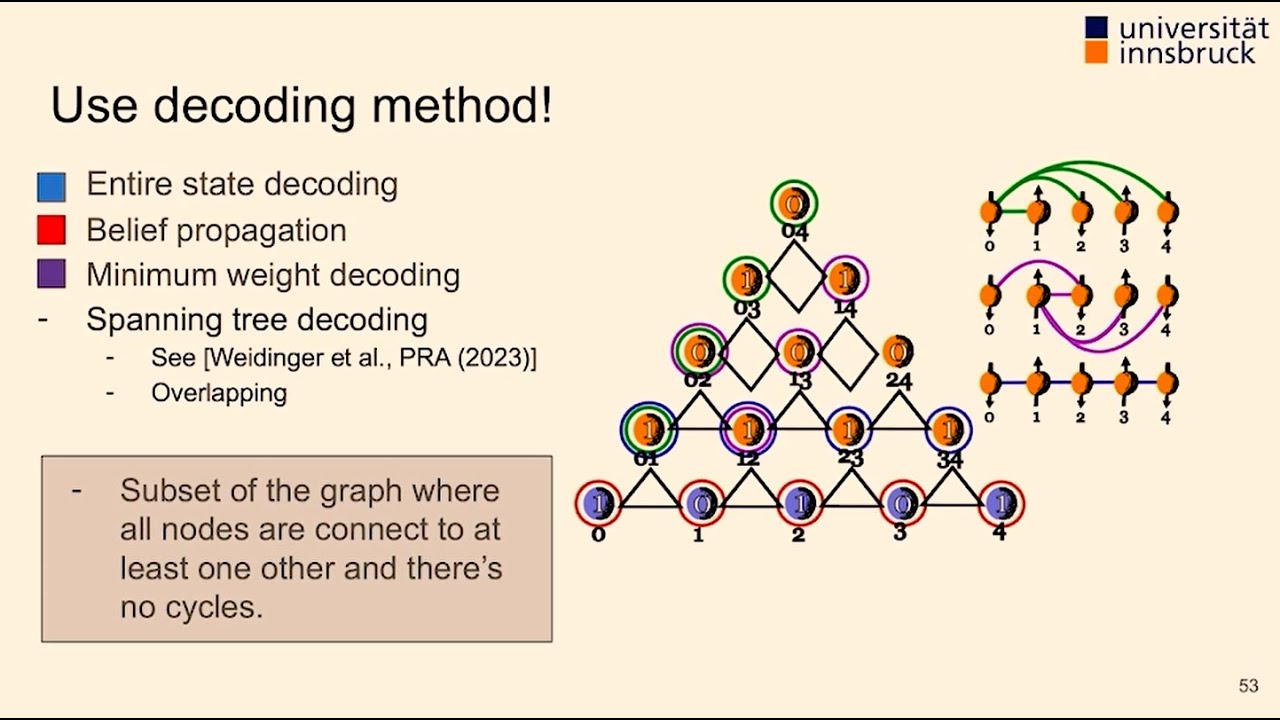
- Introduction of decoding methods: entire state, belief propagation, minimum weight
- Spanning tree decoding and its superior performance
- Comparison across different system sizes and sanity checks
- Conclusions and future directions
Cited Sources
- Paper on LHZ embedding — Original paper introducing the LHZ parity embedding.
- Paper on belief propagation decoding — Reference for belief propagation decoding method.
- Paper on minimum weight decoding — Reference for minimum weight decoding method.
Concurring Sources
- Quantum walk — General concept of quantum walks.
- LHZ embedding — Original paper on LHZ embedding.
Contribution & Novelties
The talk presents original research on combining quantum walks with the LHZ embedding and demonstrates that post-readout error correction, particularly spanning tree decoding with energy-based selection, can significantly improve success probability. This is a novel contribution to the field of quantum optimization.
Pour aller plus loin :
- Quantum walk — Provides background on quantum walks.
- LHZ embedding — Original paper on the LHZ embedding.
- Sherrington-Kirkpatrick model — Background on the SK model used in simulations.
75 words
Radar Profile
The radar profile shows high scores in technical level and information quality, with slightly lower scores in information quantity and reliability, reflecting the focused but specialized nature of the talk.
💬 No comments were provided for analysis.