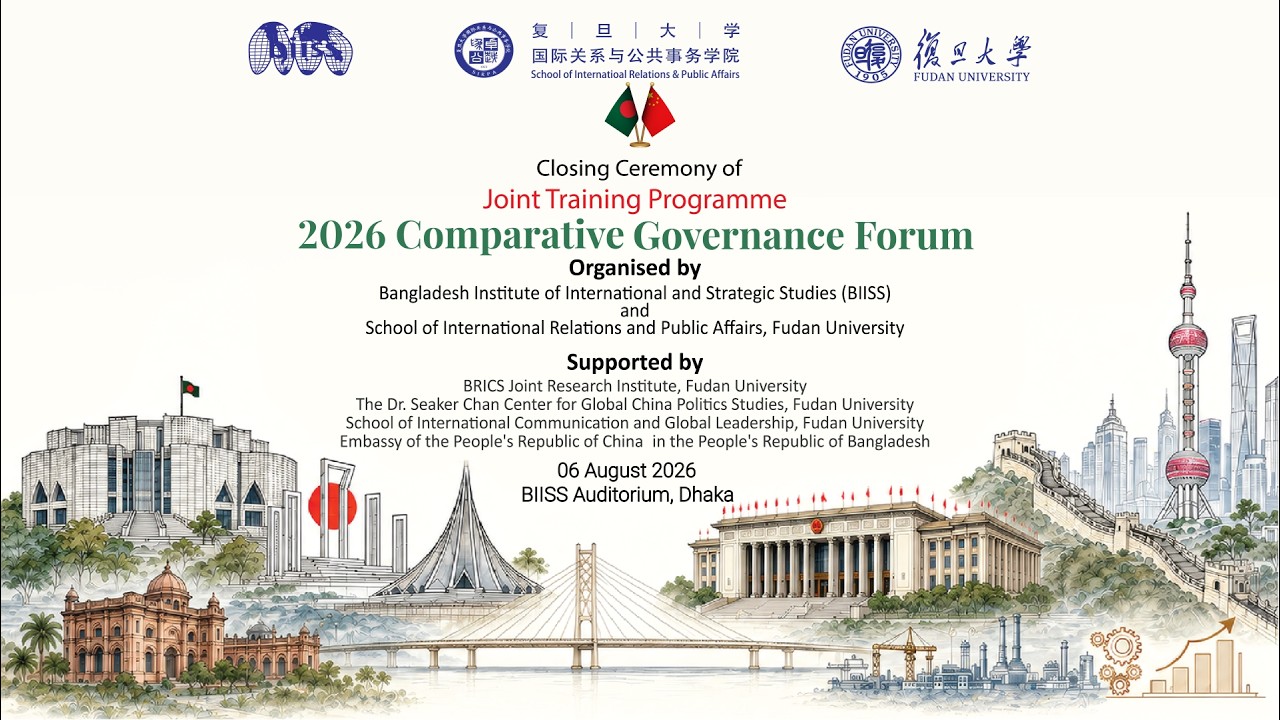
International Training on Comparative Governance Forum 2026 on Thursday, 06 August 2026
Keywords
Summary
170 words
Critical Evaluation
Value of the Information & Strength of the Argument
The video’s value lies in documenting a diplomatic event and showcasing the official perspectives of Bangladesh and China on their bilateral relationship and governance cooperation. However, the argumentation is largely rhetorical and lacks substantive analysis. The speeches contain broad claims about economic progress, political stability, and the benefits of cooperation, but these are not supported by data or detailed evidence. The chief guest’s remarks include political commentary on Bangladesh’s recent history, which appears one-sided and may not reflect a balanced view. Overall, the content is more ceremonial than informative, offering limited critical insight into governance models.
Scientific Rigor, Source Quality, Title Accuracy
The video does not cite any scientific sources or provide references. The information presented is based on the speakers’ opinions and official positions. The title accurately reflects the content, which is a recording of the forum’s closing session. There is no evidence of rigorous scientific methodology or fact-checking. The claims made about economic figures and political events are unverified and may be subject to bias. The low view count and lack of engagement suggest limited reach and impact.
189 words
Title / Content Match
The title accurately describes the content: a recording of the closing session of the 2026 Comparative Governance Forum.
Quality & Reliability
5/10
The video is a recording of a diplomatic event, primarily featuring speeches and ceremonial proceedings. It contains no scientific data, methodology, or verifiable sources. The content is largely promotional and political, with claims about economic and political conditions that are not substantiated. The low view count and lack of engagement further limit its reliability as a source of information.
Key Moments
Markers derived by PSI from the transcript: the creator did not define chapters.
- Opening and welcome remarks by the session chair, Major General S.M. Rashed-e-Mahmud.
- Reflections on the four-day forum and its discussions on governance.
- Certificate presentation to participants.
- Remarks by Professor Zhang Ping from Fudan University.
- Closing address by His Excellency Muhammad Ismail Zabihullah.
- Discussion on Bangladesh-China economic cooperation and AI in governance.
- Concluding remarks and souvenir exchange.
Contribution & Novelties
The video provides a record of the official discourse surrounding Bangladesh-China governance cooperation, but offers little original insight. It highlights the importance of comparative governance and the potential for academic collaboration, but does not delve into specific models or outcomes.
Pour aller plus loin :
- Comparative Politics — Provides a framework for understanding comparative governance.
- Bangladesh–China relations — Context on the bilateral relationship.
- Fudan University — Information on the partner institution.
71 words
Radar Profile
The radar profile shows low scores across all dimensions, indicating that the video is not a substantive scientific resource. It is primarily ceremonial and lacks depth in information, technical content, and reliability.