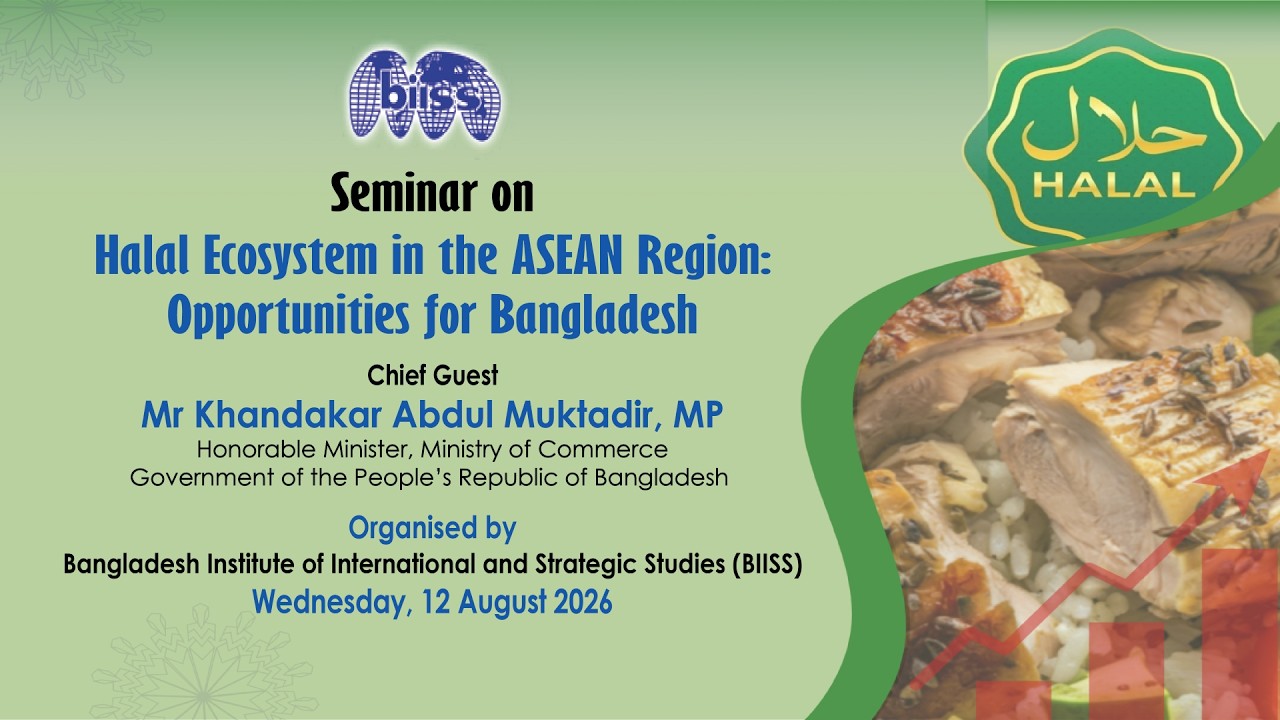
Seminar on “Halal Ecosystem in the ASEAN Region: Opportunities for Bangladesh” on 12 August 2026
Keywords
Summary
178 words
Critical Evaluation
Value of the Information & Strength of the Argument
The seminar provides a valuable overview of the halal ecosystem’s potential for Bangladesh, highlighting market size, growth projections, and strategic opportunities. The argumentation is coherent, emphasizing the need for a comprehensive approach involving certification, traceability, technology, and regional cooperation. However, the discussion remains largely qualitative, with limited empirical evidence or detailed case studies. The speakers rely on general statements and policy advocacy rather than rigorous data analysis, which weakens the persuasiveness of the arguments.
Scientific Rigor, Source Quality, Title Accuracy
The seminar demonstrates moderate scientific rigor. The speakers reference general trends and examples from Malaysia, Indonesia, and Thailand, but specific sources are not cited. The title accurately reflects the content, and the discussion is relevant to the topic. The quality of sources is limited to the speakers’ expertise and institutional knowledge, with no external references provided. The adéquation between title and content is strong, as the seminar directly addresses the halal ecosystem in ASEAN and opportunities for Bangladesh.
167 words
Title / Content Match
The title accurately reflects the content, which is a seminar on the halal ecosystem in ASEAN and its opportunities for Bangladesh.
Quality & Reliability
6/10
The seminar provides a structured overview of the halal ecosystem in ASEAN and its opportunities for Bangladesh, with contributions from government officials and experts. However, it lacks detailed data, citations, and rigorous analysis, relying more on general statements and policy advocacy.
Key Moments
Markers derived by PSI from the transcript: the creator did not define chapters.
- Welcome address by session chair, Major General ASM Riduan Rahman, setting the context for the seminar.
- Keynote presentation by Dr. Mahus Kobir on the halal ecosystem in ASEAN, covering global market size and growth projections.
- Discussion on key sectors of the halal ecosystem, including food, pharmaceuticals, cosmetics, and tourism.
- Panel discussion with experts from Islamic Foundation and BSTI on certification and standardization.
- Speech by chief guest, Minister of Commerce, on government initiatives and cooperation with Malaysia.
- Open discussion and interventions from participants.
- Concluding remarks by the session chair, summarizing key points and recommendations.
Contribution & Novelties
The seminar provides a comprehensive overview of the halal ecosystem in ASEAN and its relevance to Bangladesh, emphasizing the need for a holistic approach beyond certification. It highlights specific opportunities in sectors like pharmaceuticals, cosmetics, and tourism, and suggests policy recommendations for institutional strengthening and regional integration. The discussion on digital traceability and blockchain as tools for enhancing trust is particularly relevant.
Pour aller plus loin :
- Halal industry overview — Provides background on halal certification and its global significance.
- ASEAN Economic Community — Context on regional integration and trade opportunities.
- Islamic finance — Relevant to the financing aspects of the halal ecosystem.
103 words
Radar Profile
The radar profile shows moderate scores across all dimensions, with slightly higher scores in quantity of information and reliability, reflecting the seminar's broad coverage and institutional credibility, but lower scores in technical depth and information quality due to the lack of detailed data and rigorous analysis.
💬 No comments were provided for analysis.