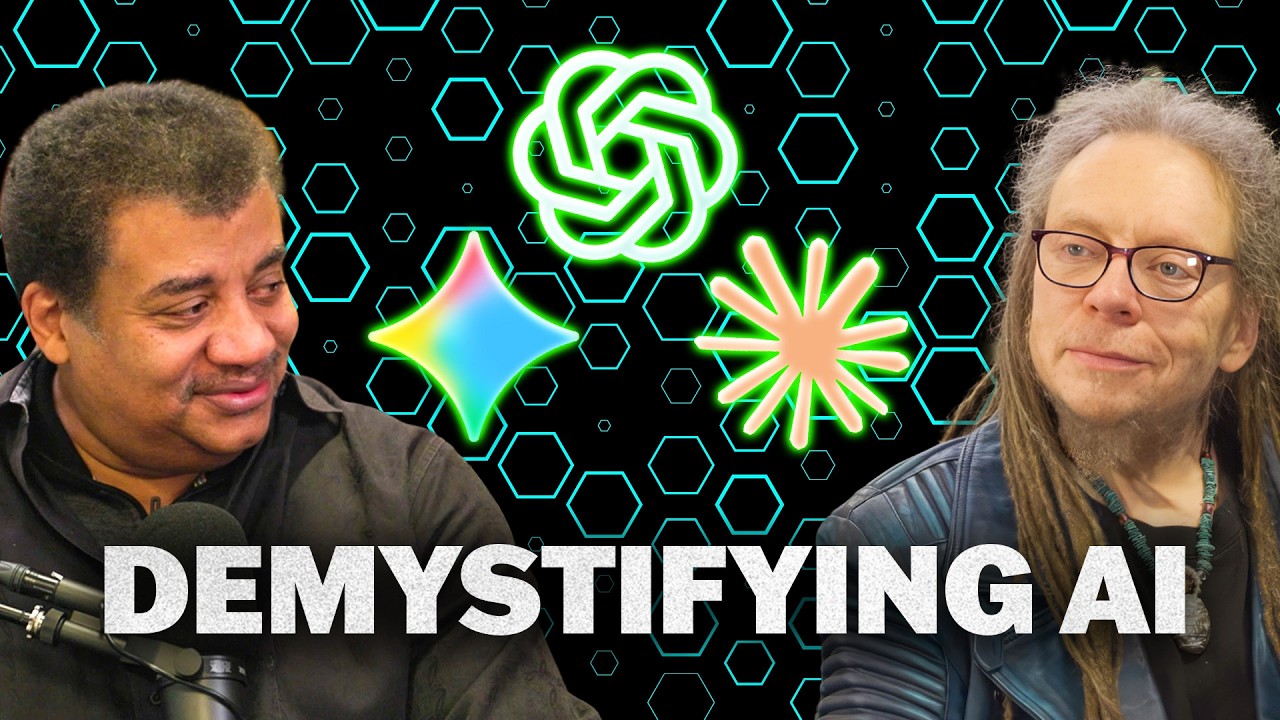
There Is No AI, Really (It’s Just People), with Jaron Lanier
Keywords
Summary
204 words
Critical Evaluation
The episode provides a compelling and thought-provoking analysis of the internet’s dysfunction and AI’s role, delivered by Jaron Lanier, a highly credible figure in computer science. Lanier’s arguments are well-articulated and grounded in his extensive experience, particularly his insights into VR’s commercial failure and the ethical lapses in tech development. He effectively critiques the dominant business model of social media, which capitalizes on triggering fight-or-flight responses, and offers a novel solution in ‘data dignity’—a concept that reframes data as a form of labor deserving compensation. The discussion is rigorous in its logic, though it relies heavily on anecdotal evidence and personal observations rather than empirical data. For instance, Lanier’s claim about VR nausea affecting mostly Asian women is presented without citing specific studies, which weakens the scientific robustness. Additionally, while he advocates for alternative business models, he does not delve into the practical implementation challenges. The adéquation between title and content is strong, as the central thesis—that AI is not a sentient entity but a collective human effort—is consistently explored. The conversation is balanced, with hosts posing critical questions, though at times the discussion veers into speculative territory. Overall, the episode offers valuable insights into the societal impact of technology, but its reliance on expert opinion rather than systematic evidence limits its scientific rigor. The public comments reflect high appreciation, with many viewers praising Lanier’s clarity and depth, indicating the episode’s success in engaging its audience.
236 words
Title / Content Match
The title accurately reflects the central thesis of the episode: Lanier argues that AI is not a sentient entity but a collaboration of human efforts.
Quality & Reliability
8/10
The discussion features Jaron Lanier, a renowned computer scientist and VR pioneer, offering expert insights. The conversation is nuanced, critical of tech industry practices, and grounded in his experience. However, it is an opinion-based discussion without formal citations, and some claims are anecdotal.
Chapters
- Introduction: Jaron Lanier
- The Thinking Behind Virtual Reality
- Why VR Flopped
- Social Media Addiction Lawsuits
- The Social Media Addicted Personality
- The Internet’s Business Model
- Is Social Media Equally Bad for Everyone?
- AI’s Changes to the Internet
- Stop Mythologizing AI
- There Is No AI
- Data Dignity & Inventing a New Jobs Under AI
- Why Privacy is Difficult
- Is the Internet Toast?
- Everyone’s Suing AI
- Closing Thoughts
Cited Sources
- Take Me to Your Leader — Neil deGrasse Tyson's latest book, mentioned in the introduction, explores the possibilities of alien life within the laws of physics.
Concurring Sources
- Jaron Lanier's official website — Provides background on Lanier's work and publications, supporting his expertise.
Dissenting Sources
- Critique of AI hype
Contribution & Novelties
The episode offers a unique perspective by having Jaron Lanier, a pioneer in virtual reality, critically examine the internet’s evolution and AI’s role. Lanier’s concept of ‘data dignity’ is a novel proposition that reframes data as a form of human labor deserving compensation, challenging the current extractive model. He also demystifies AI, arguing that it is not a sentient entity but a collaboration of human efforts, which counters the prevalent mythologizing. The discussion provides a comprehensive critique of social media’s business model and suggests alternative approaches, such as micropayments and legal accountability.
Pour aller plus loin :
- Data dignity — A concept discussed by Lanier, proposing that data should be treated as labor and compensated.
- Network effect — The phenomenon central to the internet’s dysfunction, as explained by Lanier.
- Virtual reality — The technology Lanier pioneered, with its history and challenges.
141 words
Radar Profile
The radar profile shows high scores in information quantity and quality, reflecting the depth of the discussion. The technical level is moderate, making it accessible to a broad audience. Global reliability is strong, though the reliance on expert opinion rather than empirical data slightly lowers it.
💬 Très positif. Sur les 30 commentaires analysés, les spectateurs expriment une forte appréciation, demandant le retour de Jaron Lanier et saluant la profondeur de ses idées.