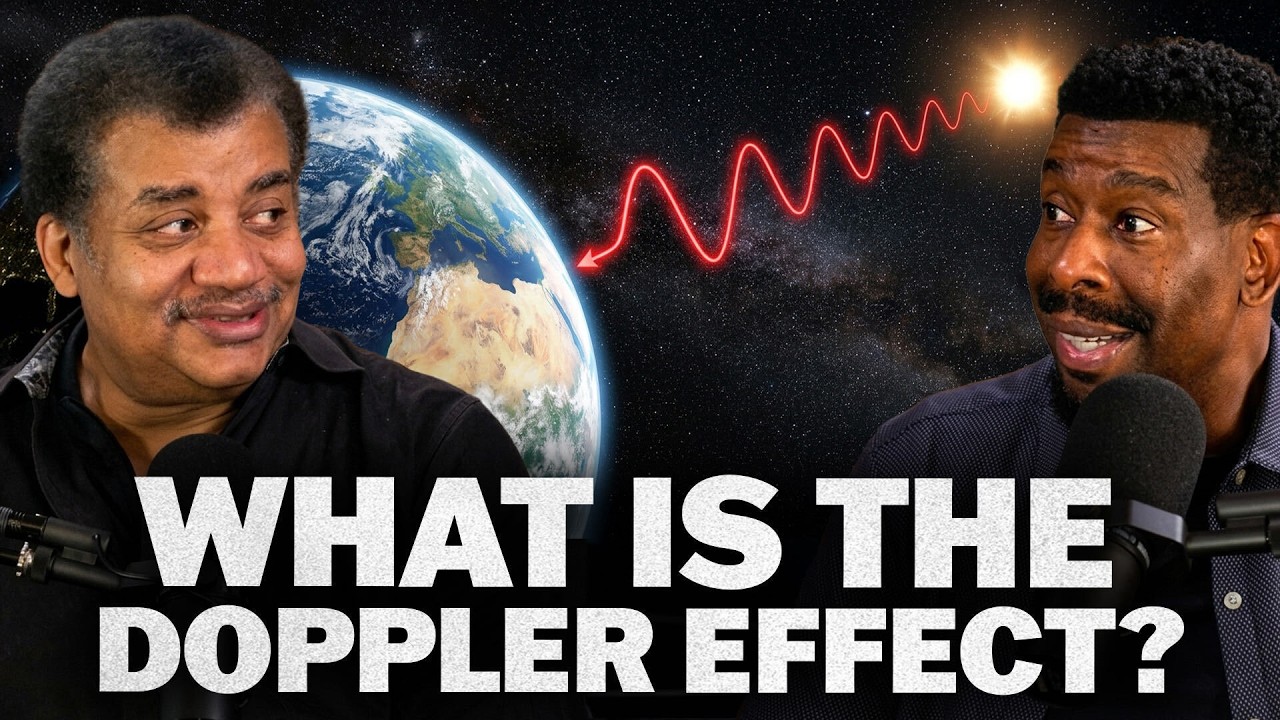
Neil deGrasse Tyson Explains the Doppler Effect
Keywords
Summary
207 words
Critical Evaluation
Value of the Information & Strength of the Argument
The video provides a solid explanation of the Doppler effect, combining historical anecdotes, intuitive analogies, and clear scientific reasoning. Tyson effectively uses the train whistle example to illustrate the concept, and his step-by-step breakdown of the physics is accessible without oversimplifying. The argumentation is coherent, and the inclusion of practical applications like radar and astronomy demonstrates the relevance of the phenomenon. However, the conversational style occasionally leads to tangents, but these do not detract from the overall educational value.
Scientific Rigor, Source Quality, Title Accuracy
The scientific content is accurate and aligns with established physics. Tyson, as a respected astrophysicist, lends credibility to the explanation. The video does not cite specific academic sources, but the historical reference to Christian Doppler and the correct application of the Doppler formula are appropriate. The title accurately reflects the content, and the video stays on topic throughout. The description includes a link to a book by Tyson, but no direct references to external scientific literature are provided.
172 words
Title / Content Match
The title accurately reflects the content, which focuses on explaining the Doppler effect.
Quality & Reliability
8/10
Neil deGrasse Tyson, astrophysicist and director of the Hayden Planetarium, provides a clear and accurate explanation of the Doppler effect, supported by historical context and practical applications. The content is scientifically sound, though presented in a conversational style.
Chapters
Cited Sources
- Take Me to Your Leader — Mentioned in the video description as a book by Neil deGrasse Tyson.
Concurring Sources
- Doppler effect — General reference on the Doppler effect, consistent with the video's explanation.
Contribution & Novelties
The video offers a fresh and engaging perspective on the Doppler effect, making it accessible to a broad audience. It effectively connects the phenomenon to everyday experiences, such as train whistles and speeding tickets, and extends to astronomical applications. The explanation of the sonic boom as an extreme case of the Doppler effect is particularly insightful.
Pour aller plus loin :
- Doppler effect — Comprehensive overview of the phenomenon across different wave types.
- Sonic boom — Detailed explanation of the physics behind sonic booms.
- Radar gun — How Doppler radar is used to measure speed.
95 words
Radar Profile
The radar chart shows a balanced profile with high scores in quality and reliability, moderate in quantity and technical level, indicating a well-rounded educational content.
💬 No comments were provided for analysis.