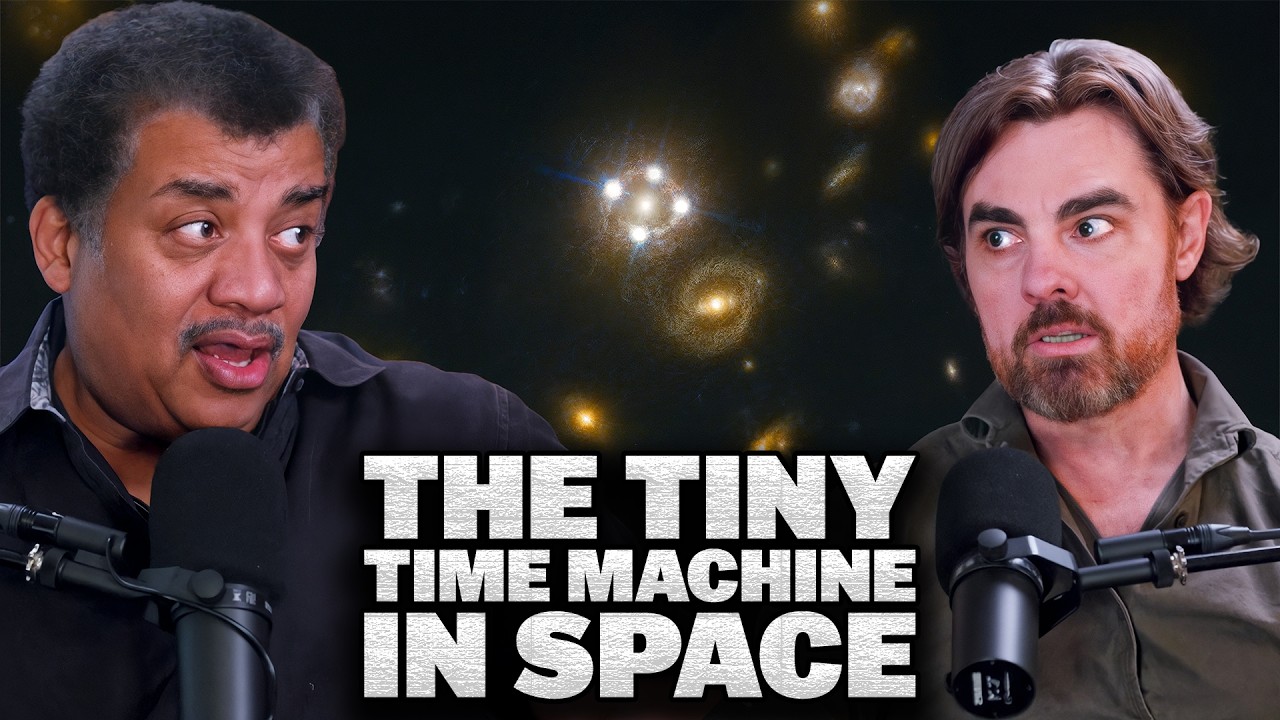
Matt O’Dowd’s Favorite Object in the Universe
Keywords
Summary
194 words
Critical Evaluation
The episode offers a rich and engaging discussion of quasars, blending expert knowledge with accessible explanations. Matt O’Dowd’s expertise is evident as he explains complex concepts like accretion disks, gravitational lensing, and the use of AI in astronomy. The scientific content is accurate and up-to-date, referencing recent developments such as the Vera Rubin Observatory’s first light and the Event Horizon Telescope’s imaging of M87’s black hole. The argumentation is solid, with clear cause-and-effect explanations for quasar luminosity and the mechanisms of gravitational lensing. The sources mentioned, including the Vera Rubin Observatory and the Event Horizon Telescope, are credible and well-established. The title accurately reflects the content, focusing on O’Dowd’s favorite object. The discussion of AI in astronomy is particularly valuable, highlighting both its potential and its pitfalls, such as the risk of algorithmic bias. The episode also touches on the philosophy of science, emphasizing the importance of understanding tools of thought over rote memorization. Overall, the content is scientifically rigorous and presented in an engaging manner, making it a valuable resource for anyone interested in astrophysics. The only minor weakness is the lack of formal citations, but the conversational format compensates with the authority of the speakers.
197 words
Title / Content Match
The title accurately reflects the content, as the episode focuses on Matt O’Dowd’s favorite object (quasars) and includes his personal insights.
Quality & Reliability
8/10
High credibility due to the presence of two expert astrophysicists (Neil deGrasse Tyson and Matt O’Dowd), accurate explanations of quasars, gravitational lensing, and AI applications, and references to established research and observatories. Minor caveats: conversational format and lack of formal citations.
Chapters
Cited Sources
- T-Mobile 5G Home Internet — Advertisement sponsor mentioned in the description.
- Take Me to Your Leader — Book by Neil deGrasse Tyson, referenced in the description.
Concurring Sources
- Event Horizon Telescope — Mentioned in the episode as the collaboration that imaged M87's black hole.
Contribution & Novelties
The episode provides an up-to-date overview of quasar research, including recent findings and the upcoming Vera Rubin Observatory’s impact. It uniquely combines expert insights with a discussion of AI’s role in astronomy, offering a forward-looking perspective. The conversation also highlights the importance of science communication and the value of critical thinking.
Pour aller plus loin :
- Quasar - Wikipedia — Comprehensive overview of quasars, their properties, and history.
- Gravitational lens - Wikipedia — Detailed explanation of gravitational lensing and its applications.
- Vera C. Rubin Observatory — Information about the observatory and its Legacy Survey of Space and Time (LSST).
- Variational autoencoder - Wikipedia — Background on the AI technique mentioned in the episode.
113 words
Radar Profile
The radar profile shows high scores across all dimensions, indicating a well-rounded and reliable content. The strongest aspects are the quantity and quality of information, while the technical level is slightly lower, reflecting the accessible presentation style.
💬 Très positif. Sur les 30 commentaires analysés, les spectateurs expriment une admiration unanime pour Matt O’Dowd et la collaboration entre StarTalk et PBS Space Time, soulignant la qualité de la vulgarisation scientifique et l’enthousiasme suscité.