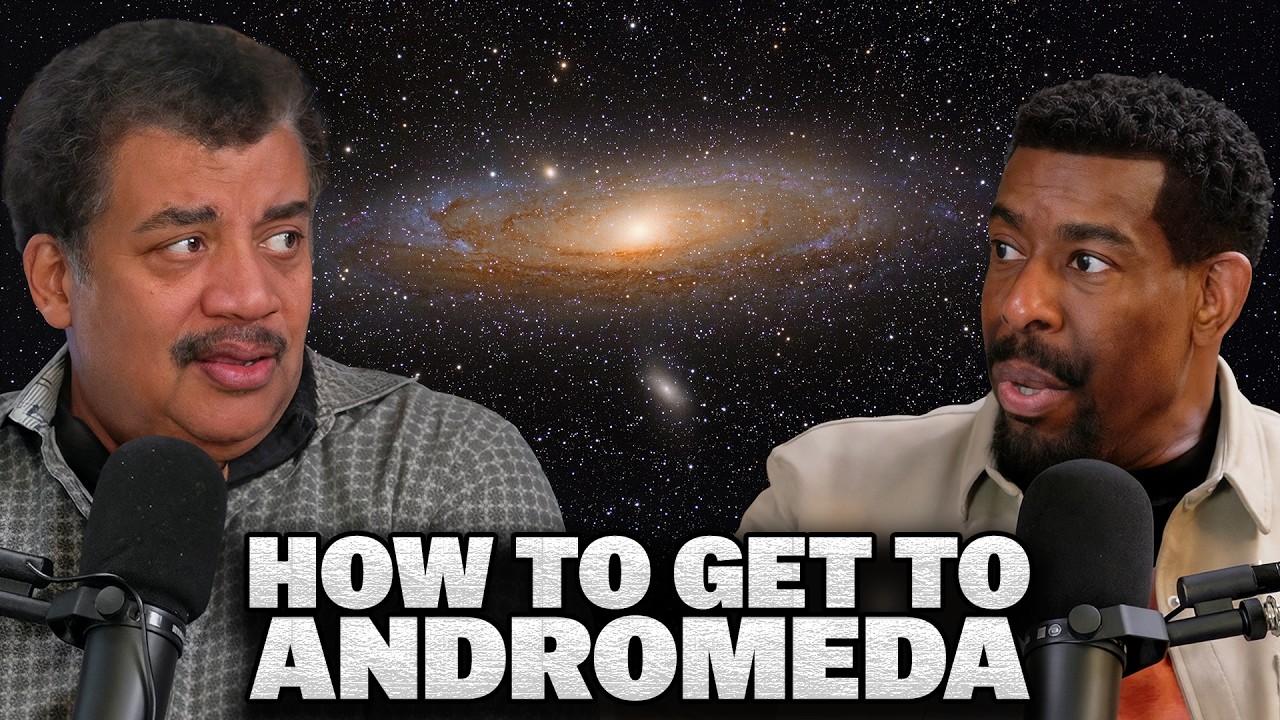
How Do We Get To Andromeda? | Cosmic Queries #111
Keywords
Summary
121 words
Critical Evaluation
The episode provides a scientifically sound yet accessible discussion of various astrophysical topics. Neil deGrasse Tyson demonstrates his expertise by explaining concepts like interferometry and Jupiter’s magnetic field with clarity. The explanations are generally accurate, though some topics, such as wormholes and alien humor, are speculative and presented as such. The show’s strength lies in its ability to make complex ideas understandable to a broad audience without oversimplifying. The use of humor and banter enhances engagement but occasionally distracts from the scientific content. The sources cited are minimal, with only a book promotion link, but the information is consistent with established scientific knowledge. The title’s focus on Andromeda is somewhat misleading as it is only one of many topics, but the content still delivers on the promise of cosmic queries. Overall, the episode is informative and entertaining, with a high level of scientific credibility.
144 words
Title / Content Match
The title highlights the final question about reaching Andromeda, which is one of several topics covered in this grab-bag episode. It accurately reflects the cosmic scope of the content.
Quality & Reliability
8/10
Neil deGrasse Tyson, astrophysicist, provides scientifically accurate explanations on topics like interferometry, Jupiter's rotation, and wormholes. The discussion is grounded in established physics, though some speculative elements (e.g., wormholes, alien humor) are clearly presented as such. The show's format blends education with entertainment, maintaining scientific rigor.
Chapters
Cited Sources
- Take Me to Your Leader — Book by Neil deGrasse Tyson, promoted in the video description.
Concurring Sources
- NASA - Space Interferometry Mission — Mentioned in the episode as a planned mission.
Contribution & Novelties
The episode offers a unique blend of humor and science, making complex topics like interferometry and wormholes accessible. It provides a fresh perspective on common questions, such as the feasibility of space-based telescopes and the potential for extraterrestrial humor. The discussion on Jupiter’s rotation clarifies misconceptions about its influence on Earth. The show’s format encourages curiosity and critical thinking.
Pour aller plus loin :
- Interferometry — Explains the technique of combining telescopes.
- Wormhole — Theoretical concept discussed in the episode.
- Jupiter’s magnetic field — Details on Jupiter’s magnetic field and rotation.
91 words
Radar Profile
The radar profile shows high scores in quantity and quality of information, with a moderate technical level. The reliability is strong, reflecting the expertise of the host. The overall balance indicates a well-rounded educational content.
💬 Très positif. Sur les 30 commentaires analysés, la grande majorité exprime un fort enthousiasme pour l'épisode, louant l'humour, le montage et la chimie entre Neil et Chuck, avec quelques commentaires sur le contenu scientifique.