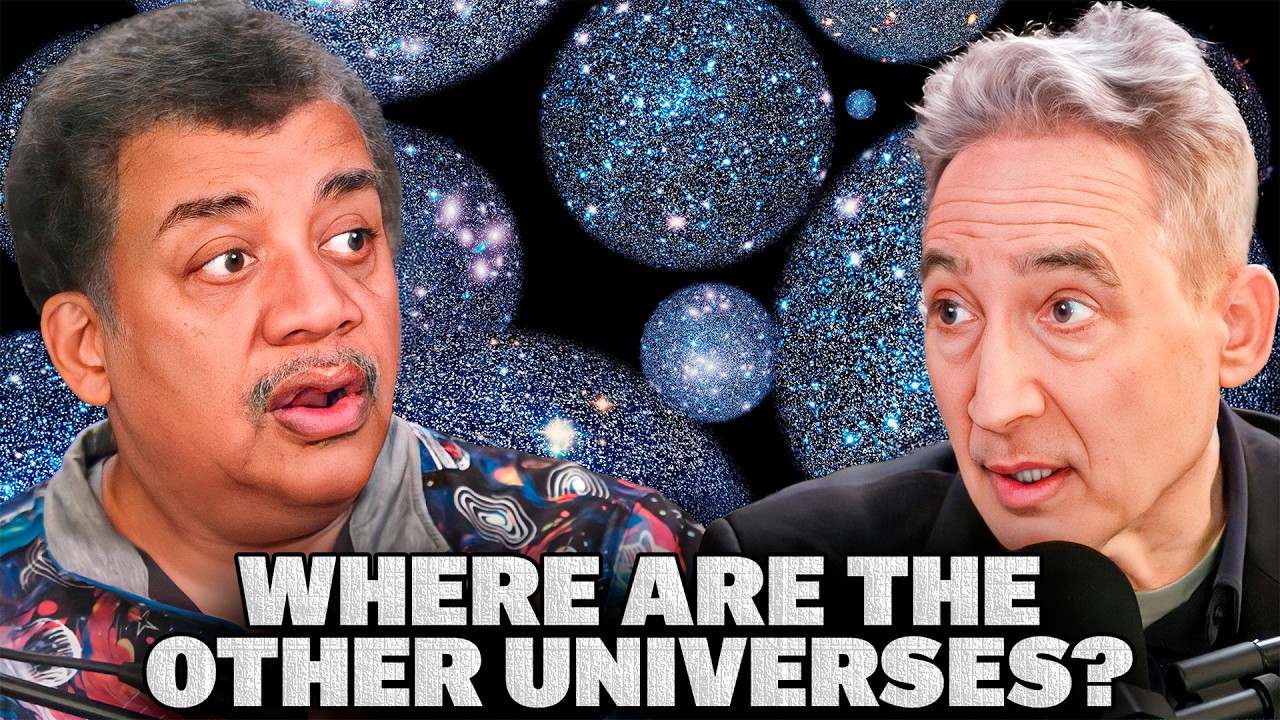
Exploring Hidden Dimensions with Brian Greene
Keywords
Summary
191 words
Critical Evaluation
This episode of StarTalk provides an engaging and intellectually stimulating exploration of advanced topics in theoretical physics, featuring Brian Greene as a guest. The value of the information is high, as Greene is a renowned physicist and science communicator, and he presents complex ideas in an accessible yet accurate manner. The discussion covers a wide range of topics, from the many-worlds interpretation to string theory, and includes both established concepts and speculative ideas, clearly distinguishing between the two. The argumentation is generally solid, with Greene grounding his explanations in mathematical formalism and known physics, while also acknowledging the speculative nature of some topics, such as the multiverse and string theory. The scientific rigor is commendable, as Greene carefully explains the origins of ideas and the reasoning behind them, avoiding oversimplification. The sources cited are not explicitly mentioned in the video, but the discussion references the work of physicists like Hugh Everett and Erwin Schrödinger, and the concepts are well-established in the physics community. The title accurately reflects the content, as the episode indeed explores hidden dimensions and other advanced concepts. The presence of Chuck Nice provides a grounding perspective, making the content more relatable to a general audience. Overall, this is a high-quality episode that offers both entertainment and education, making it a valuable resource for anyone interested in modern physics.
221 words
Title / Content Match
The title accurately reflects the content, which focuses on exploring hidden dimensions and other advanced physics concepts with Brian Greene.
Quality & Reliability
8/10
High-quality discussion with a leading theoretical physicist, Brian Greene, covering complex topics with clarity. The content is based on established physics theories, though some speculative elements are presented as possibilities. The conversation is well-structured and informative, with minimal inaccuracies.
Chapters
- Introduction: Brian Greene
- Origins of Multiverse Theory
- “The Math Tells Us”
- Hilbert Space: The Place Where the Mutliverse Is
- The Many Worlds Theory
- Are There Infinite Worlds?
- Levels of Infinity
- You’re an Improbable Configuration of Molecules
- Where Are the Other Universes?
- Visualizing Gravity in String Theory
- Figuring Out String Theory
- The Dimensions That Come Out of String Theory
- The State of String Theory
- Is the Fabric of Spacetime Wormholes?
- Spacetime’s Favorite Movie
- The Information Paradox
- Are We in a Rotating Universe?
- Quark Catastrophe
- Is Time a Dimension or a Field?
- Is Life Inevitable?
- Time Travel in Einstein Equations & Measuring Dark Matter
- What Does Supersymmetry Fix?
- Experiments to Find Elusive Particles
- Quantum Entanglement in Time Dimension
- Is Time an Emergent Property of Light?
- Is Dark Matter Connected to Expansion?
- Probability Clouds During Ionization
- Will The Graviton Help Us Reconcile Relativity
- Detecting Other Dimensions
- Counterpart Particles
- Why Can’t We Reach Absolute Zero?
Contribution & Novelties
This episode offers a comprehensive and accessible overview of several cutting-edge topics in theoretical physics, particularly the many-worlds interpretation and string theory. Brian Greene’s explanations provide clarity on complex concepts, and the discussion highlights the ongoing debates and open questions in the field. The episode also touches on the role of mathematics in physics, offering a nuanced perspective on whether math is discovered or invented.
Pour aller plus loin :
- Many-worlds interpretation — Provides a detailed overview of the interpretation, its history, and its implications.
- String theory — Explains the basics of string theory, including extra dimensions and its challenges.
- Hilbert space — A mathematical concept central to quantum mechanics, discussed in the episode.
- Hugh Everett III — The physicist who proposed the many-worlds interpretation.
- Black hole information paradox — A key topic in the episode, exploring the fate of information in black holes.
144 words
Radar Profile
The radar profile shows high scores in quantity and quality of information, with a slightly lower score for technical level, indicating that the content is rich and well-presented but may require some background knowledge to fully appreciate. The overall reliability is high, reflecting the credibility of the guest and the accuracy of the discussion.
💬 Très positif. Sur les 30 commentaires analysés, les spectateurs expriment une forte appréciation pour la durée étendue de l'épisode, la présence de Brian Greene, et l'équilibre entre humour et science apporté par Chuck Nice.