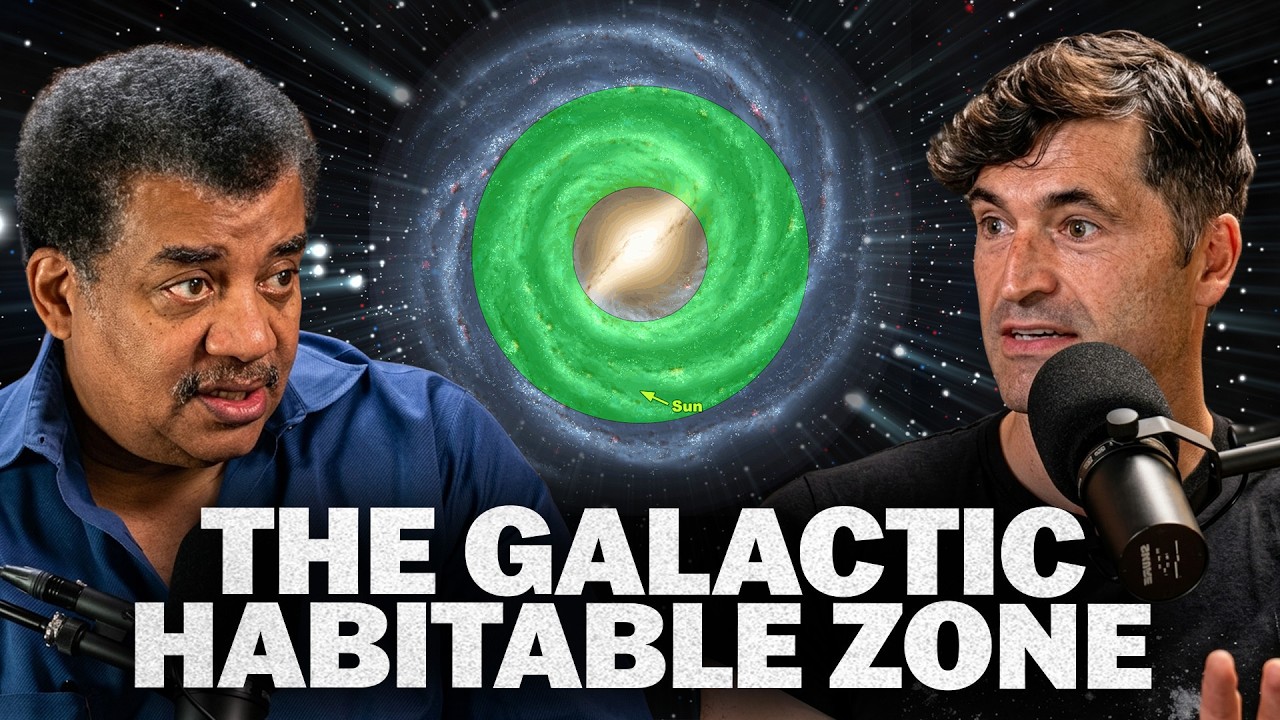
Life May Only Be Able to Exist in this Part of the Galaxy, with David Kipping
Keywords
Summary
130 words
Critical Evaluation
Value of the Information & Strength of the Argument
The video provides substantial educational value by explaining current topics in exoplanet science, such as the K2-18b dimethyl sulfide detection and the challenges of confirming life. David Kipping offers a thoughtful perspective on the epistemic difficulties of biosignature detection, proposing a statistical ‘AB testing’ approach to improve confidence. The discussion on exomoons and brown dwarfs clarifies definitions and highlights the diversity of planetary systems. The argumentation is generally sound, with appropriate scientific skepticism and acknowledgment of uncertainties. However, some speculative topics, like the galactic habitable zone and life on rogue planets, are presented with less rigor and more conjecture, which is typical for a conversational science podcast.
Scientific Rigor, Source Quality, Title Accuracy
The video references specific scientific findings, such as the exomoon candidate around a brown dwarf and the detection of dimethyl sulfide on K2-18b, but does not provide direct citations to peer-reviewed papers. The hosts and guest are credible experts, and the discussion aligns with current scientific consensus, though it simplifies complex topics for a general audience. The title is somewhat clickbait, as the content does not focus on a specific ‘part of the galaxy’ but rather on broader exoplanet habitability. The promotional segments for Bitdefender and T-Mobile are clearly separated and do not affect the scientific content. Overall, the sources are reliable but not formally cited, and the title slightly overstates the video’s focus.
236 words
Title / Content Match
The title is somewhat sensationalist and broader than the content, which focuses on exoplanets, exomoons, and biosignatures rather than a specific galactic habitable zone claim.
Quality & Reliability
8/10
The video features a recognized astrophysicist (David Kipping) and covers established scientific topics with appropriate caveats. However, it is a conversational podcast with speculative elements and no formal peer review, and includes promotional segments.
Key Moments
Markers derived by PSI from the transcript: the creator did not define chapters.
- Introduction of David Kipping and discussion of exomoon discovery around brown dwarf.
- Explanation of brown dwarfs and the definition of planets vs. moons.
- Discussion on biosignatures like dimethyl sulfide and the challenges of confirming life.
- Audience questions about LHS 1140b and the habitable zone.
- Debate on intelligent vs. microbial life and technosignatures.
- Speculation about rogue planets and the galactic habitable zone.
Cited Sources
- T-Mobile 5G Home Internet — Advertisement segment in the video.
- Bitdefender Scam Radar — Advertisement segment in the video.
- Take Me to Your Leader (book) — Mentioned as a promotional item by the host.
Concurring Sources
- NASA Exoplanet Archive — Provides data on exoplanets, including those mentioned in the video.
- IAU Definition of Planet — Official definition of a planet, relevant to the discussion on exomoons.
- K2-18b Studies — NASA article on K2-18b, which is referenced in the video.
Dissenting Sources
- Critique of K2-18b biosignature
- Alternative explanations for phosphine on Venus
Contribution & Novelties
The video offers a unique perspective on the search for life by emphasizing the need for statistical strategies, such as AB testing, to overcome the problem of false positives in biosignature detection. It also clarifies the IAU definitions of planets and moons, using the recent exomoon candidate as a case study. The discussion on the galactic habitable zone and the potential for life on rogue planets provides thought-provoking ideas, though these are speculative. For further exploration, consider these resources:
- Exoplanet Exploration - NASA’s official exoplanet database and news.
- Habitable Zone Calculator - University of Victoria’s tool for calculating habitable zones.
- SETI Institute - Official site for the search for extraterrestrial intelligence.
- David Kipping’s Cool Worlds - His YouTube channel with related content.
122 words
Radar Profile
The video scores high on information quantity and quality, providing a rich discussion of current exoplanet research. The technical level is moderate, suitable for a general audience with some science background. The reliability is high due to the expert guest, but the speculative nature of some topics prevents a perfect score.
💬 Based on the 0 comments provided, there is no data to analyze. The video has a high like-to-view ratio, suggesting positive reception, but no specific comment trends can be identified.