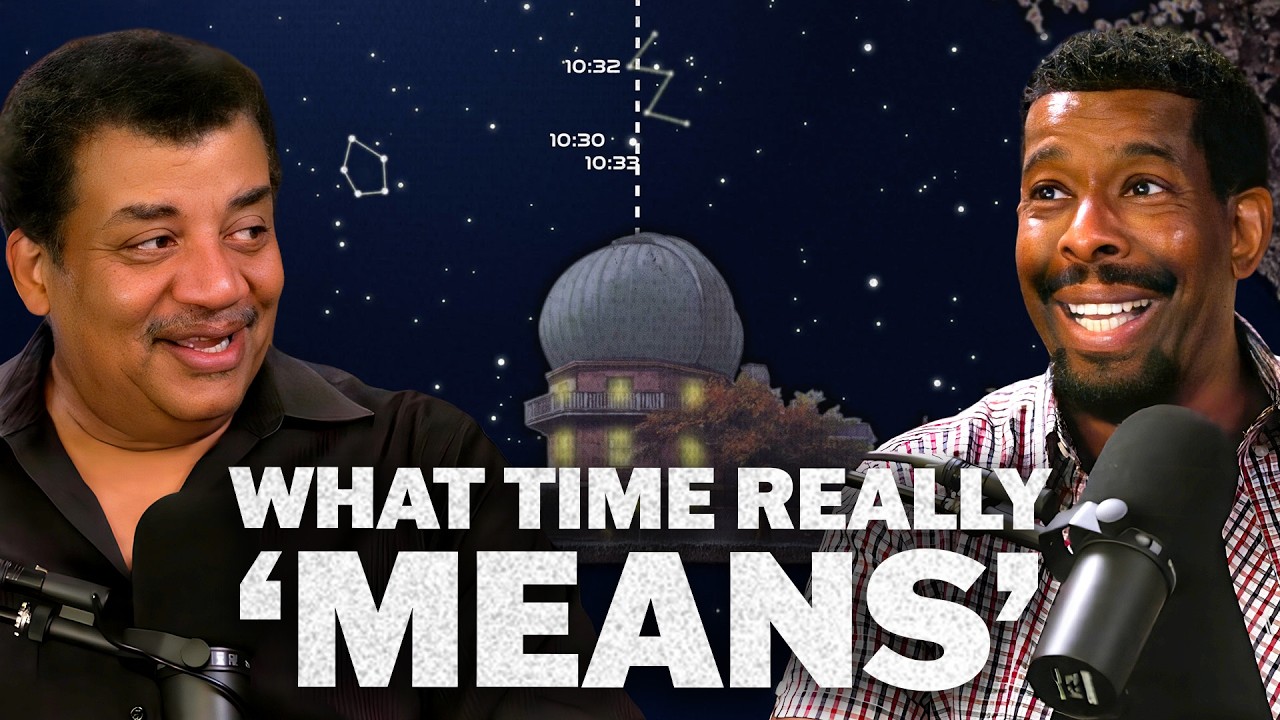
How England Colonized Time
Keywords
Summary
153 words
Critical Evaluation
The video excels in making complex astronomical concepts accessible to a general audience. Neil deGrasse Tyson’s expertise ensures scientific accuracy, while Chuck Nice’s comedic interjections keep the tone light and engaging. The explanation of why we have 24 time zones and the distinction between sidereal and solar time is particularly well done, using relatable analogies. The historical narrative about the British Empire’s influence on time standardization is presented with nuance, acknowledging the contributions of other cultures. The discussion of the equation of time and the need for averaging is accurate, though simplified. The video does not delve into the political controversies surrounding time zones, but that is not its focus. Overall, it is a reliable and entertaining educational piece, though it may oversimplify some details for experts. The ad breaks are clearly separated and do not detract from the content. The title accurately reflects the content, and the video delivers on its promise.
153 words
Title / Content Match
The title accurately reflects the content, focusing on how England established GMT and the global time system.
Quality & Reliability
8/10
The video provides accurate scientific explanations of time zones, GMT, and Earth's rotation, with clear references to historical context. The content is well-structured and presented by an astrophysicist, ensuring high reliability. Minor simplifications for a general audience do not detract from the overall accuracy.
Chapters
Cited Sources
- StarTalk Patreon — Support the channel
- StarTalk on Twitter — Follow StarTalk on Twitter
- StarTalk on Facebook — Follow StarTalk on Facebook
- StarTalk on Instagram — Follow StarTalk on Instagram
- To Infinity and Beyond: A Journey of Cosmic Discovery — Book by Neil deGrasse Tyson
Concurring Sources
- Greenwich Mean Time - Wikipedia — Provides detailed information on GMT, its history, and its definition.
- Equation of time - Wikipedia — Explains the difference between apparent and mean solar time, relevant to the video's discussion.
Contribution & Novelties
The video provides a clear and engaging explanation of the history and science behind time zones and GMT, making it accessible to a broad audience. It effectively connects astronomical concepts like sidereal time and the equation of time to everyday timekeeping.
Pour aller plus loin :
- Greenwich Mean Time — Detailed history and definition of GMT.
- Equation of time — Explanation of the discrepancy between apparent and mean solar time.
- Prime Meridian — The history and significance of the Prime Meridian at Greenwich.
83 words
Radar Profile
The radar profile shows high scores in information quality and reliability, with slightly lower scores in technical depth and quantity, reflecting the video's focus on clear communication over exhaustive detail.
💬 Très positif : les commentaires expriment une forte appréciation pour l'explication claire et l'humour, avec de nombreux éloges pour la pédagogie de Neil deGrasse Tyson. Sur les 30 commentaires analysés, la majorité sont positifs, certains partageant des anecdotes personnelles et des remerciements.