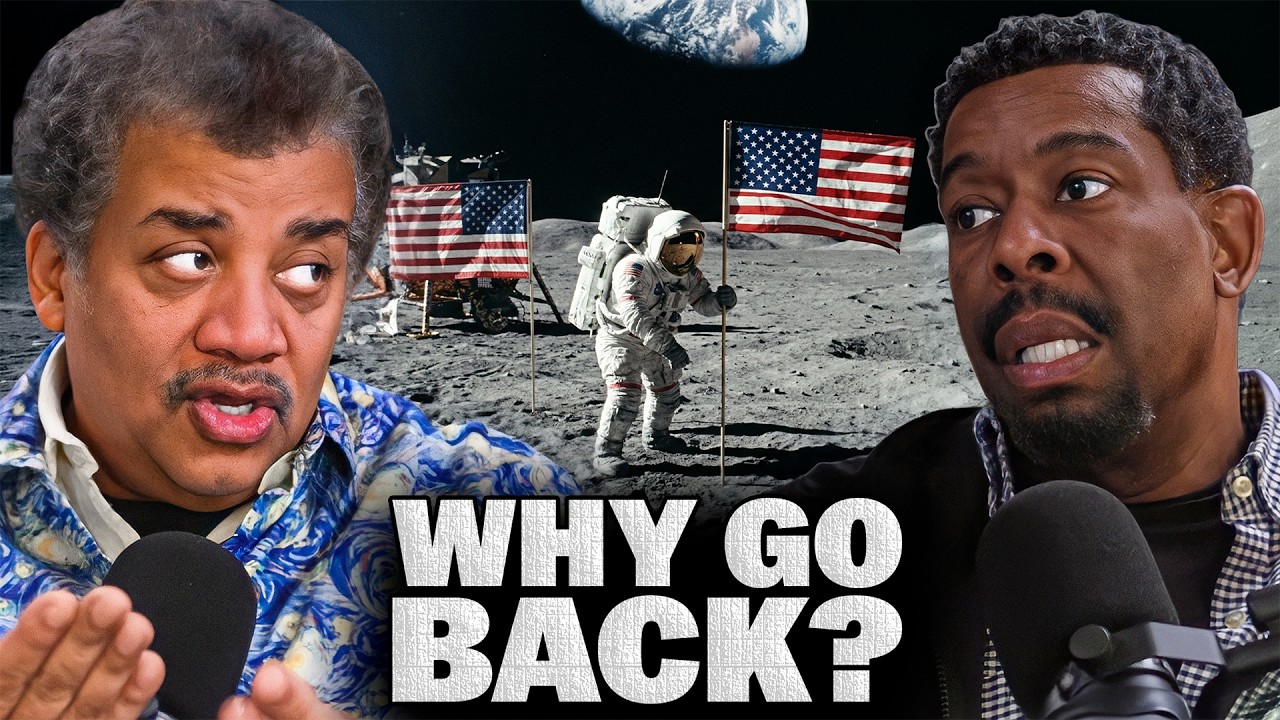
The Missions Bringing Us Back to the Moon
Keywords
Summary
201 words
Critical Evaluation
The video offers a compelling and accessible overview of the Artemis missions, blending historical context with current technological details. Tyson’s expertise shines in explaining complex concepts like multistage rockets and the cold traps at the lunar poles, making them understandable to a general audience. The discussion is well-structured, moving from the past (Apollo) to the present (Artemis) and future (lunar South Pole). However, the content is heavily opinionated, particularly regarding the geopolitical motivations behind space exploration. While Tyson’s claims about the Cold War driving Apollo are widely accepted, his assertion that China’s lunar program is the primary catalyst for Artemis is presented as fact without substantial evidence. The historical accuracy is generally solid, but some simplifications, such as attributing multistage rocketry solely to von Braun, are challenged by commenters who point out earlier contributions by Robert Goddard. The video also touches on the Artemis Accords, but only superficially, without delving into the legal and ethical implications of lunar resource extraction. The production quality is high, with engaging banter between Tyson and Nice, but the scientific depth is moderate, suitable for a general audience rather than specialists. The title accurately reflects the content, and the episode successfully conveys the excitement and significance of returning to the Moon. Overall, it is an informative and entertaining discussion, though viewers should seek additional sources for a more nuanced understanding of the political and technical aspects.
231 words
Title / Content Match
The title accurately reflects the content, which focuses on the reasons and details of returning to the Moon.
Quality & Reliability
7/10
The video provides a historically grounded and scientifically accurate overview of the Artemis missions, with clear explanations of rocket staging and lunar water ice. However, it is primarily an opinion-driven discussion with a political focus, and some historical details (e.g., von Braun's role) are simplified or contested by commenters.
Chapters
Cited Sources
- StarTalk Patreon — Support the channel
- StarTalk Twitter — Follow StarTalk on Twitter
- StarTalk Facebook — Follow StarTalk on Facebook
- StarTalk Instagram — Follow StarTalk on Instagram
- To Infinity and Beyond: A Journey of Cosmic Discovery — Book by Neil deGrasse Tyson
Concurring Sources
- NASA Artemis — Official NASA page for Artemis missions
Dissenting Sources
- Robert Goddard and multistage rockets — Some commenters point out that multistage rocketry was not von Braun's original idea, but was proposed by Robert Goddard earlier.
Contribution & Novelties
The video provides a clear and engaging explanation of the Artemis missions, emphasizing the geopolitical motivations behind space exploration. It offers a unique perspective by connecting historical Apollo missions to current lunar ambitions, highlighting the role of competition with China. The discussion of lunar water ice and its potential for fuel is particularly insightful.
Pour aller plus loin :
- Artemis program - Wikipedia — Official overview of the Artemis missions.
- Outer Space Treaty - Wikipedia — Basis for the Artemis Accords.
- Lunar water - Wikipedia — Scientific background on lunar ice.
91 words
Radar Profile
The radar profile shows high scores in information quality and reliability, reflecting the expertise of the host and the accurate scientific content. The lower score in technical level indicates that the video is accessible to a general audience, while the quantity of information is moderate, focusing on key points rather than exhaustive detail.
💬 Très positif : Les commentaires sont extrêmement favorables, avec des éloges pour l'humour et la clarté des explications, et une anticipation enthousiaste pour les missions Artemis. Sur les 30 commentaires analysés, la grande majorité exprime un soutien massif et une excitation pour le retour sur la Lune.