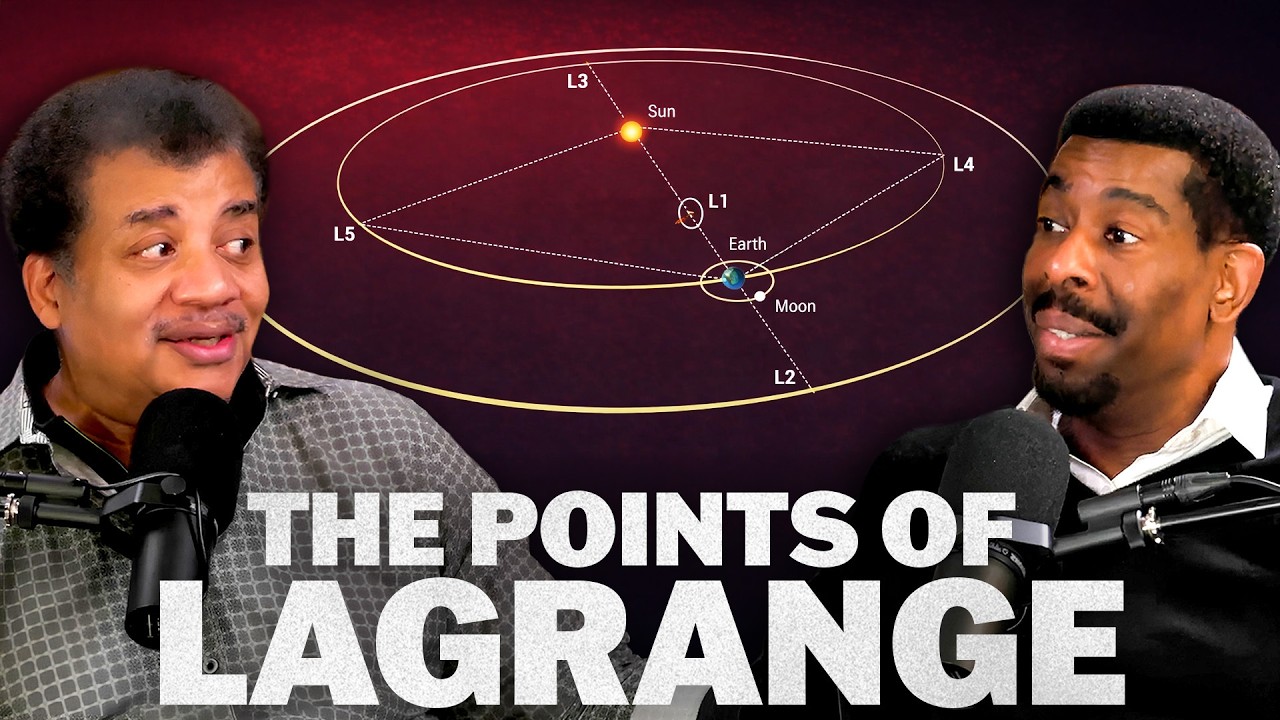
What are the Points of Lagrange?
Keywords
Summary
164 words
Critical Evaluation
The video provides a clear and engaging explanation of Lagrange points, a topic that is often misunderstood. Neil deGrasse Tyson’s expertise ensures scientific accuracy, while Chuck Nice’s comedic interjections make the content accessible without diluting the core physics. The use of visual aids, such as diagrams and animations, effectively illustrates the concepts of equilibrium and force balance. The explanation of stable versus unstable equilibrium using the marble analogy is particularly effective, as it grounds abstract physics in intuitive imagery. The video also corrects a common misconception about astronauts leaving Earth’s gravitational pull, demonstrating a commitment to precision. The historical context, including the L5 Society and the naming of Trojan asteroids, adds depth and interest. The discussion of real-world applications, such as the James Webb Space Telescope at L2 and the potential for space construction, highlights the practical relevance of Lagrange points. The segment on low-energy trajectories and the work of Ed Belbruno introduces viewers to advanced concepts in astrodynamics, encouraging further exploration. The production quality is high, with clear audio and engaging visuals. The pacing is well-suited for a general audience, and the dialogue between Tyson and Nice maintains a lively tone. The video successfully balances entertainment and education, making complex physics accessible without oversimplifying. The only minor critique is that the explanation of L4 and L5 could benefit from a more detailed mathematical treatment, but this is appropriate for the intended audience. Overall, this is an excellent educational resource that effectively communicates the significance of Lagrange points in space exploration.
251 words
Title / Content Match
The title accurately reflects the content, which focuses on explaining Lagrange points, their discovery, and applications.
Quality & Reliability
8/10
The explanation is scientifically accurate, based on established physics (Newtonian gravity, centrifugal force, Lagrange points). Neil deGrasse Tyson is a renowned astrophysicist, and the content aligns with textbook knowledge. The video includes historical context and real applications (JWST, Trojan asteroids). Minor simplifications for a general audience do not compromise accuracy.
Chapters
Cited Sources
- StarTalk Patreon — Support the channel
- StarTalk book 'To Infinity and Beyond' — Book by Neil deGrasse Tyson
Concurring Sources
- Lagrange point - Wikipedia — Confirms the existence and properties of the five Lagrange points.
- James Webb Space Telescope - NASA — Confirms JWST's location at L2.
Dissenting Sources
- No discordant sources found — The content aligns with established scientific knowledge.
Contribution & Novelties
The video offers a clear and engaging explanation of Lagrange points, making complex physics accessible to a general audience. It stands out for its use of intuitive analogies and visual aids, and for connecting the concept to real-world applications like the James Webb Space Telescope and Trojan asteroids. The discussion of low-energy trajectories introduces viewers to cutting-edge astrodynamics.
Pour aller plus loin :
- Lagrange point - Wikipedia — Comprehensive overview of the five points and their mathematical derivation.
- James Webb Space Telescope - NASA — Details on the telescope’s orbit around L2.
- Trojan asteroid - Wikipedia — Information on asteroids at Jupiter’s L4 and L5 points.
- Ed Belbruno - Princeton University — Research on low-energy trajectories and ‘Fly Me to the Moon’.
122 words
Radar Profile
The radar profile shows high scores in quality of information and global reliability, reflecting the scientific accuracy and expertise of the presenter. The quantity of information and technical level are also strong, indicating a substantive yet accessible explanation. The overall profile suggests a well-rounded educational video.
💬 Très positif. Sur les 30 commentaires analysés, les spectateurs expriment une grande appréciation pour la clarté de l'explication et la pédagogie de Neil deGrasse Tyson, avec de nombreux commentaires soulignant que le concept est enfin compris.