Keywords
Summary
149 words
Critical Evaluation
The episode provides a solid overview of several complex physics topics, presented in an accessible and engaging manner. Neil deGrasse Tyson’s explanations of time dilation, gravitational effects, and the cosmic web are accurate and well-illustrated with relatable analogies. The discussion on simulation theory is philosophical but grounded in scientific reasoning, with Neil advocating for embracing objective truths. The show’s strength lies in its ability to make advanced concepts understandable without oversimplifying them to the point of inaccuracy. However, the rapid-fire format means some topics are only briefly touched upon, and the depth of explanation varies. For instance, the segment on memories being made of atoms is somewhat superficial, and the discussion on black hole information reconstruction could have benefited from more detail. The inclusion of humor and Paul Mecurio’s comedic interjections adds entertainment value but occasionally distracts from the scientific content. The sources cited are not explicitly mentioned within the episode, but the topics align with established scientific literature. Overall, the episode is a valuable educational resource for a general audience, though viewers seeking in-depth analysis may need to consult additional sources. The title accurately reflects the central question, and the content delivers on that promise while also covering a range of other intriguing cosmic queries.
206 words
Title / Content Match
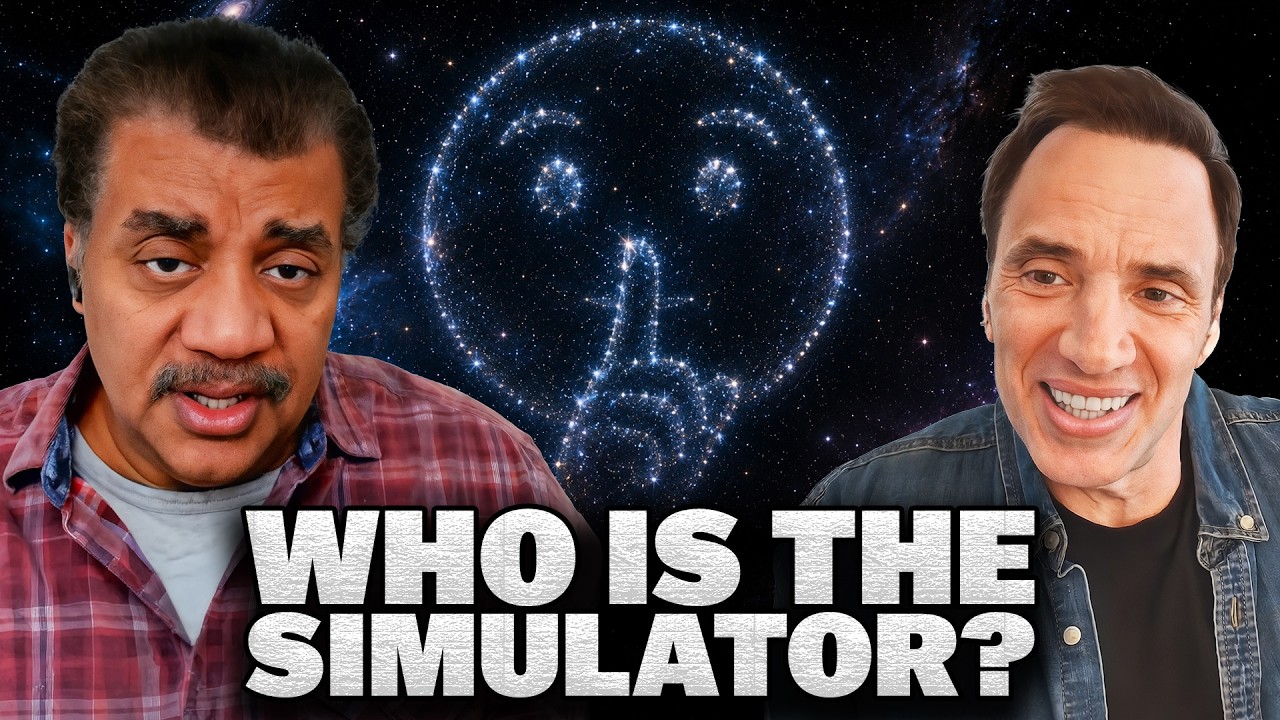
The title accurately reflects the central question of the episode, which is discussed extensively, though the episode covers many other topics as well.
Quality & Reliability
8/10
Neil deGrasse Tyson is a renowned astrophysicist with strong credentials. The episode covers established physics concepts (time dilation, gravity, black holes) accurately, though simplified for a general audience. The discussion includes speculative topics like simulation theory, clearly framed as philosophical. No major errors detected, but some topics are treated superficially.
Chapters
Cited Sources
- T-Mobile 5G Home Internet — Sponsor advertisement
- Star Trek: Strange New Worlds Season 4 — Promotional mention
Concurring Sources
- Interstellar (film) — The film's depiction of time dilation near a black hole is discussed.
Contribution & Novelties
The episode offers a unique blend of humor and science, making complex topics like time dilation and simulation theory accessible to a broad audience. It encourages viewers to think critically about the nature of reality and the limits of scientific knowledge.
Pour aller plus loin :
- Simulation hypothesis — A philosophical theory that reality could be a computer simulation.
- Time dilation — A consequence of Einstein’s relativity, relevant to the Interstellar discussion.
- Cosmic web — The large-scale structure of the universe, discussed in the final segment.
- Black hole information paradox — A key topic in theoretical physics, related to the reconstruction of information.
103 words
Radar Profile
The radar profile shows high scores in information quantity and quality, with a moderate technical level. This indicates a content-rich episode that is accessible to a general audience while maintaining scientific accuracy.
💬 Très positif. Sur les 30 commentaires analysés, la grande majorité exprime de l'appréciation et de l'enthousiasme pour l'épisode, avec des discussions engageantes sur la simulation et la physique. Quelques commentaires critiques notent une superficialité sur certains sujets, mais le ton général est très favorable.