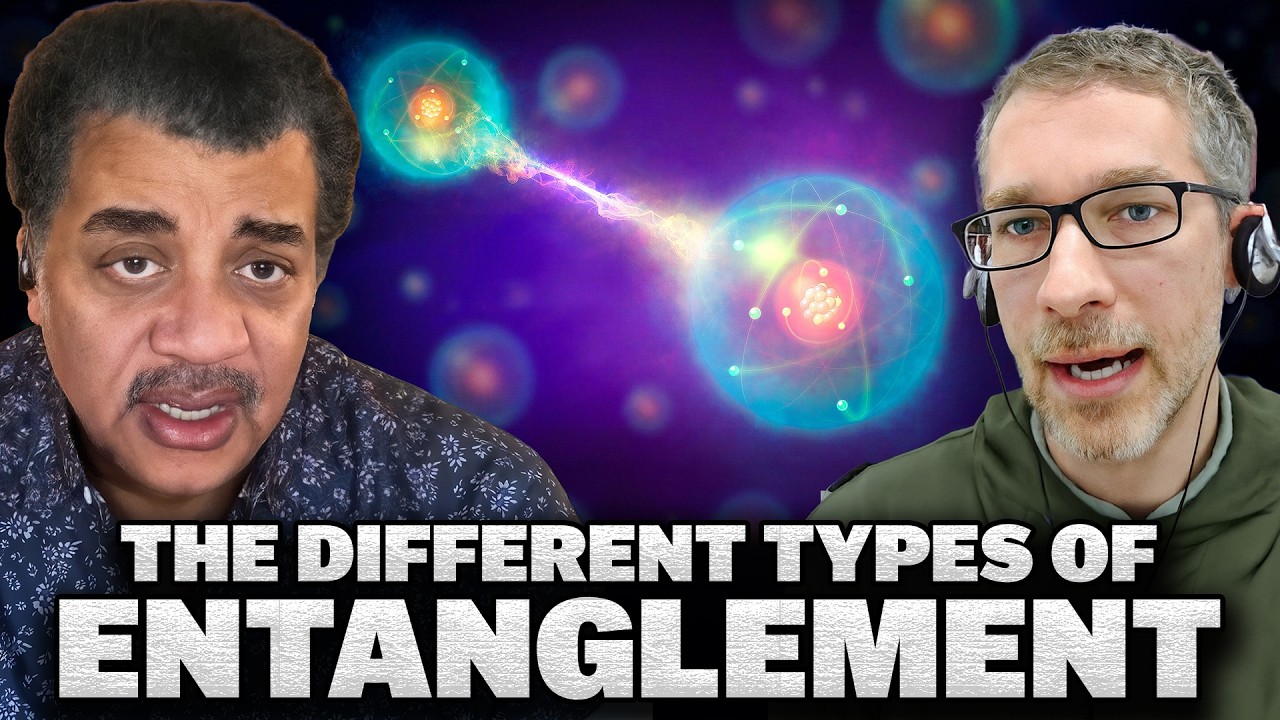
Is Entanglement the Key to a Theory of Quantum Gravity? with Sean Hodgman
Keywords
Summary
160 words
Critical Evaluation
The video provides a valuable and accessible introduction to quantum entanglement, particularly from an experimental perspective. Sean Hodgman’s expertise is evident as he explains complex concepts with clarity, using analogies like coins to illustrate superposition. The discussion is grounded in real experimental work, which adds credibility. However, the show’s format, with comedic interludes and a broad audience in mind, sometimes oversimplifies the material, potentially glossing over nuances. For instance, the explanation of Bell’s theorem is brief and may not fully convey its significance. The sources cited in the description are promotional links, not scientific references, which is a limitation for viewers seeking further reading. Nevertheless, the content is scientifically accurate and aligns with established quantum mechanics. The title’s promise of exploring entanglement as a key to quantum gravity is only partially fulfilled; the discussion touches on this idea but does not delve deeply into theoretical frameworks. Overall, the video is informative and engaging, but viewers seeking a rigorous treatment may need to consult additional resources. The ad breaks are clearly separated and do not detract from the content. The public comments reflect a positive reception, with many viewers appreciating the clarity of explanations and the experimental focus.
197 words
Title / Content Match
The title accurately reflects the content, which explores whether entanglement could be key to quantum gravity, though the discussion is more focused on experimental aspects of entanglement.
Quality & Reliability
8/10
The video features an experimental physicist (Sean Hodgman) discussing his research on entanglement with atoms, providing credible firsthand insights. The content is well-structured with clear explanations, but it is a popular science show, so some simplifications are made. The sources cited are limited to promotional links, but the scientific content is consistent with established quantum mechanics.
Chapters
- Introduction: Sean Hodgeman
- Creating A Bose-Einstein Condensate
- How to Entangle Atoms
- How Long Do They Stay Entangled?
- Understanding Superpositions
- Bell Inequality Theorem & Interference Patterns
- How Do You Know It’s Entangled
- Subtypes of Entanglement
- Entanglement & Reality
- Is There a Size Limit to Entanglement?
- Subspace Communication
- Is The Universe Woven Out of Entangled Particles?
- Quantum Fluctuations Effect on Entanglement
- If Particle Entanglement Stopped
- Why Does Distance Matter For Spooky Action at a Distance?
- Not Messing it Up
- Math vs. Experiments vs. Philosophy
- How Does a Particle with Mass Function as a Wave Cloud
- Leading the entanglement
Cited Sources
- T-Mobile Home Internet — Sponsor link in the description.
- Star Trek: Strange New Worlds Season 4 — Promotional link for the show.
Concurring Sources
- Quantum Entanglement — General reference for the concept discussed.
Contribution & Novelties
The video offers a unique perspective by featuring an experimental physicist who works with atoms rather than photons, highlighting recent advancements in entangling massive particles. This provides insight into the practical challenges and potential future applications, such as probing quantum gravity. The discussion also clarifies common misconceptions about entanglement and its limits.
Pour aller plus loin :
- Bose-Einstein condensate — Relevant background on the state of matter used in the experiments.
- Bell’s theorem — Key theoretical foundation for understanding entanglement tests.
- Quantum gravity — Overview of the theoretical framework that entanglement might help explore.
94 words
Radar Profile
The radar profile shows high scores in information quantity and quality, with a slightly lower technical level, reflecting the show's balance between depth and accessibility. The reliability score is strong, indicating trustworthy content.
💬 Très positif. Sur les 30 commentaires analysés, les spectateurs expriment une grande appréciation pour la clarté des explications et l'approche expérimentale, avec des remarques enthousiastes sur la compréhension enfin acquise de concepts comme la superposition.