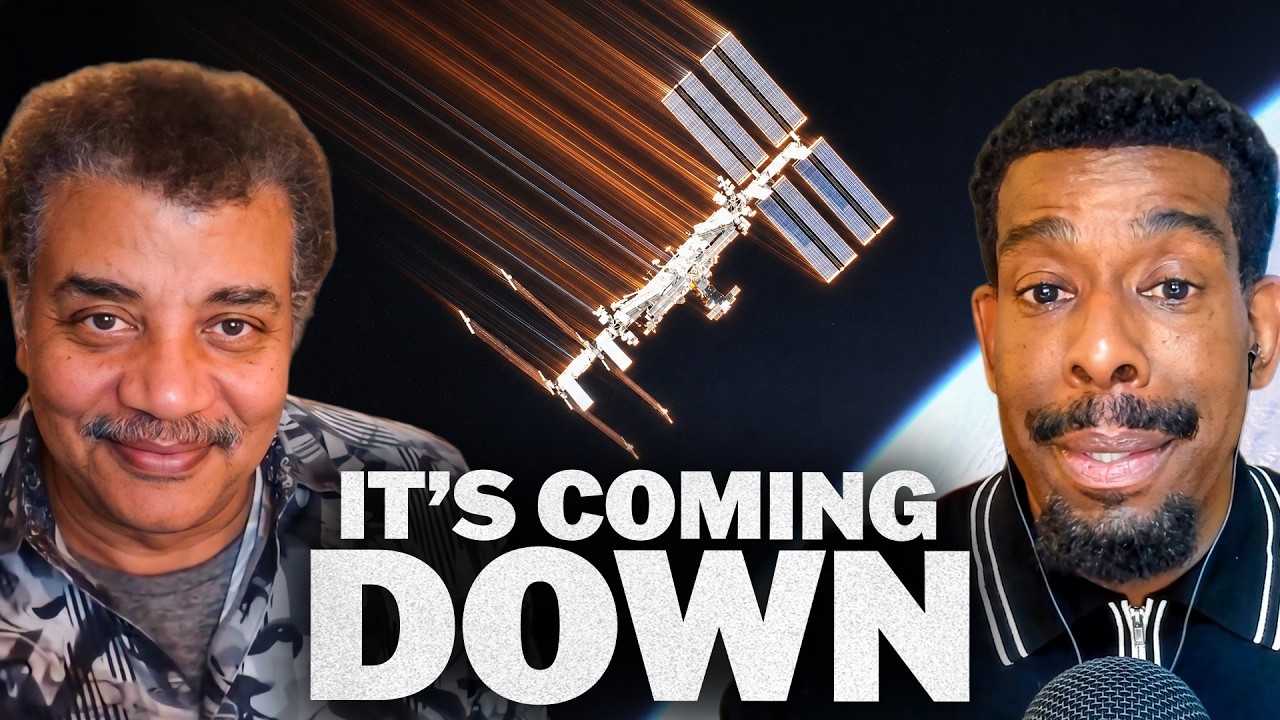
Where’s the Best Place to Watch The ISS Deorbit? | Cosmic Queries #114
Keywords
Summary
201 words
Critical Evaluation
This episode of StarTalk’s Cosmic Queries offers a broad and engaging overview of several astrophysical topics, presented by Neil deGrasse Tyson, a well-known astrophysicist, and Chuck Nice, who provides comedic relief. The scientific content is generally accurate and well-explained, with Tyson drawing on his expertise to clarify complex concepts such as the Kuiper Belt, the definition of a planet, and galaxy classification. The discussion on Planet 9 is appropriately cautious, acknowledging the speculative nature of the evidence and the ongoing scientific debate. The explanation of Pluto’s demotion is thorough and historically contextualized, effectively addressing common misconceptions. The segment on semiconductor physics correctly distinguishes between relativity and quantum mechanics, though it may leave some viewers wanting a deeper connection. The exploration of galaxy shapes is informative, though it could benefit from more visual aids. The discussion on dark matter is speculative but clearly labeled as such, and Tyson does well to distinguish between established science and theoretical possibilities. The personal anecdote about the meteorite near-miss adds a human touch and illustrates the unpredictability of such events. The episode’s strength lies in its ability to make complex topics accessible and entertaining, though it sometimes sacrifices depth for breadth. The title, focusing on the ISS deorbit, is somewhat misleading as that topic is only briefly covered, but this is a minor issue given the grab-bag format. Overall, the content is reliable and well-presented, though viewers seeking in-depth analysis on any single topic may need to look elsewhere. The inclusion of a sponsor segment is noted but does not detract from the scientific value.
260 words
Title / Content Match
The title is somewhat misleading as it focuses on the ISS deorbit, but the episode is a grab bag covering many topics; the ISS question is only briefly addressed.
Quality & Reliability
8/10
The content is presented by a renowned astrophysicist and is based on established scientific knowledge, with clear explanations of complex topics. The information is generally accurate and well-contextualized, though some speculative topics (e.g., Planet 9, dark matter) are discussed with appropriate uncertainty.
Chapters
- Introduction: Grab Bag
- Finding Planet 9
- Hitting the Planet Requirements
- Semiconductor Physics
- What Dictates a Galaxy’s Shape?
- A Question From an Astrophysics Autodidact
- Could Dark Matter Be Stuff Hidden in the Folds of Spacetime?
- Watching the ISS Get Deorbitted
- Getting Hit By a Meteorite
- Does Dark Matter Get Sucked Into Black Holes?
Contribution & Novelties
The episode provides a comprehensive and accessible overview of several current topics in astrophysics, including the search for Planet 9, the reclassification of Pluto, and the nature of dark matter. It offers clear explanations of complex concepts, making them understandable to a general audience. The discussion on galaxy shapes and the criteria for planethood is particularly well-structured. The episode also touches on the upcoming deorbit of the ISS, a timely topic.
Pour aller plus loin :
- Kuiper belt — The region of the solar system beyond Neptune, home to Pluto and other icy bodies.
- Planet Nine — Hypothetical planet in the outer solar system, inferred from gravitational anomalies.
- IAU definition of planet — The three criteria established by the International Astronomical Union in 2006.
- Galaxy morphological classification — The Hubble sequence and other classification schemes for galaxies.
- Dark matter — The mysterious substance that makes up most of the universe’s mass.
151 words
Radar Profile
The radar profile shows high scores in information quantity, quality, and reliability, with a slightly lower technical level, indicating content that is rich in accurate information but accessible to a broad audience.
💬 Positif. Sur les 30 commentaires analysés, le climat est très positif, avec des éloges pour Neil et Chuck, de l'enthousiasme pour le contenu, et des discussions engageantes sur les sujets abordés, notamment Pluto et Planet 9.