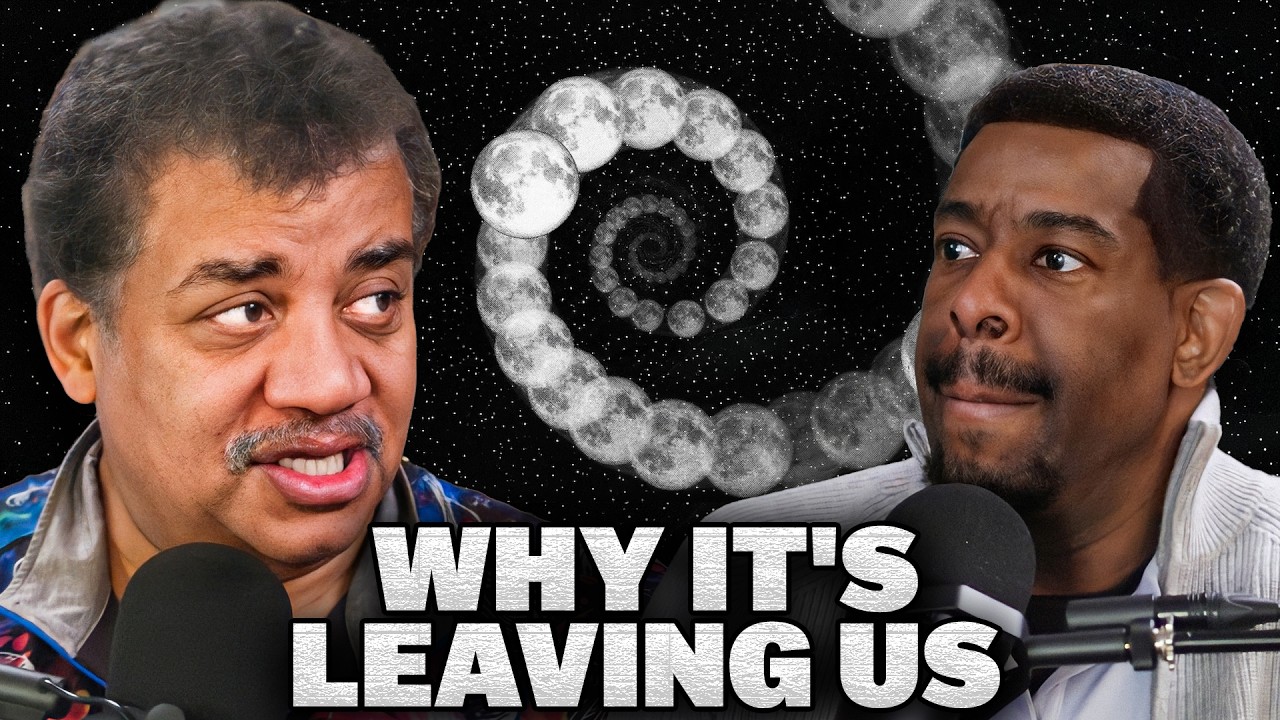
Why the Moon is Spiraling Away From Us
Keywords
Summary
183 words
Critical Evaluation
The video provides a clear and engaging explanation of the Moon’s recession, a phenomenon rooted in gravitational physics. The scientific content is accurate and well-presented, with Tyson effectively breaking down complex concepts like tidal forces and angular momentum into accessible terms. The use of analogies, such as the beach chair example, helps illustrate the tidal bulge and its effects. The argumentation is logically structured, moving from the Moon’s formation to the current recession rate and future implications. The sources cited are not explicitly mentioned in the video, but the information aligns with established scientific knowledge, and the mention of lunar laser ranging and leap seconds adds credibility. The video’s strength lies in its ability to educate while entertaining, though it simplifies some aspects, such as the exact mechanisms of tidal friction. The title accurately reflects the content, and the video does not overpromise. Overall, the scientific rigor is high, and the video serves as an excellent educational resource for a general audience, though it may lack depth for experts. The presence of a brief sponsored segment (likely the book promotion) does not detract from the content’s quality.
187 words
Title / Content Match
The title accurately reflects the content, which explains the Moon's recession and its causes.
Quality & Reliability
8/10
The video presents established scientific concepts (tidal forces, tidal locking, angular momentum) with accuracy, and includes references to measurable phenomena (lunar laser ranging, leap seconds). The information is consistent with current scientific understanding, though presented in a simplified, entertaining manner.
Chapters
Cited Sources
- StarTalk Patreon — Support page for the show, mentioned in the description.
- StarTalk book 'To Infinity and Beyond' — Book promotion mentioned in the description.
Concurring Sources
- NASA - Tidal Locking — NASA's explanation of tidal locking, consistent with the video's content.
Contribution & Novelties
The video offers a comprehensive and accessible explanation of the Moon’s recession, connecting tidal forces, angular momentum, and the future of solar eclipses. It effectively uses humor and analogies to make complex physics understandable. The discussion of the Bay of Fundy as a significant contributor to tidal friction is a notable detail.
Pour aller plus loin :
- Tidal acceleration — Provides a detailed scientific explanation of the phenomenon.
- Lunar Laser Ranging experiment — Explains the technique used to measure the Moon’s distance precisely.
- Leap second — Discusses the practice of adding seconds to UTC to account for Earth’s slowing rotation.
100 words
Radar Profile
The radar profile shows high scores in information quantity, quality, and reliability, with a slightly lower technical level, indicating content that is scientifically sound but accessible to a broad audience.
💬 Très positif. Sur les 30 commentaires analysés, le public exprime un fort enthousiasme pour la dynamique entre Neil et Chuck, apprécie la clarté des explications et la qualité du montage, et souligne la valeur éducative de la vidéo.