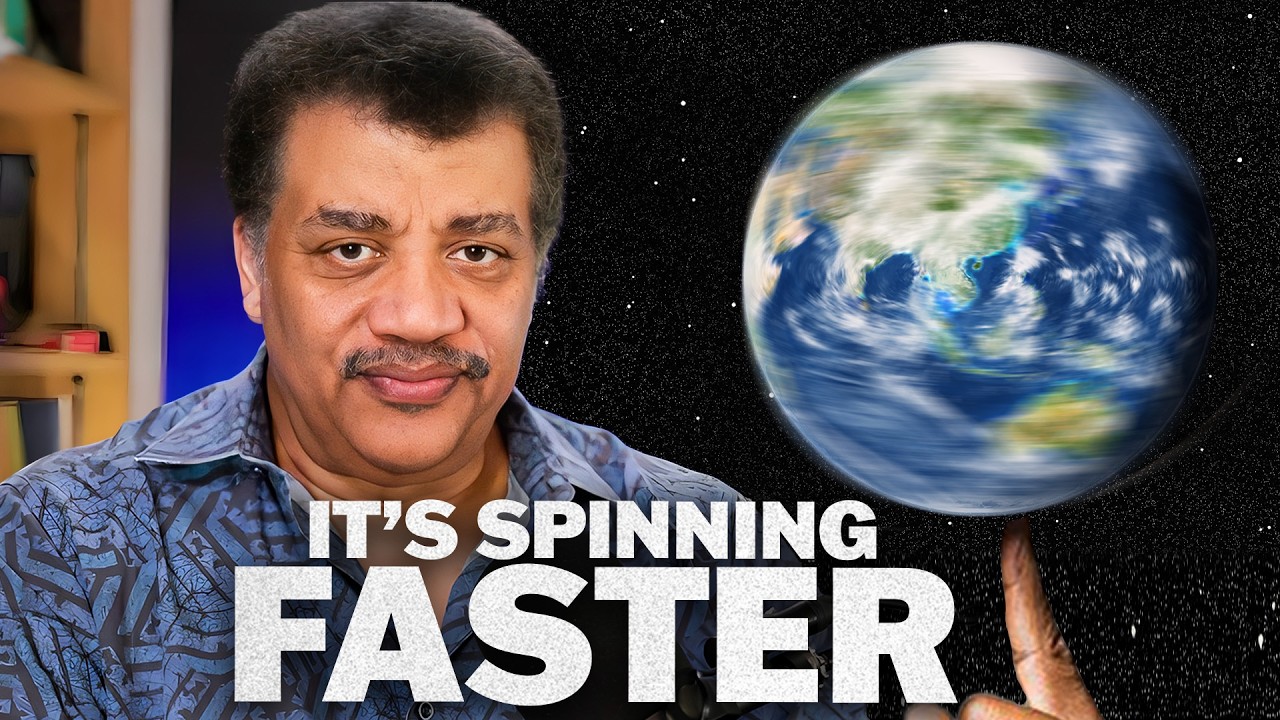
Why Earth’s Rotation Speed is Changing
Keywords
Summary
154 words
Critical Evaluation
The video provides a clear and scientifically accurate explanation of the factors affecting Earth’s rotation. Neil deGrasse Tyson, a respected astrophysicist, presents the information in an engaging and accessible manner without oversimplifying the underlying physics. He correctly explains the role of tidal friction in slowing Earth’s rotation and the moon’s recession, citing the Apollo 11 corner reflectors as evidence. The conservation of angular momentum is used appropriately to explain how mass redistribution affects rotation speed. The discussion of leap seconds is accurate, and he correctly notes that the exact cause of a particular day’s variation may be unknown, but this does not make it mysterious. The video effectively debunks clickbait headlines by distinguishing between not knowing and mystery. The inclusion of a sponsored segment for Ground News is clearly disclosed and does not detract from the scientific content. The video’s strength lies in its ability to communicate complex concepts to a general audience while maintaining scientific rigor. The only minor weakness is that it does not delve deeply into the technical details of how leap seconds are implemented, but this is appropriate for the target audience. Overall, the video is an excellent example of science communication.
196 words
Title / Content Match
The title accurately reflects the content, which explains the various factors influencing Earth's rotation speed and addresses common misconceptions.
Quality & Reliability
9/10
The video is presented by a renowned astrophysicist with high credibility. It explains scientific concepts accurately, references established mechanisms (tidal friction, conservation of angular momentum), and cites specific data (leap seconds, lunar recession). The content aligns with current scientific consensus, and the presentation is clear and rigorous.
Chapters
Cited Sources
- Ground News — Mentioned as a sponsor for staying informed on science news, with a discount link.
Concurring Sources
- NASA Earth Observatory — General source for Earth science data, consistent with the video's content on Earth's rotation.
Contribution & Novelties
The video provides a clear and engaging explanation of the various factors influencing Earth’s rotation, synthesizing well-known scientific principles into an accessible format. It effectively counters sensationalist media narratives by emphasizing the scientific understanding behind these changes.
Pour aller plus loin :
- Leap second — Provides detailed information on the history and implementation of leap seconds.
- Tidal acceleration — Explains the gravitational interaction between Earth and the Moon that affects rotation.
- Conservation of angular momentum — Fundamental physics principle used to explain rotation changes.
84 words
Radar Profile
The radar profile shows high scores in information quality and reliability, with slightly lower scores in quantity and technical depth, reflecting a concise yet accurate presentation suitable for a general audience.
💬 Très positif. Les commentaires expriment une grande appréciation pour la clarté des explications et la crédibilité de Neil deGrasse Tyson, avec de nombreux remerciements et des remarques humoristiques sur la perception du temps.