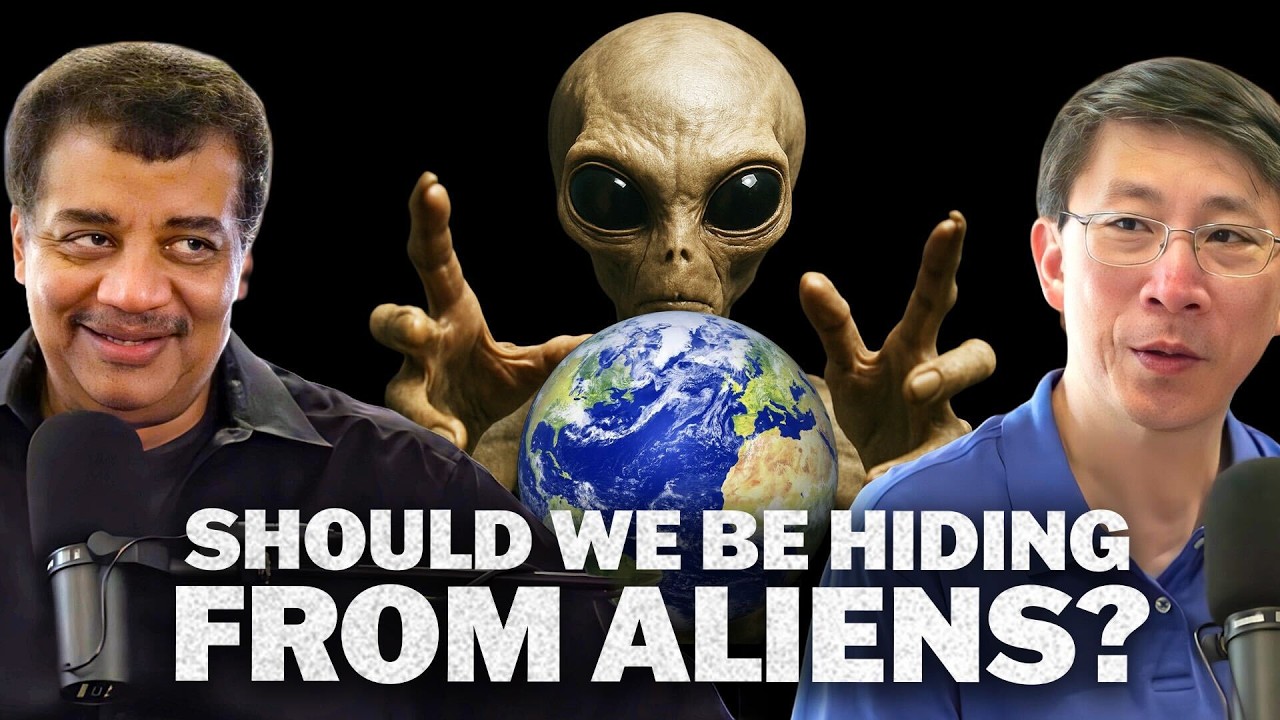
Answering Questions About Grabby Aliens, Qubits & Free Will, with Charles Liu
Keywords
Summary
150 words
Critical Evaluation
The episode provides a valuable and engaging discussion of complex scientific topics, leveraging the expertise of astrophysicist Charles Liu alongside Neil deGrasse Tyson’s communication skills. The scientific content is generally accurate, with appropriate caveats about speculative areas like string theory and the nature of quantum entanglement. Liu consistently emphasizes the distinction between established physics and theoretical possibilities, which enhances the reliability of the information. The discussion of quantum entanglement correctly notes that it does not involve a classical force or energy exchange, and the analogy of entangled particles as a single stretched particle is a helpful simplification. The segment on qubits accurately explains the difference between classical bits and quantum bits, though it could delve deeper into the technical challenges of quantum computing. The ‘grabby aliens’ discussion is speculative but clearly framed as such, and the hosts engage with the ethical considerations of contacting extraterrestrial civilizations. The main weakness is the conversational format, which sometimes leads to interruptions and incomplete explanations, as reflected in the comments. Additionally, the show occasionally veers into humor that, while entertaining, can detract from the scientific depth. Overall, the episode succeeds in making complex topics accessible without sacrificing accuracy, and it encourages curiosity and critical thinking.
201 words
Title / Content Match
The title accurately reflects the content: a Q&A session covering a range of topics including grabby aliens, qubits, and free will, with Charles Liu as the expert guest.
Quality & Reliability
8/10
The discussion features astrophysicist Charles Liu and Neil deGrasse Tyson, both credible scientists. They address complex topics with appropriate caveats, distinguishing established physics from speculative theories. The conversational format allows for some oversimplification, but the core scientific content is accurate and well-contextualized.
Chapters
Contribution & Novelties
The episode offers a unique blend of expert commentary and accessible explanations on cutting-edge topics in physics and cosmology. It clarifies common misconceptions about quantum entanglement and qubits, and introduces viewers to the ‘grabby aliens’ theory, which is a relatively recent concept in astrobiology. The discussion on free will and quantum mechanics provides a nuanced perspective, acknowledging the ongoing debate without oversimplifying.
Pour aller plus loin :
- Quantum entanglement - Wikipedia — Provides a comprehensive overview of the phenomenon, including its history and experimental verification.
- Qubit - Wikipedia — Explains the fundamental unit of quantum information, including its physical implementations and challenges.
- Grabby aliens - Wikipedia — Details the theory proposed by Robin Hanson and colleagues, which suggests that advanced civilizations expand and are visible, with implications for the Fermi paradox.
- String theory - Wikipedia — Offers an introduction to the theoretical framework that attempts to unify physics by positing extra dimensions.
- Free will - Stanford Encyclopedia of Philosophy — Discusses philosophical perspectives on free will, including compatibilism and libertarianism, relevant to the episode’s discussion.
175 words
Radar Profile
The radar profile shows high scores in information quantity, quality, and reliability, with a slightly lower technical level, indicating that the content is rich and trustworthy but accessible to a general audience. The balance suggests a well-rounded educational resource.
💬 Très positif. Sur les 30 commentaires analysés, la grande majorité exprime une forte appréciation pour Charles Liu et son expertise, tout en regrettant qu'il soit souvent interrompu par les autres animateurs.