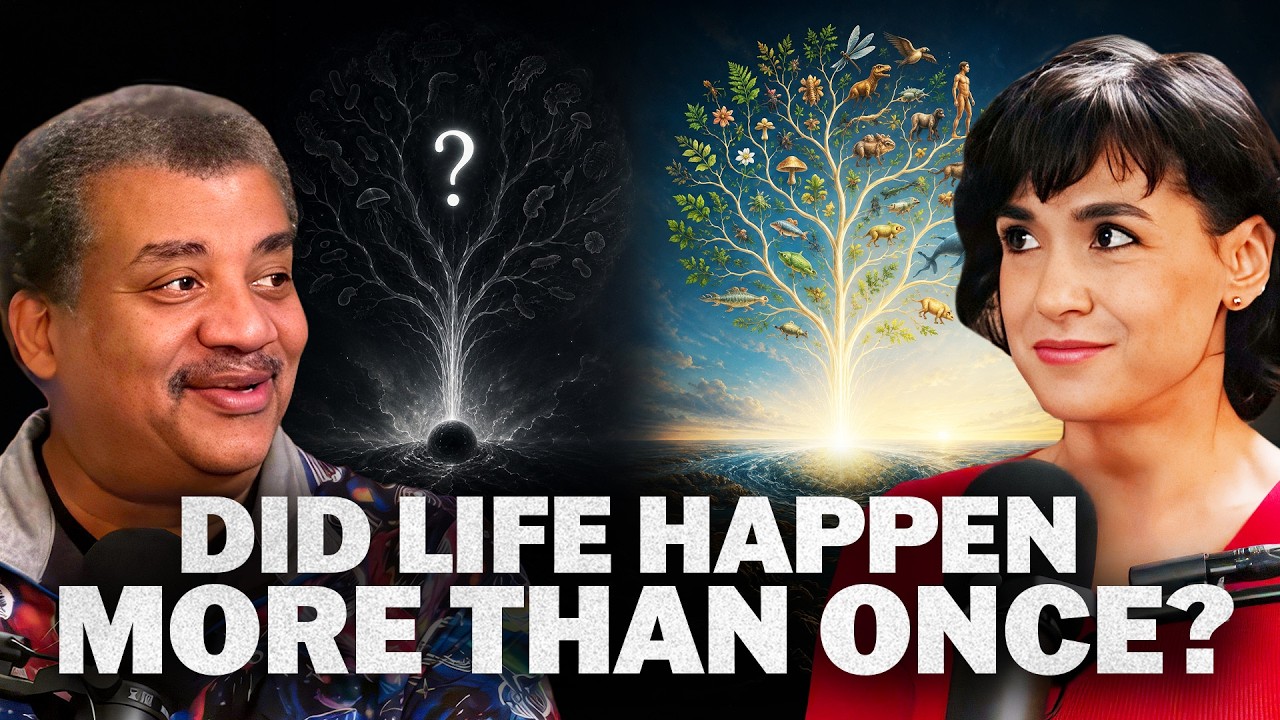
An Astrobiologist Pieces Together How Life Started, with Betül Kaçar
Keywords
Summary
212 words
Critical Evaluation
The episode provides a compelling and accessible overview of astrobiology, focusing on the work of Betül Kaçar, a leading researcher in the field. The discussion is scientifically rigorous, with Kaçar clearly explaining complex concepts such as resurrecting ancient enzymes, nitrogen fixation, and evolutionary singularities. The conversation is well-structured, moving from specific research methods to broader questions about life’s origins and potential elsewhere in the universe.
One of the strengths of the episode is the depth of information presented. Kaçar’s explanations are detailed and accurate, reflecting her expertise. For example, she clarifies the role of nitrogen fixation in making nitrogen available to living cells and compares it to the Haber-Bosch process, providing a concrete example of the significance of biological processes. The discussion of evolutionary singularities—events that occurred only once and transformed the planet—is particularly insightful, offering a framework for understanding the contingency of life’s history.
The argumentation is solid, with Kaçar grounding her claims in her published research and the broader scientific literature. She is careful to distinguish between what is known and what is speculative, such as when discussing the likelihood of multiple origins of life. This intellectual honesty enhances the credibility of the content.
The quality of sources is high, as Kaçar references her own work in Nature and other scientific studies. However, the episode does not provide specific citations for all claims, which is typical for a popular science podcast. The hosts, Neil deGrasse Tyson and Chuck Nice, contribute to the discussion with their characteristic humor, which makes the content engaging but occasionally distracts from the scientific depth.
The title accurately reflects the content, as the episode indeed focuses on how an astrobiologist pieces together the origins of life. The adéquation between title and content is strong.
Overall, the episode is scientifically valuable, offering insights into cutting-edge research in astrobiology. The main limitation is the lack of detailed citations, but this is mitigated by the expertise of the guest and the clarity of the explanations. The episode successfully communicates complex scientific ideas to a general audience without oversimplifying them.
342 words
Title / Content Match
The title accurately reflects the content: an astrobiologist discusses how life started, focusing on her research on ancient enzymes and the origins of life.
Quality & Reliability
8/10
The episode features a leading astrobiologist (Betül Kaçar) discussing her published research in Nature, with clear explanations of complex topics. The conversation is grounded in scientific evidence, though it includes speculative elements about life's origins and contingency. The host's interjections are sometimes humorous but do not undermine the scientific content.
Chapters
- Introduction: Betül Kaçar
- Reserrecting Ancient Enzymes
- Testing Life’s Limits
- Why Hasn’t There Been More Than One Genesis?
- What is Nitrogen Fixation?
- Betul and Chuck’s Arguement about the Nature of Life
- How Did Life Evolve a Metabolism
- All Life is Extremophiles
- Why Are Enzymes Important?
- The Contingency of Life
- The Range of Possibility
- The Earliest Organism
- Metabolism, Energy Gradients, & The Criteria For life
- The Limits of Life
- Life is…Metal?
- The Haber-Bosch Process
- Closing Thoughts
Cited Sources
- Take Me to Your Leader (book by Neil deGrasse Tyson) — Mentioned in the video description as a promotional item, not directly related to the scientific content.
Concurring Sources
- Nature (journal) — Betül Kaçar's research on resurrecting ancient enzymes was published in Nature, as mentioned in the episode.
Contribution & Novelties
The episode provides a unique perspective on the origins of life by focusing on the resurrection of ancient enzymes, a cutting-edge approach that allows scientists to experimentally probe the molecular machinery of extinct organisms. This method offers new insights into how life’s earliest metabolic pathways evolved and how they might have functioned under different planetary conditions. The discussion of evolutionary singularities, such as nitrogen fixation and oxygenic photosynthesis, highlights the contingency of life’s history and the potential for different outcomes on other worlds.
Pour aller plus loin :
- Ancestral sequence reconstruction — A key method used in the episode to resurrect ancient enzymes.
- Nitrogen fixation — The process discussed in detail, essential for life.
- Haber-Bosch process — The industrial counterpart to biological nitrogen fixation, compared in the episode.
- Extremophiles — Organisms that thrive in extreme environments, relevant to the search for life elsewhere.
- Last universal common ancestor — The hypothetical common ancestor of all life, discussed in the context of the tree of life.
164 words
Radar Profile
The radar profile shows high scores in quantity and quality of information, reflecting the episode's rich scientific content. The technical level is moderately high, suitable for an informed audience. The overall reliability is strong, given the guest's expertise and the credible sources referenced.
💬 Très positif. Sur les 30 commentaires analysés, les spectateurs expriment un enthousiasme marqué pour l'invitée, saluant son intelligence, son humour et sa capacité à vulgariser des sujets complexes, et demandent son retour.