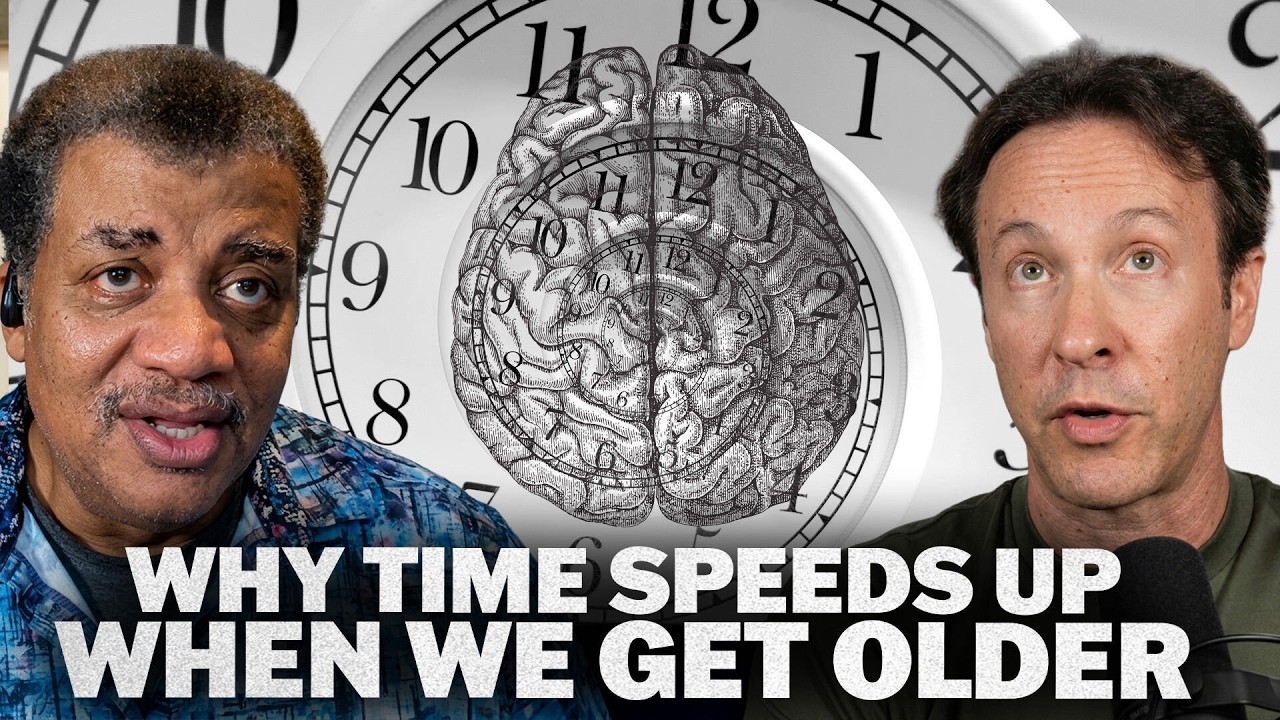
How The Brain Perceives Time, with David Eagleman
Keywords
Summary
185 words
Critical Evaluation
Value of the Information & Strength of the Argument
The video provides valuable insights into neuroscience, particularly regarding neuroplasticity and sensory substitution. Eagleman presents compelling evidence and personal research, such as the tower experiment, to support his arguments. The discussion is well-structured, moving from concrete examples (e.g., sensory substitution devices) to broader theories (e.g., dreams as territory defense). The argumentation is generally solid, with hypotheses clearly distinguished from established facts. However, some claims, like the dream theory, are speculative and presented with enthusiasm rather than rigorous evidence. The conversational format allows for accessible explanations, but occasionally lacks depth on complex topics.
Scientific Rigor, Source Quality, Title Accuracy
The scientific rigor is high, with Eagleman referencing specific studies and experiments. He cites the 1969 Nature paper by Paul Bach-y-Rita, the 1930 Science paper on echolocation, and his own research. The discussion is grounded in established neuroscience, though some theories are presented as novel hypotheses. The title is somewhat misleading as the video covers a broad range of topics beyond time perception, but the core content is accurate. The sources are credible, and the information is presented in a way that is accessible without oversimplifying. The adéquation between title and content is acceptable, though a more comprehensive title would better reflect the episode’s scope.
212 words
Title / Content Match
The title accurately reflects the main topic of time perception, but the video covers a broader range of neuroscience topics including sensory substitution, dreams, and consciousness.
Quality & Reliability
8/10
The discussion features a recognized neuroscientist (David Eagleman) presenting research findings, including his own experiments (e.g., the 150-foot tower drop) and references to published studies (e.g., 1969 Nature paper, 1930 Science paper on echolocation). The content is largely consistent with established neuroscience, though presented in a conversational, pop-science format. Some claims (e.g., dreams as 'brain's screensaver') are hypotheses and are labeled as such. Overall, high reliability with minor caveats regarding speculative elements.
Chapters
- Introduction: David Eagleman
- Seeing With Our Tongues
- Is Reading Braille the Same as Reading with Vision
- The Competition Between Senses
- Gaps in Our Memory
- Does Synesthesia Make You More Creative?
- Aphantasia: The Vivid Movie in Your Brain
- Hallucinations
- Does Everyone See the Same Colors?
- Do You See in Slow Motion in an Emergency
- Why Time Seems to Speed Up as You Grow Older
- Mental Time Dialation & Neural Time Dialation
- At-Home Experiment
- Time Perception & Credit Misattribution
- Explaining Consciousness
Cited Sources
- Patreon page for StarTalk — Support page mentioned in the description, not directly cited in the video.
Concurring Sources
- Livewired: The Inside Story of the Ever-Changing Brain — Book by David Eagleman, published in 2020, which expands on the topics discussed.
Contribution & Novelties
The video offers a unique perspective on time perception, particularly Eagleman’s tower experiment, which is a rare empirical study on subjective time dilation. It also presents the ‘defensive activation theory’ of dreams, which is an original hypothesis. The discussion on sensory substitution provides a compelling demonstration of neuroplasticity. The conversational format makes complex neuroscience accessible to a broad audience.
Pour aller plus loin :
- David Eagleman’s website — Official site with publications and research.
- Neuroplasticity - Wikipedia — Overview of the brain’s adaptability.
- Sensory substitution - Wikipedia — Historical and modern approaches.
- Time perception - Wikipedia — Scientific background on how time is perceived.
104 words
Radar Profile
The radar profile shows high scores in information quantity, quality, and reliability, with a slightly lower technical level, reflecting the accessible yet scientifically grounded nature of the content. The balance between depth and accessibility is well maintained.
💬 No comments were provided for analysis.