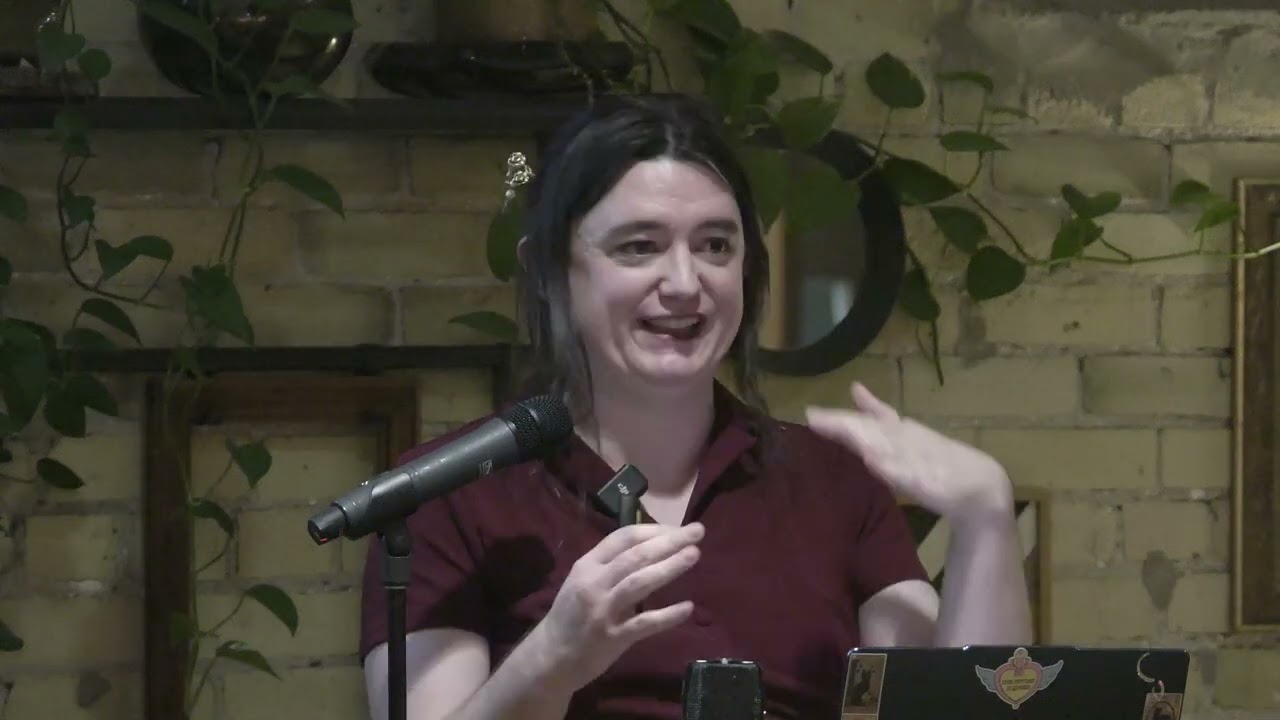
Bri Watson - Lecture Series '25 - A World Divided into Sheep & Goats
Keywords
Summary
147 words
Critical Evaluation
Value of the Information & Strength of the Argument
The talk provides a valuable and original perspective on the history of sexuality and the role of taxonomy in shaping social norms. Watson’s argument is well-supported by a wealth of archival evidence, including primary sources and personal interviews. They effectively challenge the conventional narrative of the sexual revolution, offering a nuanced analysis of how Kinsey’s work was interpreted and used by different groups. The argumentation is logical and compelling, though some claims could benefit from further peer-reviewed validation. The speaker’s expertise in information science and history adds credibility to the discussion.
Scientific Rigor, Source Quality, Title Accuracy
Watson demonstrates rigorous research methods, drawing on extensive archival collections and academic literature. They cite specific sources, such as the Kinsey Institute’s print media collection and academic articles, and provide context for their findings. The title accurately reflects the central theme of binary categorization, though the talk covers a broader scope than the title suggests. The speaker acknowledges the limitations of their research and the need for further investigation. Overall, the sources are credible and well-integrated into the argument.
185 words
Title / Content Match
The title 'A World Divided into Sheep & Goats' aptly captures the central theme of binary categorization in Kinsey's work and its implications, though the talk covers broader historical and social aspects.
Quality & Reliability
7/10
The talk is based on extensive archival research and personal interviews, but it is an interpretive historical argument rather than a peer-reviewed study. The speaker is a professor with relevant expertise, but the claims are not all independently verified.
Key Moments
Markers derived by PSI from the transcript: the creator did not define chapters.
- Introduction and land acknowledgement
- Discussion of Linnaeus and the origins of taxonomy
- Introduction of Alfred Kinsey and his work on sexuality
- Examination of the term 'sexual revolution' and its historical usage
- Analysis of the Kinsey Institute's research and its impact
- Discussion of the legacy of Kinsey and the implications for classification
- Conclusion and Q&A session
Cited Sources
- Sexual Behavior in the Human Male — Kinsey's seminal work on male sexuality, cited as a primary source.
- Sexual Behavior in the Human Female — Kinsey's companion volume on female sexuality, mentioned in the talk.
- Systema Naturae — Linnaeus's influential work on taxonomy, discussed in the context of classification.
- The Kinsey Institute — The institution founded by Kinsey, which houses the archives and collections mentioned.
Concurring Sources
- The Kinsey Institute — The institution's official website provides information on its research and collections, supporting the talk's claims.
Dissenting Sources
- Critiques of Kinsey's methodology — Some scholars have criticized Kinsey's sampling methods and the representativeness of his data, which may challenge the talk's interpretation.
Contribution & Novelties
The talk offers a novel historical argument that the sexual revolution was not caused by Kinsey’s work but was a term used earlier, and that Kinsey’s data reflected earlier generations. It also highlights the role of taxonomy in shaping personal identity and the connection between classification and colonialism. The speaker’s background in information science provides a unique perspective on how knowledge organization affects society.
Pour aller plus loin :
- History of taxonomy — Provides background on the development of biological classification.
- Alfred Kinsey — Overview of Kinsey’s life and work.
- Sexual revolution — Discusses the concept and its historical interpretations.
100 words
Radar Profile
The radar chart shows high scores in quantity and quality of information, with moderate technical level and reliability. This indicates a well-researched talk with substantial content, though the technical depth is not extremely high, making it accessible to a general audience.
💬 Sur les 0 commentaires analysés, aucune tendance n'est disponible.