João Pinheiro da Silva - (Micro)Biology and the Causal Closure of the Physical
Keywords
Summary
181 words
Critical Evaluation
Value of the Information & Strength of the Argument
The talk provides a valuable contribution to the debate on causal closure and hylomorphism by challenging Robinson’s strict interpretation. The argument is well-structured and engages with contemporary literature, particularly Gillett’s work on reductionism and emergence. The use of scientific examples, such as the fractional quantum Hall effect and the cellular operating system, strengthens the case for higher-level causation. The speaker acknowledges potential objections and clarifies his position, making the argument more robust. However, the talk is an abridged version, and some nuances may be lost. The argumentation is solid, though it relies on the assumption that higher-level constraints can be genuinely causal, which is a contested point.
Scientific Rigor, Source Quality, Title Accuracy
The talk demonstrates scientific rigor by referencing specific philosophers and scientists, such as Robinson, Gillett, and Yeager and Calkins. The sources are relevant and appropriately used to support the argument. The title accurately reflects the content, focusing on microbiology and causal closure. The talk is part of a graduate student conference, indicating a scholarly context. The speaker mentions that the article is published in Topoi, adding credibility. However, no direct citations or URLs are provided in the description, so the sources are not verifiable from the video alone. The title is appropriate and does not mislead.
218 words
Title / Content Match
The title accurately reflects the content, focusing on microbiology and the causal closure of the physical, though the talk also covers broader philosophical issues.
Quality & Reliability
7/10
The talk presents a philosophical argument with references to contemporary literature (e.g., Robinson, Gillett) and scientific examples (fractional quantum Hall effect, cellular operating system). The argument is coherent and engages with existing debates, though it is not peer-reviewed in this format and relies on the speaker's interpretation.
Key Moments
Markers derived by PSI from the transcript: the creator did not define chapters.
- Introduction and overview of the talk
- Explanation of hylomorphism and Robinson's argument
- Critique of Robinson's strict causal closure
- Discussion of Gillett's everyday reductionism and challenging compositional cases
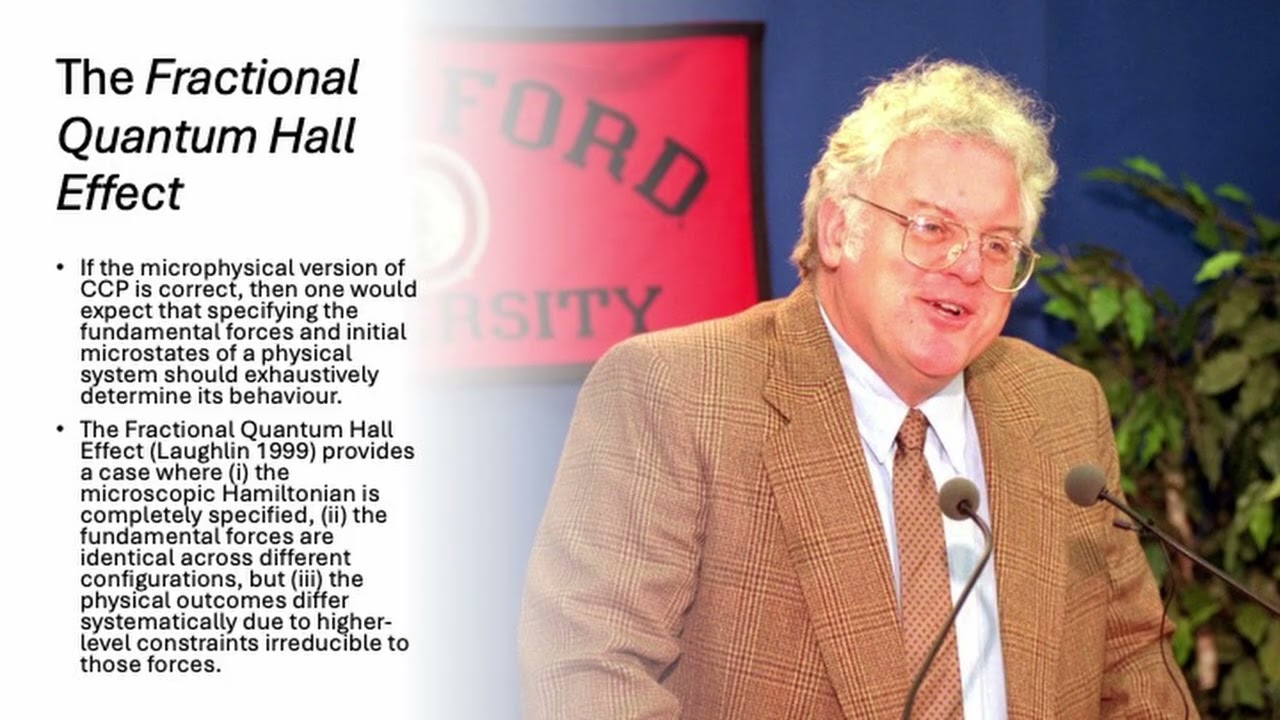
- Example from physics: fractional quantum Hall effect
- Example from microbiology: cellular operating system and RNase P
- Implications for causal closure and conclusion
Cited Sources
- Topoi (journal) — The speaker mentions his article is published in Topoi.
- Howard Robinson's articles against hylomorphism — The speaker references Robinson's arguments.
- Carl Gillett's books on reduction and emergence — The speaker references Gillett's work.
- Yeager and Calkins on top-down causation — The speaker mentions their work on cellular operating system.
Concurring Sources
- Causal closure — General background on the principle.
- Hylomorphism — Philosophical theory discussed.
- Emergence — Related concept.
Dissenting Sources
- Howard Robinson's argument — The speaker directly challenges Robinson's strict interpretation of causal closure.
Contribution & Novelties
The talk offers a novel defense of hylomorphism by arguing that a properly understood causal closure does not preclude higher-level causal factors. It provides concrete scientific examples to support this claim, moving beyond abstract philosophical debate. The reinterpretation of closure as only requiring no gaps at the fundamental level is a significant contribution.
Pour aller plus loin :
- Causal closure — Provides background on the principle.
- Hylomorphism — Overview of the philosophical theory.
- Emergence — Relevant to the discussion of higher-level properties.
- Top-down causation — Directly related to the talk’s argument.
91 words
Radar Profile
The radar profile shows high scores in quality of information and technical level, reflecting the speaker's expertise and the depth of the argument. The quantity of information is moderate, and the global reliability is good, though not perfect due to the lack of verifiable sources in the video description.
💬 No comments were provided for analysis.