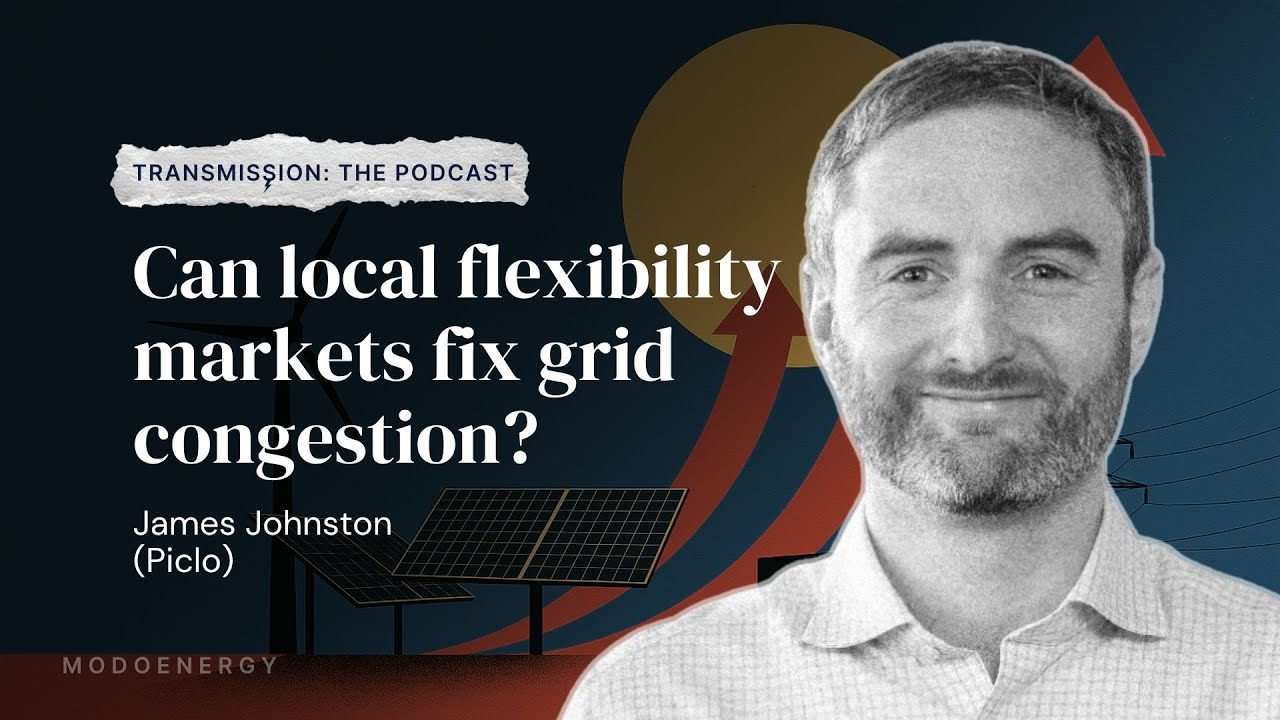
The Grid Is Full — Can Local Flexibility Fix It?
Keywords
Summary
180 words
Critical Evaluation
Value of the Information & Strength of the Argument
The value of the information lies in its practical insights from a leading flexibility marketplace operator. Johnston provides concrete examples of how flexibility markets work, the challenges of scaling them, and the innovative Project ACE concept. The argumentation is coherent and grounded in real-world experience, though it is inherently promotional for Piclo. The discussion of the ‘missing money’ problem and the potential for private capital to fund grid flexibility is compelling and well-articulated. However, the episode lacks critical examination of potential drawbacks or alternative solutions, and some claims (e.g., the 3% figure) are presented without rigorous evidence.
Scientific Rigor, Source Quality, Title Accuracy
The scientific rigor is moderate. The guest is a credible expert, and the discussion is based on industry experience rather than peer-reviewed research. No external sources are cited beyond the Piclo website. The title accurately reflects the content, focusing on grid congestion and local flexibility. The episode does not delve into technical details or provide data to support all claims, but it offers a valuable overview of current challenges and emerging solutions in the energy sector.
188 words
Title / Content Match
The title accurately reflects the core theme: grid congestion and the role of local flexibility markets.
Quality & Reliability
7/10
The interview features a domain expert (CEO of Piclo) discussing real-world applications and market mechanisms. Claims are plausible and grounded in industry experience, but specific data points (e.g., 3% investment, $80/kW-year) are not independently verified. The discussion is forward-looking and promotional, with limited critical scrutiny.
Key Moments
Markers derived by PSI from the transcript: the creator did not define chapters.
- Introduction of James Johnston and overview of Piclo's growth since last appearance.
- Discussion on the challenges of scaling a flexibility marketplace internationally.
- Explanation of Piclo's evolution from peer-to-peer trading to DSO flexibility markets.
- Introduction of Project ACE: data centers funding local VPPs to accelerate grid connections.
- Analysis of the financial incentives for data centers and flexibility providers.
- Discussion on the role of utilities and community buy-in in flexibility projects.
- Challenges of scaling in the US market and the importance of local partnerships.
- Future outlook for flexibility markets and the potential for global adoption.
Cited Sources
- Piclo Website — Mentioned as the company's official site for more information about their flexibility marketplace.
Concurring Sources
- Piclo Website — Official source for the company's services and market insights.
Contribution & Novelties
The episode introduces Project ACE, a novel concept where data centers fund local virtual power plants to accelerate their grid connections, addressing the ‘missing money’ problem. It provides insights into the scalability of flexibility markets and the evolving role of DSOs. The discussion offers a practical perspective on how private capital can be leveraged to enhance grid flexibility.
Pour aller plus loin :
- Virtual power plant — Provides background on VPPs, a key component of the proposed solution.
- Distribution system operator — Explains the role of DSOs in managing distribution networks and flexibility.
- Demand response — Related concept for managing grid flexibility through consumer participation.
105 words
Radar Profile
The radar profile shows high scores in information quantity and quality, reflecting the expert interview's depth. The technical level is moderate, suitable for a professional audience. The overall reliability is good, though the promotional nature of the discussion slightly reduces the score.