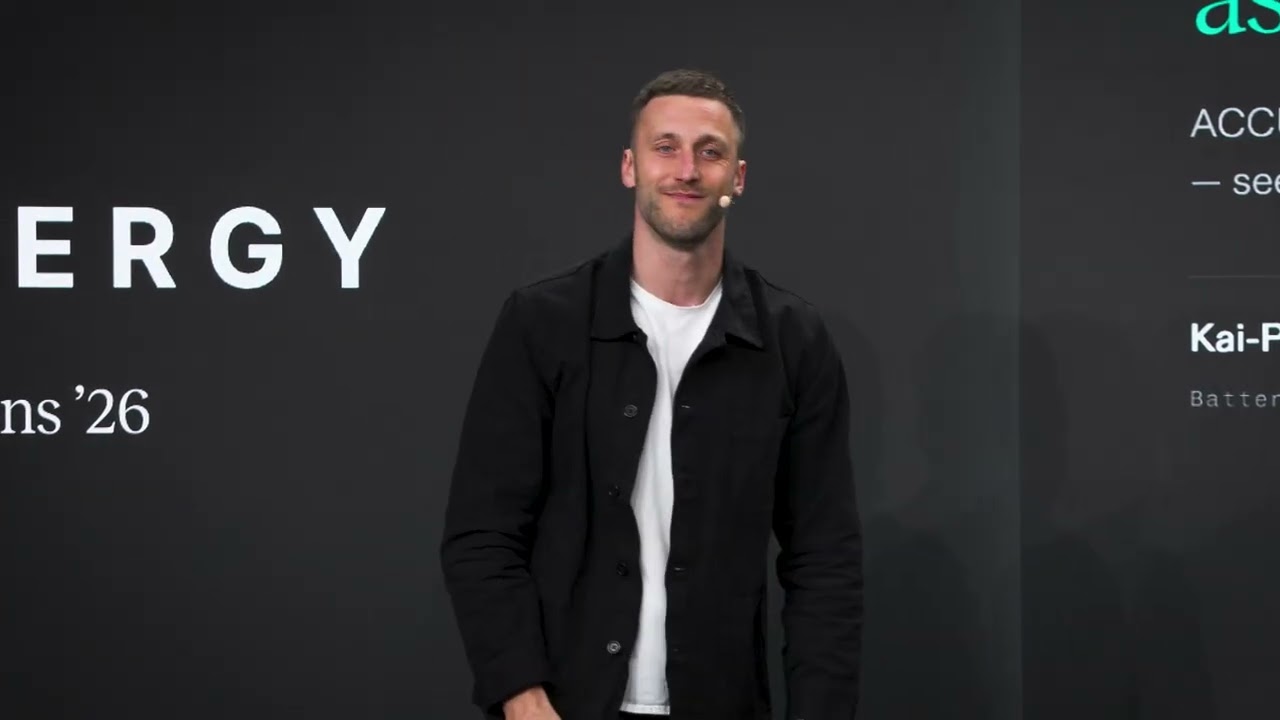
The Hidden Revenue Your Battery Is Losing Every Day - Dr. Kai-Phillips (ACCURE Battery Intelligence)
Keywords
Summary
137 words
Critical Evaluation
Value of the Information & Strength of the Argument
The talk provides valuable insights into a less-visible but critical aspect of battery storage operations: the financial impact of SOC inaccuracy. The speaker uses a concrete case study with real data, which strengthens the argument. He quantifies the revenue erosion (e.g., £700k per GWh per year in GB, $1M per GWh per year in ERCOT) and demonstrates a 5% revenue uplift from improved SOC accuracy. The argumentation is logical and well-structured, moving from problem to solution to evidence. However, the presentation is inherently promotional, as it showcases ACCURE’s product, and the speaker acknowledges the difficulty of quantifying gains without a counterfactual, relying on the client’s validation.
Scientific Rigor, Source Quality, Title Accuracy
The talk is based on the speaker’s expertise and proprietary data from ACCURE’s operations. The case study with Gore Street Capital is cited, but no external sources are provided. The title accurately reflects the content, focusing on hidden revenue losses. The description includes a link to Modo Energy’s sign-up page, which is not a source for the claims. The talk is not peer-reviewed, and the evidence is anecdotal, though the speaker’s credibility and the client’s validation add some rigor. The lack of independent verification and the promotional nature temper the scientific rigor.
213 words
Title / Content Match
The title accurately reflects the content, which focuses on revenue losses due to state-of-charge inaccuracy and how to mitigate them.
Quality & Reliability
7/10
The talk is based on real operational data and a case study with Gore Street Capital, but it is a vendor presentation with limited independent verification. The speaker is an expert in battery analytics, and the claims are plausible, but the lack of peer-reviewed sources and the promotional context temper the score.
Key Moments
Markers derived by PSI from the transcript: the creator did not define chapters.
- Introduction: batteries treated as boxes, but DC side matters.
- SOC inaccuracy explained: battery doesn't know its true state.
- Revenue erosion quantified: £700k per GWh per year in GB, $1M in ERCOT.
- Technical example: real data from Gore Street Capital asset showing SOC discrepancy.
- Cloud analytics approach: ingesting voltage, current, temperature to improve SOC.
- Case study results: $75k per year revenue increase, 5% uplift.
- LFP chemistry is the villain: voltage curve flat, leading to higher inaccuracy.
- Error accumulation in partial cycling, up to 30% inaccuracies.
- Why cell manufacturers don't offer similar solutions: hardware companies lack software skills.
- Quantifying gains without counterfactual: backtesting and client validation.
Cited Sources
- Modo Energy sign-up — Link in video description for exploring Modo Energy's terminal.
Concurring Sources
- Modo Energy — The event host and platform for energy market intelligence.
Contribution & Novelties
The talk highlights a specific, quantifiable source of revenue loss in battery storage operations—state-of-charge inaccuracy—and presents a cloud-based solution. It provides a case study with real data, showing a 5% revenue increase. The novelty lies in the application of electrochemical modeling to operational trading decisions, rather than just safety monitoring. The talk also emphasizes the financial impact on CapEx and asset valuation, which is often overlooked.
Pour aller plus loin :
- State of charge — Wikipedia article explaining SOC and its importance.
- Lithium iron phosphate battery — Overview of LFP chemistry and its characteristics.
- Battery management system — BMS role in monitoring and controlling batteries.
105 words
Radar Profile
The radar profile shows balanced scores across information quantity, quality, technical level, and reliability, with a slight dip in reliability due to the promotional context. The talk is informative and technically sound but relies on vendor claims.