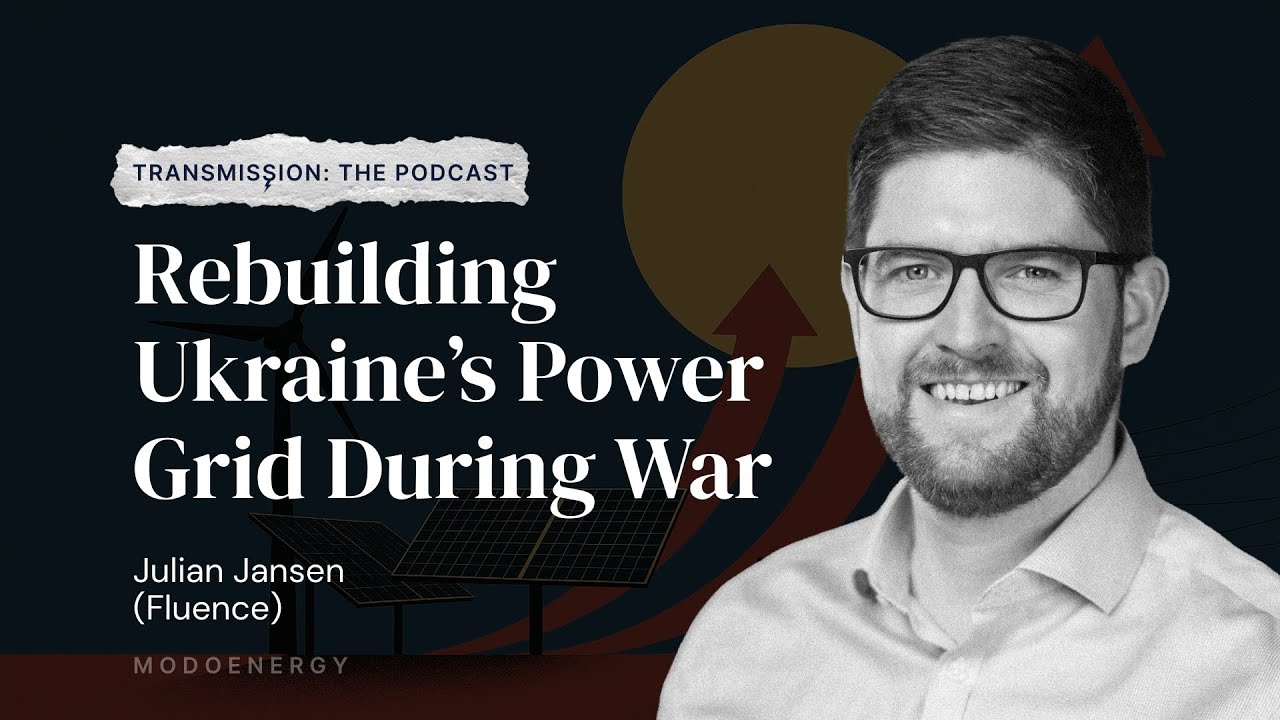
Rebuilding Ukraine’s Power Grid During War with Julian Jansen (Fluence)
Keywords
Summary
149 words
Critical Evaluation
Value of the Information & Strength of the Argument
The value of the information is high, offering unique insights into the practical challenges and solutions for deploying battery storage in a war zone. The argumentation is solid, based on the direct experience of the guest. The discussion is well-structured, covering technical, logistical, and strategic aspects. The claims about the speed of deployment and the benefits of distributed storage are compelling, though they rely on anecdotal evidence. The argument that such projects can be delivered faster with a ‘wartime mentality’ is persuasive and supported by the example of Ukraine.
Scientific Rigor, Source Quality, Title Accuracy
The scientific rigor is moderate; the information is based on expert opinion and practical experience rather than peer-reviewed research. The quality of sources is limited to the guest’s testimony and the company’s website, with no external references. The title accurately reflects the content, focusing on the rebuilding of Ukraine’s power grid with battery storage. The discussion is coherent and relevant, but lacks critical analysis of potential drawbacks or alternative solutions.
174 words
Title / Content Match
The title accurately reflects the content, focusing on the rebuilding of Ukraine's power grid with battery storage during wartime.
Quality & Reliability
8/10
The information is provided by a senior industry executive directly involved in the projects, offering first-hand insights. The claims are specific and plausible, but lack independent verification or detailed technical data.
Key Moments
Markers derived by PSI from the transcript: the creator did not define chapters.
- Introduction to the episode and the topic of Ukraine's energy infrastructure.
- Julian Jansen introduces himself and Fluence, highlighting their focus on energy storage.
- Discussion on the destruction of Ukraine's energy infrastructure and the need for storage.
- Explanation of the specific services provided by the battery projects, including frequency response and grid restoration.
- Details on the size and distribution of the projects, and the rationale for smaller sites.
- Discussion on the unique delivery model, including remote commissioning and training.
- The importance of secrecy and cybersecurity in the projects.
- The speed of deployment and how it was achieved, with lessons for the industry.
- Potential future applications of remote commissioning and the broader impact of the projects.
Cited Sources
- Fluence Energy — Company website mentioned as a source for more information about Fluence.
Concurring Sources
- Fluence Energy — Company website confirming Fluence's role in energy storage solutions.
Contribution & Novelties
This episode provides a unique case study of deploying battery storage in an active war zone, offering insights into accelerated project delivery, remote commissioning, and the critical role of storage in grid resilience. The discussion highlights how necessity can drive innovation and speed in the energy sector.
Pour aller plus loin :
- Battery energy storage system — Overview of BESS technology and applications.
- Frequency response — Explanation of frequency regulation in power systems.
- Grid forming inverter — Technology enabling batteries to provide grid stability services.
85 words
Radar Profile
The radar profile shows high scores in information quantity and quality, reflecting the detailed and expert-driven content. The technical level is moderate, suitable for a general audience interested in energy. The overall reliability is good, though limited by the lack of independent sources.
💬 Sur les 0 commentaires analysés, aucune tendance n'est disponible.