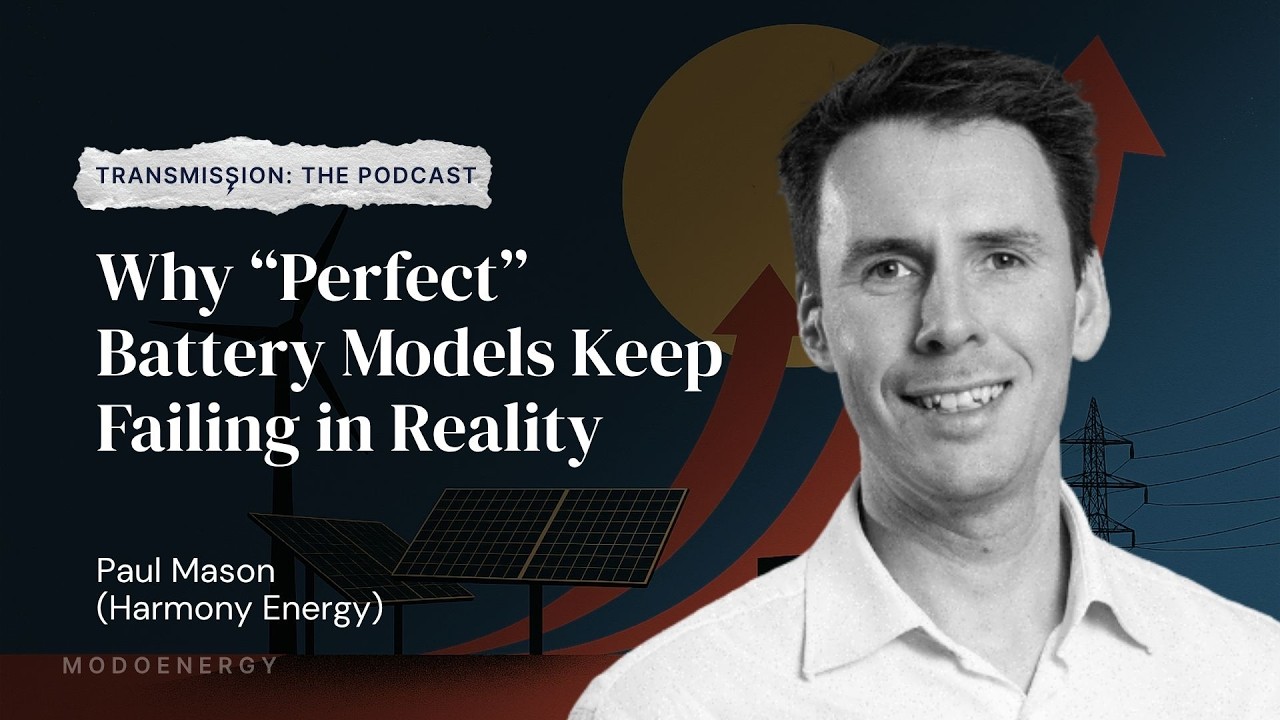
Why 'Perfect' Battery Models Keep Failing in Reality - Harmony Energy
Keywords
Summary
169 words
Critical Evaluation
Value of the Information & Strength of the Argument
The value of the information is high, offering practical, experience-based insights into BESS development and investment. Mason’s argumentation is solid, grounded in real-world examples such as the decision to build 2-hour batteries and the sale of assets to Foresight. He effectively challenges common assumptions, such as the reliability of revenue forecasts and the sustainability of ancillary revenue streams. The discussion is nuanced, acknowledging both the benefits and limitations of different strategies, and provides actionable advice for developers and investors.
Scientific Rigor, Source Quality, Title Accuracy
The scientific rigor is moderate; the content is based on expert opinion and practical experience rather than peer-reviewed research. The sources cited are limited to Modo Energy’s own resources (AI analyst and transcript), which are relevant but not external references. The title accurately reflects the content, focusing on the gap between models and reality. The discussion is coherent and well-structured, with clear arguments and examples.
159 words
Title / Content Match
The title accurately reflects the core theme of the episode: the disconnect between idealized battery models and real-world performance, as discussed by Harmony Energy's CIO.
Quality & Reliability
8/10
The discussion is grounded in extensive practical experience from a leading BESS developer, with concrete examples and a clear, nuanced perspective on revenue forecasting and market dynamics. The speaker demonstrates deep domain knowledge and provides actionable insights, though the content is primarily opinion-based rather than data-driven.
Chapters
- Introduction
- What do BESS developers get wrong when building an IPP?
- Why full EPC contracts — and why they still hired project managers
- Duration strategy: the case for 2-hour batteries early
- The full BESS lifecycle — develop, build, operate, sell
- How Harmony raised capital through listed funds (and why it worked then)
- Why listed fund capital flowed out and what came next
- The Foresight asset sale: private vs. public valuation
- New markets: what Harmony looks for in France, Germany and beyond
- Market timing — should you enter early or wait for wholesale dynamics?
- Grid connection across Europe: where it works and where it doesn't
- Operating a live fleet: what drives performance once assets are running
- How to work with optimizers without burning the relationship
- BM trading trials with Tesla — what the data showed
- Is GB still exciting for Harmony, or is it old hat?
- Audience Q&A: colocation, revenue cannibalization, and market saturation
- If you ran European power: one thing to fix
Cited Sources
- Ko - Your AI Analyst — Mentioned as a resource for follow-up questions on the episode's topics.
- Transmission Podcast Transcript — Full transcript of the episode for reference.
Concurring Sources
- Modo Energy — The host's platform, providing data and analysis on energy markets.
Contribution & Novelties
The episode provides a candid, practitioner’s perspective on the realities of BESS development and investment, challenging the common reliance on revenue forecasts and highlighting the importance of designing for uncertainty. It offers specific insights into market entry strategies, grid connection challenges, and the evolution of revenue streams.
Pour aller plus loin :
- Battery energy storage system — Overview of BESS technology and applications.
- Ancillary services (electric power) — Explanation of ancillary services in electricity markets.
- Balancing mechanism — Details on the UK’s balancing mechanism for grid stability.
87 words
Radar Profile
The radar profile shows high scores in information quantity, quality, and reliability, with a slightly lower technical level. This indicates a well-informed, expert-led discussion that is accessible to a professional audience, with strong practical value.