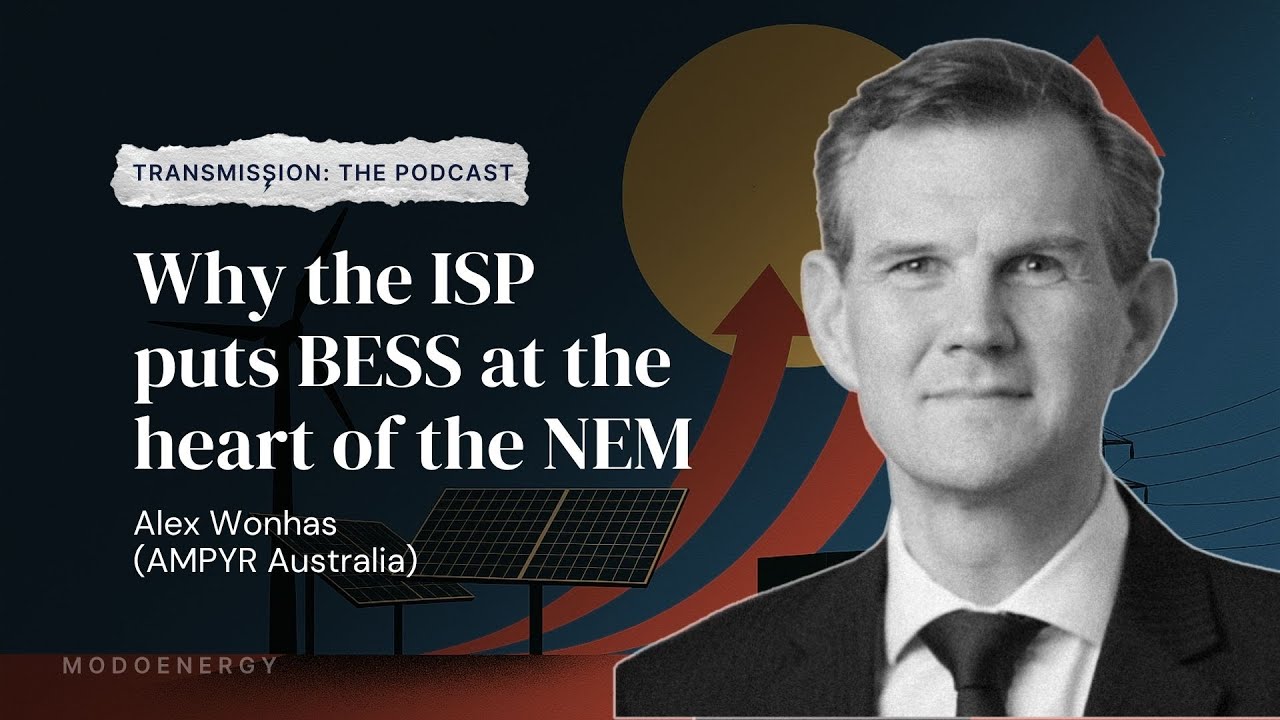
Why the ISP Puts Batteries at the Heart of the NEM with Alex Wonhas (AMPYR)
Keywords
Summary
165 words
Critical Evaluation
Value of the Information & Strength of the Argument
The interview provides valuable insights into the practical aspects of developing large-scale battery storage in Australia. Alex Wonhas offers a nuanced perspective on the ISP, acknowledging its strengths as a planning tool while cautioning against over-reliance on its optimal pathway. He argues convincingly that batteries are essential for firming renewables and supporting grid reliability, but also stresses the need for transmission investment and grid-forming technology. The discussion on innovative offtake structures and the potential for 24/7 renewable contracts adds depth, though these ideas are presented as forward-looking concepts rather than proven solutions. The argumentation is coherent and grounded in real-world experience, making it a credible source for understanding current trends in the NEM.
Scientific Rigor, Source Quality, Title Accuracy
The interview maintains a high level of scientific rigor, with Alex Wonhas referencing his experience at AEMO and involvement in the ISP. The discussion is well-structured and avoids unsupported claims, though it relies heavily on personal opinion and forward-looking statements. The sources cited are primarily the ISP and related planning documents, which are authoritative in the Australian energy context. The title accurately reflects the content, focusing on the ISP’s role in promoting battery storage. The conversation also touches on the Capacity Investment Scheme and grid-forming technology, providing a comprehensive overview. Overall, the sources are credible and the title-content alignment is strong.
229 words
Title / Content Match
The title accurately reflects the core discussion on the role of batteries in the NEM as per the ISP, with Alex Wonhas providing expert insight.
Quality & Reliability
8/10
The interview features an expert with deep experience in energy market design and system planning. The discussion is grounded in practical project experience and references to official planning documents. However, it is largely opinion and forward-looking, with limited quantitative data or citations.
Key Moments
Markers derived by PSI from the transcript: the creator did not define chapters.
- Introduction of Alex Wonhas and his background at AEMO and AMPYR.
- Discussion on the Bulabul battery project and its significance for AMPYR.
- Exploration of innovative offtake structures and contract stacking.
- Alex's vision for 24/7 renewable time-matched contracts.
- Explanation of the Integrated System Plan (ISP) and its evolution.
- Discussion on the role of batteries in supporting transmission and system strength.
- Insights on grid-forming inverters and the future of battery technology.
Cited Sources
- Modo Energy — Mentioned as the host and provider of energy market analysis.
- AMPYR Australia — Alex Wonhas is CEO of AMPYR Australia, and the company's website is referenced for more information.
- Weekly Dispatch Newsletter — Promoted for receiving news and analysis from Modo Energy.
Concurring Sources
- AEMO Integrated System Plan — The ISP is central to the discussion, and its assumptions and scenarios are referenced.
- Capacity Investment Scheme — Mentioned as a mechanism to de-risk projects and accelerate the transition.
Contribution & Novelties
The interview provides a unique perspective on the practical implementation of battery storage in the NEM, highlighting innovative approaches such as First Nations equity-sharing and complex offtake structures. It also offers a candid assessment of the ISP’s limitations and the need for adaptive planning. The discussion on grid-forming technology and its potential to enhance system strength is particularly forward-looking.
Pour aller plus loin :
- Integrated System Plan (AEMO) — Official planning document for the NEM.
- Capacity Investment Scheme (Australian Government) — Government initiative to support new renewable and storage projects.
- Grid-forming inverters (Wikipedia) — Overview of the technology and its role in power systems.
104 words
Radar Profile
The radar profile shows high scores in quality and reliability, reflecting the expert guest and credible references. The quantity of information is moderate, as the interview focuses on qualitative insights rather than extensive data. The technical level is high, suitable for an audience familiar with energy markets.
💬 No comments were provided for analysis.