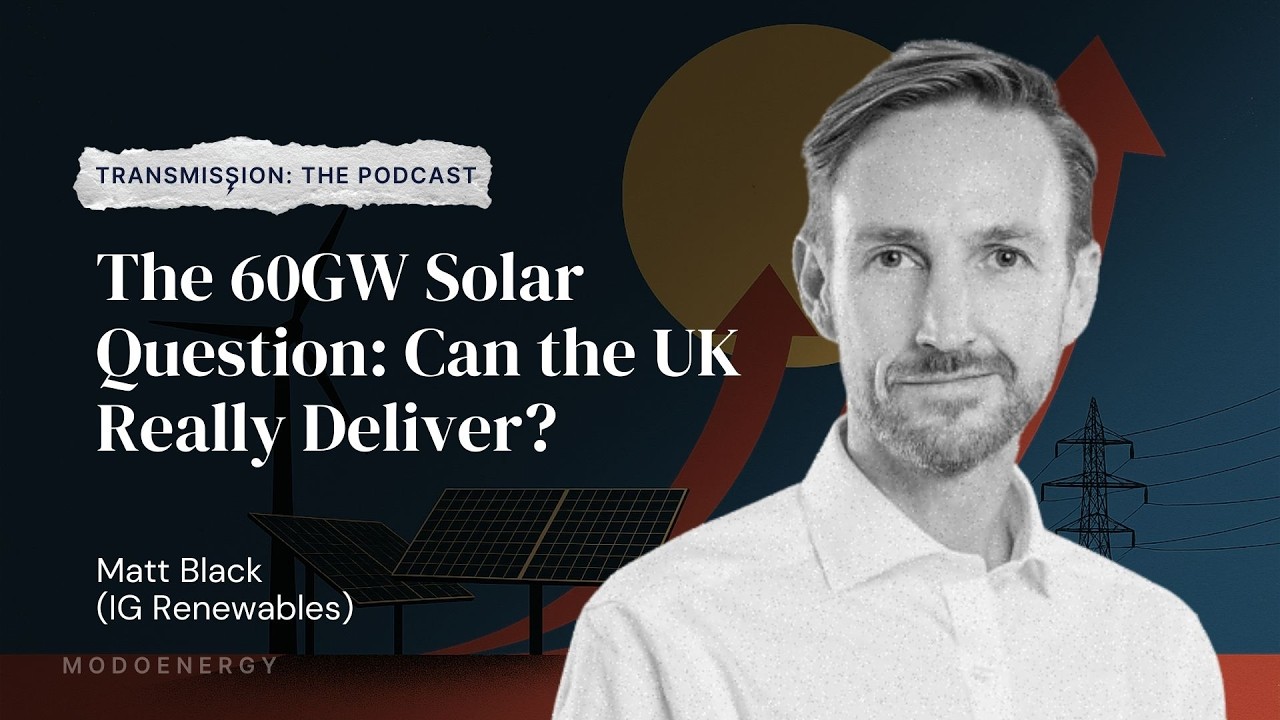
The 60GW Solar Question: Can the UK Really Deliver?
Keywords
Summary
161 words
Critical Evaluation
Value of the Information & Strength of the Argument
The video provides valuable insights into the practical challenges of scaling up solar energy in the UK, drawing on the guest’s extensive industry experience. The argumentation is coherent and well-structured, with clear explanations of complex topics like connection reform and co-location. The discussion is balanced, acknowledging both the necessity of reforms and their unintended consequences. However, the arguments are largely based on anecdotal evidence and expert opinion rather than empirical data, which limits their generalizability.
Scientific Rigor, Source Quality, Title Accuracy
The video maintains a high level of scientific rigor by featuring a credible expert and referencing specific policy documents and market mechanisms. The sources cited are primarily from the guest’s professional experience and industry knowledge, which are reliable but not peer-reviewed. The title accurately reflects the content, focusing on the feasibility of the 60GW target. The video does not include any promotional content, and the discussion is substantive and informative.
160 words
Title / Content Match
The title accurately reflects the core discussion about the feasibility of delivering 60GW of solar in the UK, addressing key challenges and opportunities.
Quality & Reliability
8/10
The video features an expert interview with Matt Black, Managing Director of IG Renewables and Chair of Solar Energy UK, providing credible industry insights. The discussion is grounded in current UK energy policy and market conditions, with references to specific reforms and challenges. However, it is primarily opinion-based and lacks peer-reviewed sources or quantitative data, limiting its scientific rigor.
Key Moments
Markers derived by PSI from the transcript: the creator did not define chapters.
- Overview of connection reform and its necessity.
- Discussion on the Gate Two shakeout and M&A activity.
- Strategic energy planning and concerns about NESO's approach.
- Co-located solar and storage challenges.
- The 60GW delivery challenge and workforce gaps.
- EPC workforce gap and construction capabilities.
- CFD, PPA, and merchant revenue uncertainty.
- Balcony solar growth and distributed generation.
- Warm Homes Plan and its implications.
- Future solar deployment shift and conclusion.
Cited Sources
- Modo Energy Weekly Dispatch — Mentioned in the video description as a resource for power market news.
Concurring Sources
- Solar Energy UK — Industry body that aligns with the guest's views on solar deployment challenges.
Dissenting Sources
Contribution & Novelties
The video offers a unique insider perspective on the UK solar industry’s readiness for the 60GW target, highlighting specific bottlenecks such as EPC capacity and grid connection uncertainties. It provides a nuanced view of the connection reform process and its implications for project development.
Pour aller plus loin :
- Solar Energy UK — Industry association representing the solar sector; relevant for understanding the industry’s perspective.
- National Energy System Operator (NESO) — The organization responsible for operating and planning the UK’s energy system; key to understanding grid reforms.
- Clean Power 2030 Action Plan — Government policy document outlining the 2030 targets and strategies.
102 words
Radar Profile
The radar profile shows high scores in information quantity and quality, indicating a content-rich discussion. The technical level is moderately high, reflecting the expert nature of the conversation. The overall reliability is strong, but the lack of empirical data and reliance on opinion slightly lowers the score.