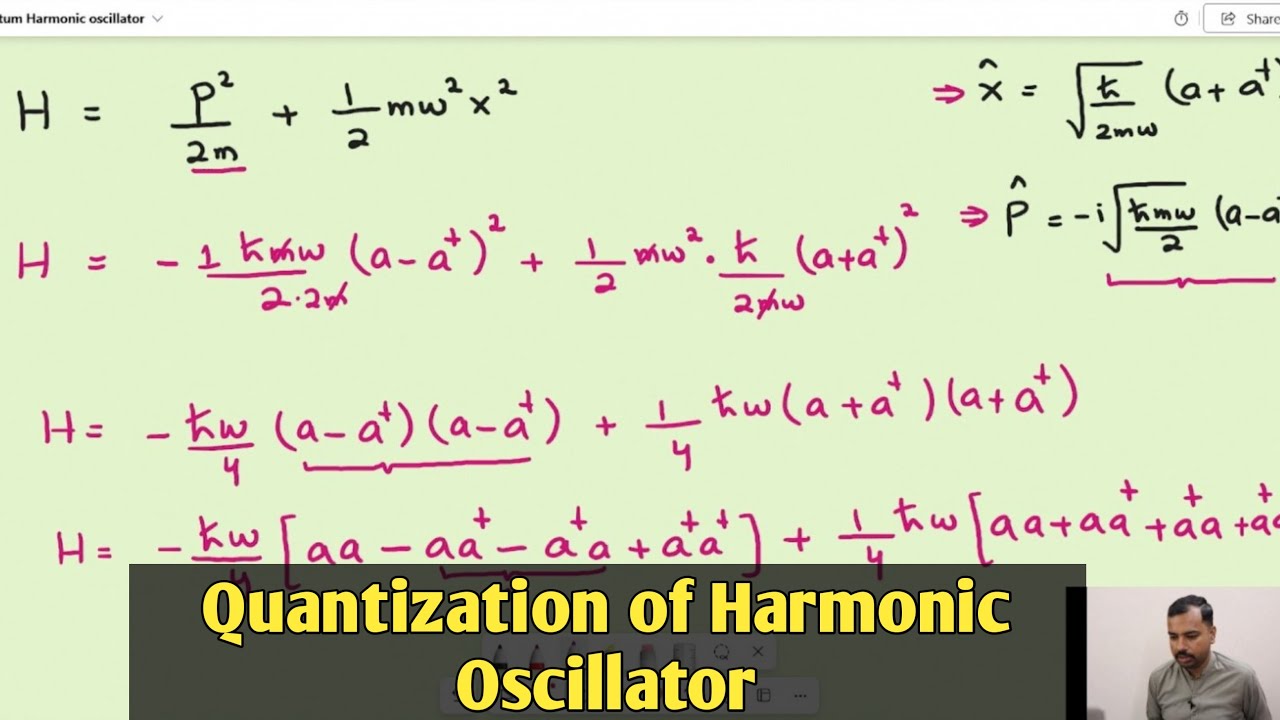
Quantum harmonic oscillator | Part-2
Keywords
Summary
209 words
Critical Evaluation
Value of the Information & Strength of the Argument
The video provides a thorough and rigorous derivation of the quantum harmonic oscillator algebra. The argumentation is logical and step-by-step, with careful attention to non-commutativity of operators. The value of the information is high for students learning quantum mechanics, as it clarifies the role of creation and annihilation operators and the origin of zero-point energy. The presentation is clear, though it assumes prior knowledge of basic quantum mechanics and linear algebra.
Scientific Rigor, Source Quality, Title Accuracy
The scientific rigor is adequate for a tutorial: the derivations are correct and follow standard textbook approaches. However, the video does not cite any external sources, and the description provides no references. The title accurately reflects the content, which is focused on the algebraic treatment of the quantum harmonic oscillator. No comments were provided for analysis.
142 words
Title / Content Match
The title accurately reflects the content, which focuses on the quantum harmonic oscillator and its algebraic treatment.
Quality & Reliability
7/10
The video provides a clear, step-by-step derivation of the quantum harmonic oscillator algebra, with correct mathematical manipulations and proper use of commutation relations. However, it lacks citations to external sources and does not discuss experimental verification or broader context, limiting its scientific depth.
Key Moments
Markers derived by PSI from the transcript: the creator did not define chapters.
- Introduction and recap of previous lecture
- Derivation of Hamiltonian in terms of a and a†
- Introduction of number operator and energy eigenvalues
- Commutation relations of Hamiltonian with a and a†
- Action of a† on number states and derivation of normalization constant
- Action of a on number states and summary of algebra
Contribution & Novelties
The video offers a clear pedagogical exposition of the quantum harmonic oscillator algebra, emphasizing the role of commutation relations and ladder operators. It is particularly useful for students seeking a step-by-step derivation. For further exploration, one can consult standard textbooks on quantum mechanics, such as Griffiths or Sakurai, and online resources like the Wikipedia article on quantum harmonic oscillator.
Pour aller plus loin :
- Quantum harmonic oscillator - Wikipedia — Comprehensive overview of the topic.
- Creation and annihilation operators - Wikipedia — Detailed explanation of ladder operators.
- Number operator - Wikipedia — Definition and properties.
95 words
Radar Profile
The radar profile shows high scores in technical level and quantity of information, indicating a detailed and mathematically rigorous presentation. The quality and reliability scores are moderate, reflecting the lack of external citations and limited context. Overall, the video is a solid educational resource for quantum mechanics students.