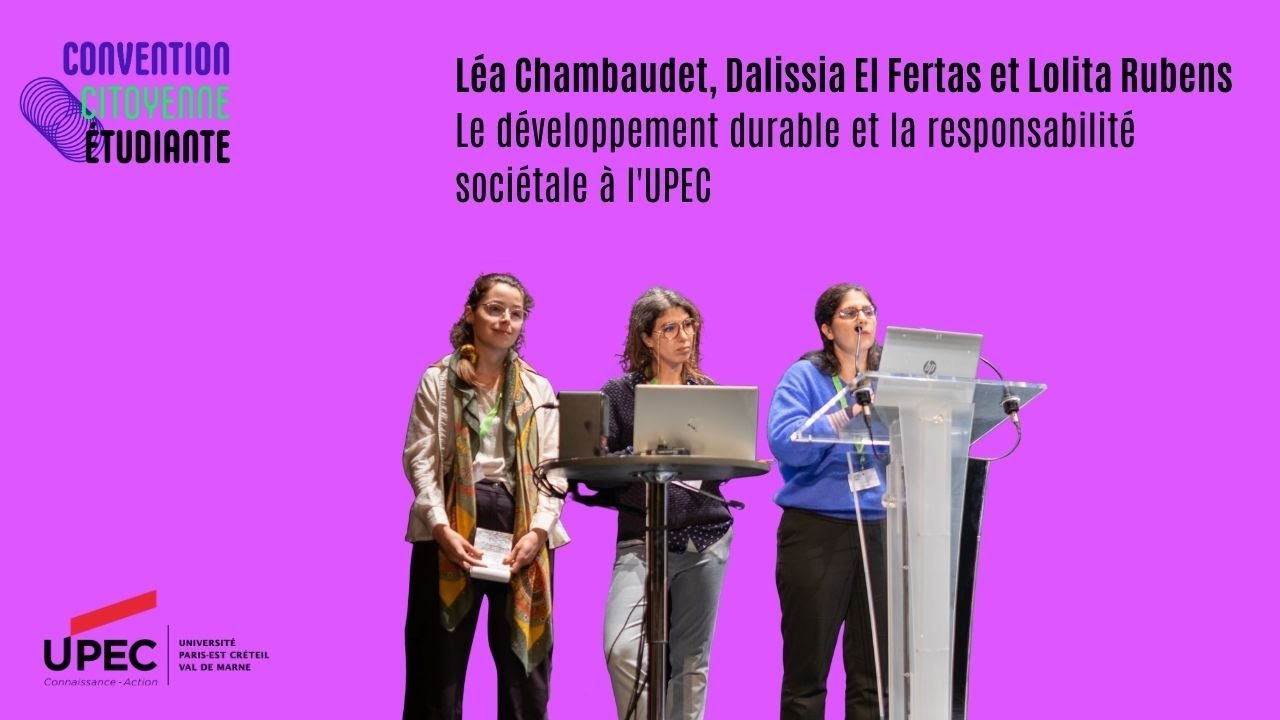
CCE 2024 - Conférence "Le développement durable et la responsabilité sociétale à l'UPEC"
Keywords
Summary
137 words
Critical Evaluation
Value of the Information & Strength of the Argument
The value of the information lies in its direct insight into the institutional implementation of sustainability policies in a French university. The speakers provide concrete examples of actions and initiatives, such as the mobility survey, carpooling incentives, and the upcoming sustainability course. The argumentation is based on their institutional roles and the existence of official documents, but it lacks critical evaluation of the effectiveness or challenges of these policies. The presentation is more descriptive than analytical, focusing on what is being done rather than why or how well it works.
Scientific Rigor, Source Quality, Title Accuracy
The scientific rigor is moderate. The speakers cite national frameworks and documents (e.g., the national SD&SR label, the Jabadi report) but do not provide specific references or data to support their claims. The sources are institutional and internal, which limits external verification. The title accurately reflects the content, which is a conference on sustainable development and social responsibility at UPEC. No comments were provided for analysis.
171 words
Title / Content Match
The title accurately reflects the content, which is a conference on sustainable development and social responsibility at UPEC.
Quality & Reliability
7/10
The conference is presented by university officials directly involved in the sustainability policy, providing credible first-hand information. However, it is largely descriptive and promotional, with limited critical analysis or external verification.
Key Moments
Markers derived by PSI from the transcript: the creator did not define chapters.
- Introduction and presentation of the conference format.
- Overview of the national framework for SD&SR in higher education.
- Presentation of the UPEC SD&SR master plan and its five axes.
- Details on strategy and governance, including the mobility plan and budget.
- Training and education initiatives, including the sustainability course for L2 students.
- Research and innovation actions, such as mapping research against SDGs.
- Environmental actions: biodiversity inventory, waste sorting, and carbon footprint.
- Social policy: equality, inclusion, disability, and violence prevention.
- Call to participate in the mobility survey and Q&A session begins.
- Q&A: carpooling details and eco-delegate development.
Cited Sources
- UPEC DDRS website — Mentioned as a resource for finding the master plan and other documents.
Concurring Sources
- UPEC official website — The university's official site likely contains the master plan and related documents.
Contribution & Novelties
This conference provides an insider view of the sustainability strategy at UPEC, highlighting specific initiatives and the participatory process. It is valuable for understanding how a French university operationalizes national guidelines.
Pour aller plus loin :
- Sustainable Development Goals — The 17 SDGs referenced in the mapping of courses and research.
- Plan Climat Biodiversité — National framework mentioned for guiding institutional strategies.
- Label DDRS — The national label for sustainable development and social responsibility in higher education.
77 words
Radar Profile
The radar profile shows balanced scores across information quantity, quality, technical level, and reliability, with a slight emphasis on quality and reliability. This suggests a well-structured presentation with credible institutional information, though not deeply technical or critical.