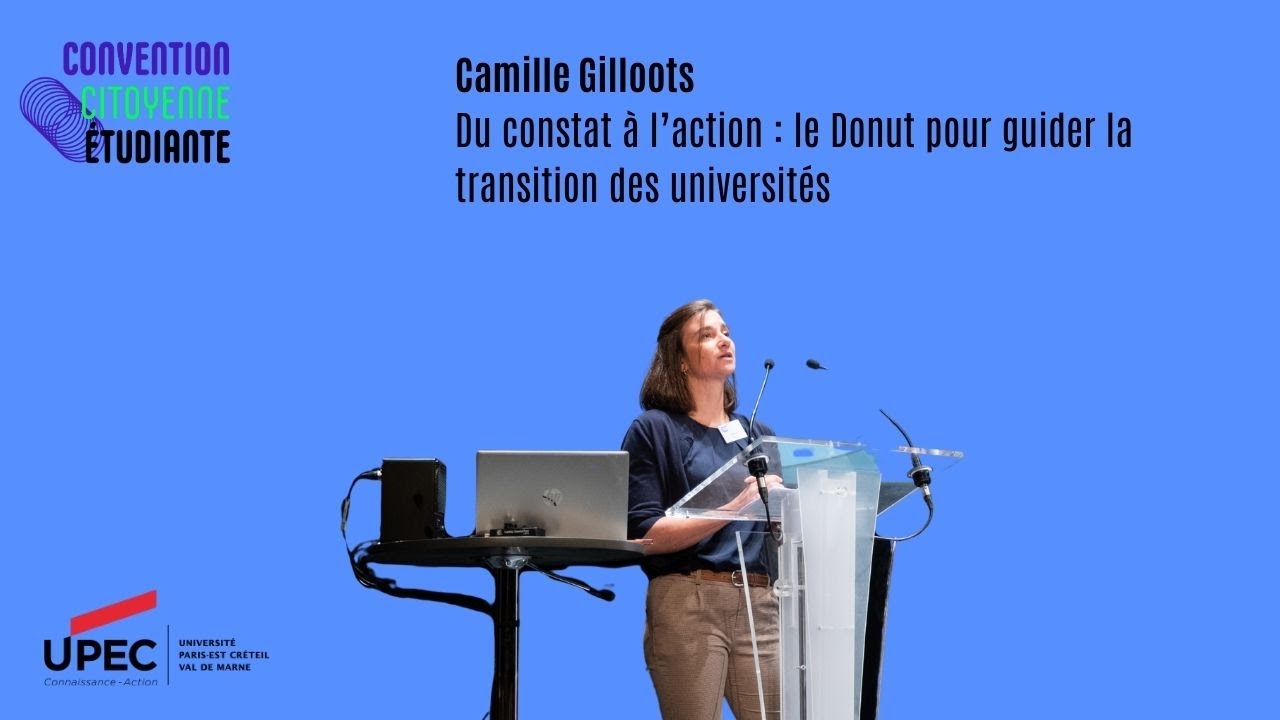
Camille Gilloots "Du constat à l’action : le Donut pour guider la transition des universités"
Keywords
Summary
187 words
Critical Evaluation
Value of the Information & Strength of the Argument
The talk provides a valuable introduction to the Doughnut model and its practical application in a university setting. It effectively synthesizes complex scientific information (planetary boundaries, IPCC/IPBES findings) into an accessible framework. The argumentation is coherent, moving from global problems to a specific case study, and it honestly addresses the limitations of the model and the insufficiency of current efforts. The speaker’s experience adds credibility, and the inclusion of concrete data (e.g., factor 30 overshoot in biodiversity) strengthens the argument.
Scientific Rigor, Source Quality, Title Accuracy
The talk demonstrates scientific rigor by referencing established sources such as the IPCC, IPBES, and the planetary boundaries framework. The speaker also transparently mentions uncertainties in the model. The case study is based on a published report and a participatory process, which adds credibility. The title accurately reflects the content, and the talk is well-structured. No comments were provided for analysis.
156 words
Title / Content Match
The title accurately reflects the content: the speaker moves from global environmental and social challenges to the application of the Doughnut model at the University of Lausanne.
Quality & Reliability
8/10
The speaker presents established scientific frameworks (planetary boundaries, IPCC, IPBES) and transparently discusses uncertainties. The case study of the University of Lausanne is based on a published report and participatory process. However, the talk is a conference presentation, not peer-reviewed, and some data are not fully detailed.
Key Moments
Markers derived by PSI from the transcript: the creator did not define chapters.
- Introduction: purpose of the talk and structure.
- Climate change facts: temperature rise, IPCC graphs.
- Biodiversity loss: IPBES data, 70% decline in vertebrate populations.
- Introduction of planetary boundaries and current status (6 of 9 exceeded).
- Explanation of the Doughnut model: social foundation and ecological ceiling.
- Application at UNIL: diagnostic results, main impact areas.
- Assembly of Transition: participatory process and outcomes.
- CAP 2037 strategy: objectives and projected emission reductions.
- Conclusion: encouragement for students to act.
Cited Sources
- Rapport Donut UNIL — Detailed report on the Doughnut diagnostic at the University of Lausanne.
- Rapport final de l'Assemblée de la transition — Final report of the participatory assembly with 28 objectives and 146 action tracks.
- Site web de la direction de l'Université de Lausanne — Institutional website with strategy documents.
Concurring Sources
- IPCC Sixth Assessment Report — Supports climate change statements.
- IPBES Global Assessment Report on Biodiversity and Ecosystem Services — Supports biodiversity loss data.
Contribution & Novelties
The talk contributes by demonstrating a concrete application of the Doughnut model to a university, providing a replicable framework for other institutions. It highlights the importance of participatory processes and transparent diagnostics. The speaker also candidly discusses the gap between current strategies and required targets, emphasizing the need for more ambitious action.
Pour aller plus loin :
- Doughnut Economics Action Lab — Official site with tools and case studies.
- Planetary Boundaries framework — Original research by Rockström et al.
- Kate Raworth’s book ‘Doughnut Economics’ — Foundational text.
87 words
Radar Profile
The radar profile shows high scores in information quantity, quality, and reliability, with a moderate technical level. This indicates a well-informed and credible presentation that is accessible to a broad audience, balancing scientific depth with practical application.